A Leonardo creator tested Nano Banana 2 and Nano Banana Pro on 10 photography prompts, from cinematic action to iPhone realism. Reuse the same prompt pack to compare look, speed, and consistency for your own workflow.
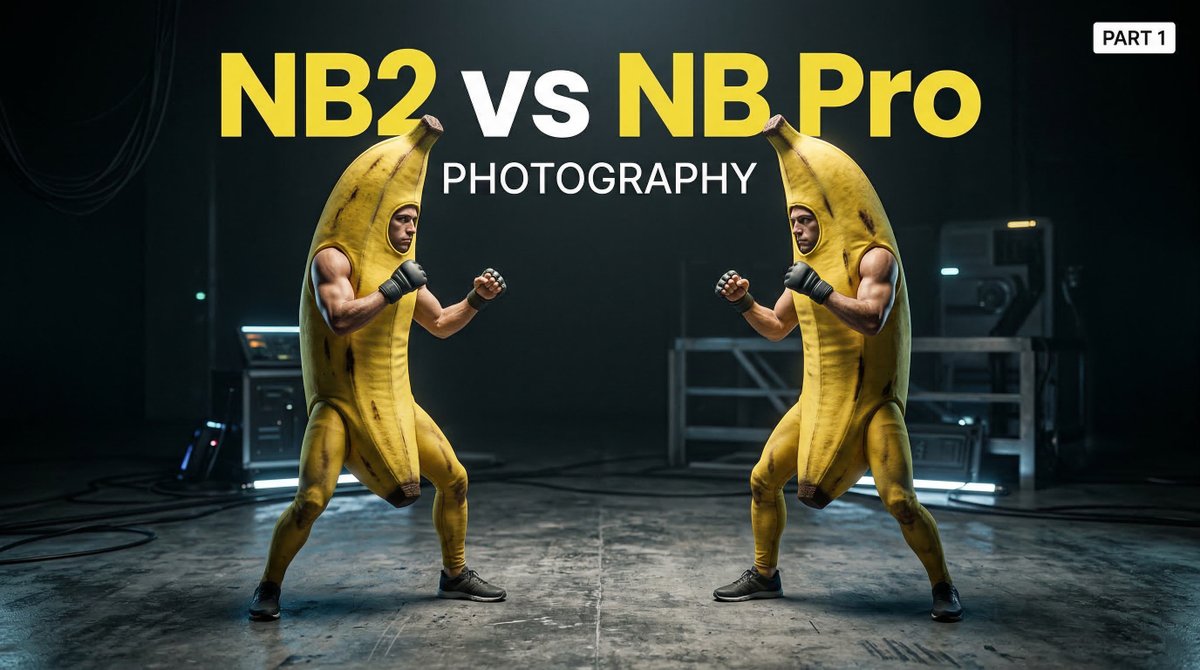
This is a creator-made side-by-side, not an official benchmark. MayorKingAI says the test compares Nano Banana 2 and Nano Banana Pro in Leonardo over 10 photography styles, then publishes the prompt set for each category rather than a scorecard or leaderboard. The follow-up Leonardo post confirms all images were made in Leonardo and includes a Leonardo link where both models can be tried.
The span of styles is broad enough to stress different parts of an image model: cinematic action, street documentary, food, interior and exterior architecture, landscape, wildlife, low-key portrait, fashion editorial, and iPhone-style social photography. That matters because the thread is less useful as "which model is best" than as a compact prompt battery for testing realism, composition control, and style consistency across your own shots.
The prompts are specific in the way production prompts need to be. Instead of only naming a genre, they pin down lens choice, aperture, vantage point, lighting, and framing. The street test in street setup specifies a subway carriage, opposite-bench camera position, seated eye level, Leica M11 look, and 50mm at f/2. The architectural interior setup in interior setup switches to a corner-of-room view, Canon EOS R5 styling, 24mm, and f/7.1 for depth.
That pattern continues across the pack. The wildlife prompt in wildlife setup uses a Nikon Z9-style 400mm telephoto with shallow depth of field; the landscape prompt in landscape setup moves to 70mm and f/11 for layered atmospheric depth; the portrait prompt in portrait setup narrows the scene to a single directional light and black background. For filmmakers, photographers, and art directors, those variables make the set easy to remix without rewriting the whole brief.
The strongest technique here is consistency of prompt structure. Across categories, the author keeps a repeated formula: declare the photo type, define subject and pose, lock camera and lens language, then finish with texture cues like film grain, natural skin texture, or ultra-detailed realism. You can see that in the ramen setup from ramen setup, which adds a 45-degree tabletop angle and steam cues, and in the iPhone brief from iPhone setup, which asks for visible pores and slightly imperfect handheld framing.
The caveat is that the evidence shows the prompts, not systematic outputs or timing data. So the practical takeaway is the test design itself: run the same 10-scene pack through both models, keep camera specs intact, and look for where one model breaks on anatomy, spatial layout, or believable photographic texture before deciding which model fits your workflow.
Nano Banana 2 vs Nano Banana Pro in Leonardo I tested 10 photography styles side by side and the results surprised me Which one wins? Prompts below 👇

2. Street Photography Prompt: Ultra realistic street photography inside a subway train carriage, frontal medium shot of a tired young couple sitting close together on the same long side bench seat along the wall of the metro carriage, photographed directly from the opposite Show more

10. iPhone Photography Prompt: Ultra realistic iPhone photo of a stunning young woman in her mid 20s posing confidently on a sunny city sidewalk, long dark hair flowing naturally in the breeze, flawless but natural makeup with defined eyes and soft glossy lips, confident and Show more


