The LabClaw team open-sourced a 211-skill layer for dry-lab reasoning, literature work, medicine, biology, and lab automation. Use it as a starting skill library for AI scientist systems instead of assembling generic tools from scratch.
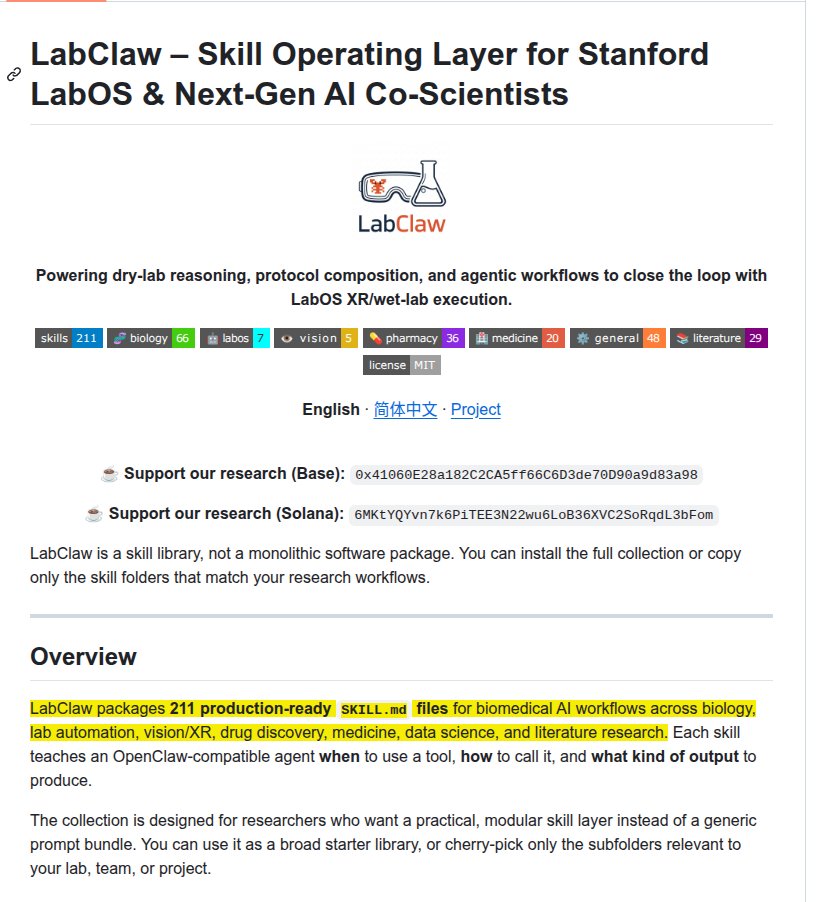
LabClaw is now available as an open-source repository GitHub repo and is positioned by its launch post as the “Skill Operating Layer for LabOS” launch repost. The project is aimed at “dry-lab reasoning, protocol composition, and agentic workflows,” according to the
, which frames it as the layer that connects model reasoning to concrete biomedical actions.
The same
says LabClaw includes 211 “production-ready SKILL.md files” spanning biology, lab automation, vision/XR, drug discovery, medicine, data science, and literature research. The category counts shown there include 66 biology skills, 36 pharmacy, 20 medicine, 29 literature, 5 vision, 7 LabOS, and 48 general skills, with the repo marked MIT-licensed repo screenshot.
The clearest implementation detail in the evidence is the workflow example from the thread: an agent can be told to “find this gene sequence,” “run a fold analysis,” and “write a summary” of related clinical trials, with the skills telling the system “which buttons to push and which APIs to call” repo walkthrough. That makes LabClaw less like a model release and more like an operational tool layer for orchestrating domain-specific actions.
The same thread argues the hard part in AI-for-science is the “last mile” and describes the emerging stack as a reasoning core, a skill library like LabClaw, and an execution layer like LabOS architecture take. That architecture claim is still a practitioner interpretation, not a benchmark, but it gives engineers a concrete starting point for building biomedical agents around a prebuilt skill inventory instead of a generic function-calling scaffold.
We’re thrilled to open-source LabClaw — the Skill Operating Layer for LabOS by Stanford-Princeton Team One command turns any OpenClaw agent into a full AI Co-Scientist. Demo: labclaw-ai.github.io Dragon Shrimp Army reporting for duty 🦞🔬 #AIforScience #OpenClaw
The hardest part of AI in science is the "last mile" This brilliant open source GitHub repository from Stanford and Princeton researchers is giving you a way to automate the boring parts of science. With it, you can basically tell an AI agent: "Go find this gene sequence in Show more


We’re thrilled to open-source LabClaw — the Skill Operating Layer for LabOS by Stanford-Princeton Team One command turns any OpenClaw agent into a full AI Co-Scientist. Demo: labclaw-ai.github.io Dragon Shrimp Army reporting for duty 🦞🔬 #AIforScience #OpenClaw

