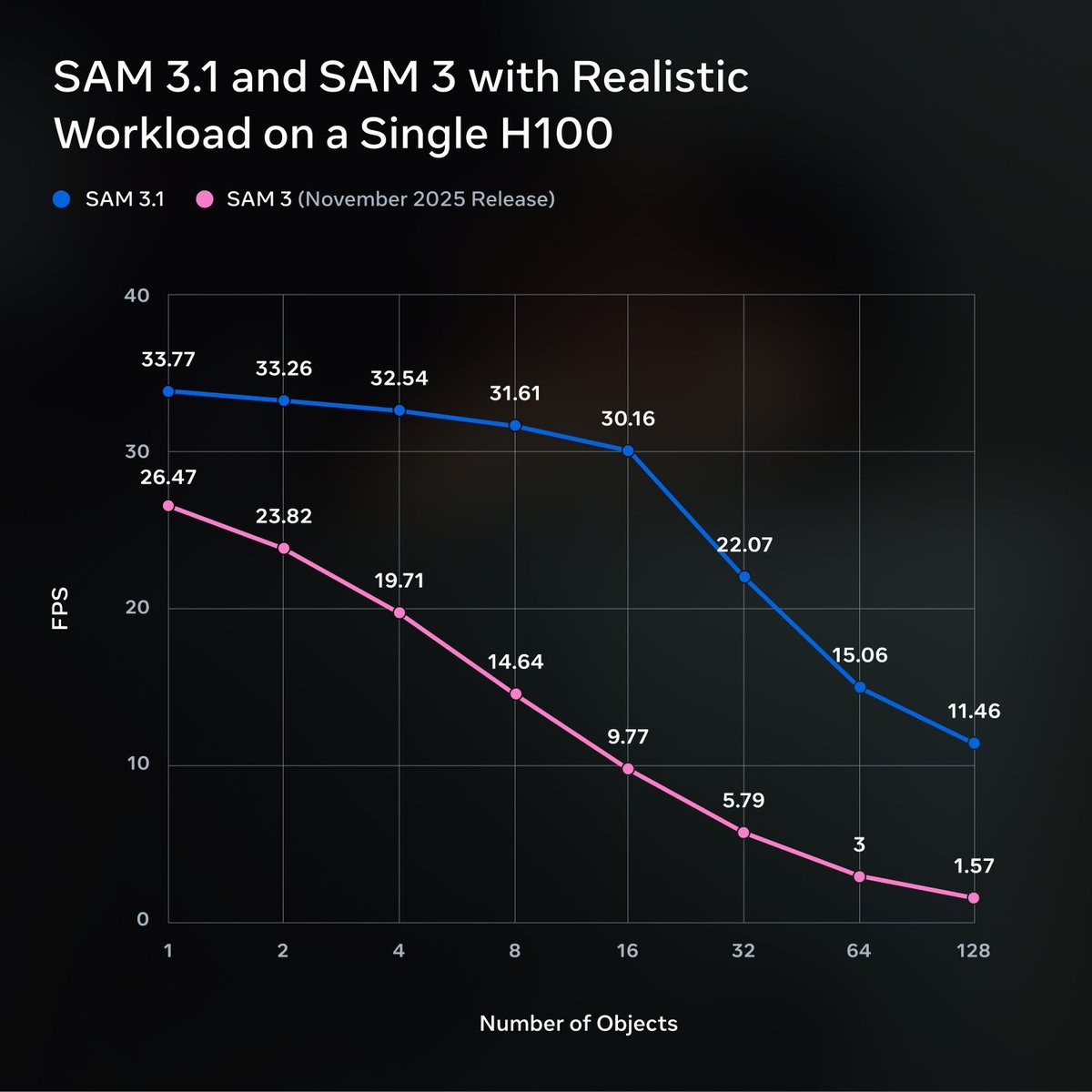
SAM 3.1 is a drop-in update that shares video computation across up to 16 tracked objects instead of rerunning most of the model per object. Meta's H100 numbers show roughly 30 FPS at 16 objects versus under 10 FPS for SAM 3, which cuts multi-object video tracking cost.
The architectural shift is narrow but useful. Meta's release post describes SAM 3.1 as a drop-in update, while the workflow diagram shows how it now multiplexes multiple tracked objects into a single shared computation and then demultiplexes the outputs. In the older SAM 3 path, each object triggered a separate pass, so most of the same frame-level work was repeated.
That matters because the bottleneck was less about raw vision quality than systems efficiency. As the thread puts it, SAM 3.1 "shares that heavy work across objects," and the attached
shows throughput holding up much better as object count rises: 33.77 FPS at one object, 30.16 at 16, and 11.46 at 128, versus 26.47, 9.77, and 1.57 for SAM 3.
Meta just shipped SAM 3.1 as a drop-in update that adds object multiplexing, letting it track up to 16 objects in one forward pass instead of rerunning the model once per object. The old setup kept repeating almost the same video computation for each new object, even though most Show more


We’re releasing SAM 3.1: a drop-in update to SAM 3 that introduces object multiplexing to significantly improve video processing efficiency without sacrificing accuracy. We’re sharing this update with the community to help make high-performance applications feasible on smaller,

Meta just dropped SAM 3.1, and the main upgrade is object multiplexing. > It can now track up to 16 objects in one go > Earlier, each object needed a separate pass > Now everything runs together, so no wasted compute > Result: faster and more efficient

We’re releasing SAM 3.1: a drop-in update to SAM 3 that introduces object multiplexing to significantly improve video processing efficiency without sacrificing accuracy. We’re sharing this update with the community to help make high-performance applications feasible on smaller,


