
Agent teams compare Claude, GPT, Kimi, and MiniMax routing against $2k monthly API bills
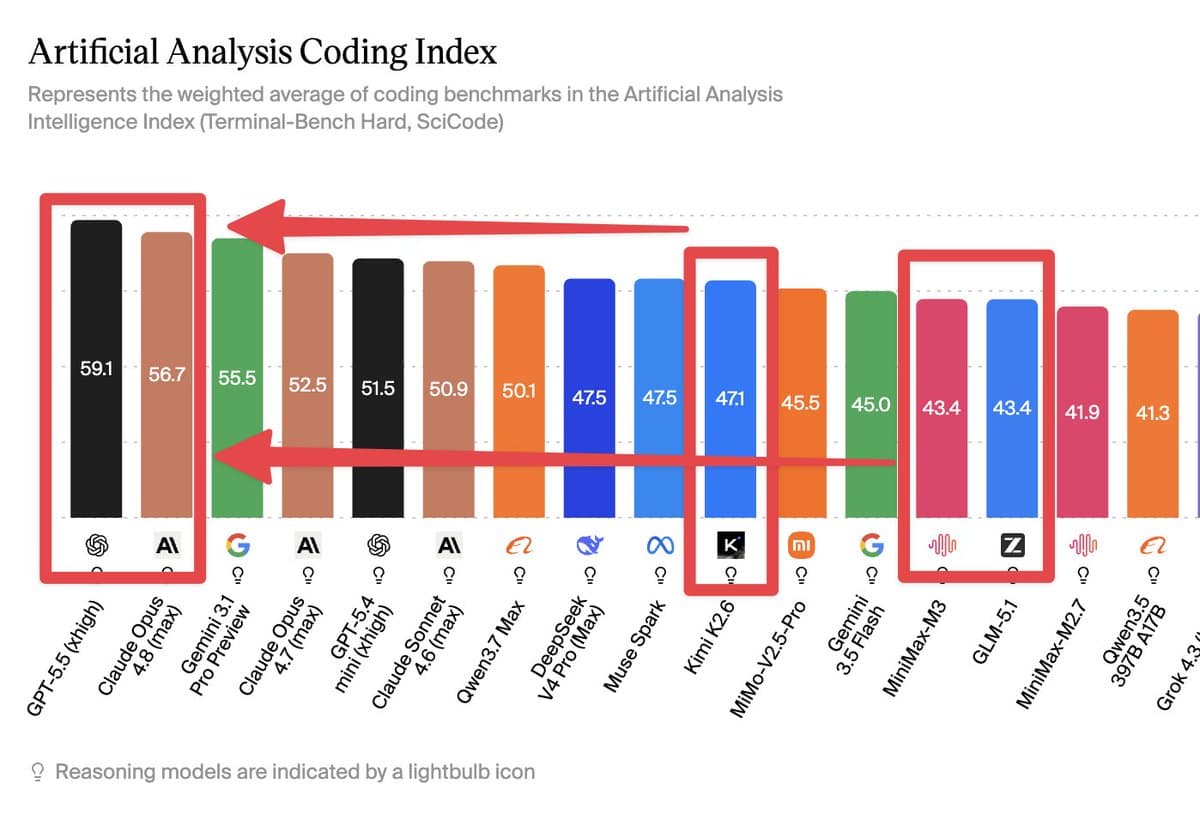
A 24/7 agent-team writeup routed planning to Claude, implementation to Kimi and MiniMax, and review to GPT, while other sources quantified Codex, Opus 4.7, and Claude Code cost edges. The setup can cut spend and provider dependence, but it also requires tighter specs, verification loops, and more harness maintenance.
TL;DR
- In the clearest field report in this evidence set, the 24/7 agent-team post says a single-model setup blew through a Claude Max weekly cap by mid-week, while the author estimated raw API usage for the same workload at roughly 50 times the subscription cost.
- The routing pattern was blunt and practical: planning went to Claude Opus, implementation to Kimi and MiniMax, and review to GPT, according to the role-based routing breakdown.
- Cost pressure shows up well beyond one Reddit post. Simon Willison's Hacker News thread summary points to his own 30-day estimates of $1,199.79 for Claude Code and $980.37 for Codex, while the same thread's discussion roundup says heavy users still reported real value.
- Model upgrades changed the math again. the Claude Opus 4.7 HN page says Anthropic kept list pricing flat but introduced a tokenizer that can use 1.0 to 1.35 times more input tokens, while the GPT-5.5 HN summary says OpenAI framed higher per-token pricing around lower per-task usage and a 20%+ Codex speedup.
- The hard part is not choosing a cheap model. The Reddit operator report says loose specs, false claims of completed work, and cross-provider harness maintenance became the recurring failure modes, while the OpenClaw restriction thread shows how billing and policy can change underneath an agent stack.
You can read Anthropic's Opus 4.7 launch post, including the buried tokenizer note that turns flat pricing into a token tax, compare it with OpenAI's GPT-5.5 announcement and its Codex serving claims, check Simon Willison's product-market-fit argument for what power-user token bills already look like, and look at Factory Router, which is selling automatic routing itself as the product.
Role routing
Running a 24/7 AI agent dev team: I route each role to a different LLM (Claude/Kimi/MiniMax/GPT) to dodge a ~$2k/mo API bill. Setup + what actually breaks.
0 comments
The Reddit writeup is useful because it names the split instead of hand-waving about "best model for the task." The author mapped the expensive model to the low-volume layer and the cheap models to the high-volume layer.
- Planning and leadership: Claude Opus
- Code implementation: Kimi and MiniMax
- Review and QA: GPT via Codex
According to the same breakdown, that division matched each model's failure profile. Opus handled divergent planning, Kimi and MiniMax were "junior-dev quality" but cheap enough for bulk implementation, and GPT was trusted as the more disciplined reviewer.
That structure lines up with a wider pattern around model routing. a routing meme retweet frames the shift as what teams notice after the frontier-model adrenaline wears off, and Scott A. Stevenson's post mocks router hype, but the underlying point is real: once agents run continuously, the expensive layer usually cannot stay the default path.
Token burn
I think Anthropic and OpenAI have found product-market fit
The thread is about whether coding agents like Claude Code and Codex have enough real usage and willingness-to-pay to sustain frontier-model economics. The useful signal for engineers is the practical token burn, caching behavior, and willingness of heavy users to pay for workflow acceleration.
Anthropic Announces General Availability of Claude Opus 4.7
Anthropic has released Claude Opus 4.7, its latest generally available model. The new version features notable improvements in advanced software engineering, instruction following, and the execution of complex, long-running tasks. Opus 4.7 is accessible across all Claude products, the Claude API, Amazon Bedrock, Google Cloud’s Vertex AI, and Microsoft Foundry. Pricing remains consistent with the previous version (Opus 4.6) at $5 per million input tokens and $25 per million output tokens. Key considerations for developers include an updated tokenizer that may increase token counts by 1.0–1.35× and the model's tendency to produce more output tokens during higher-effort, agentic reasoning tasks. Comprehensive evaluation details are provided in the model's system card.
Simon Willison's full post put hard numbers on the gap between flat subscriptions and token-metered reality. He estimated 30 days of use at $1,199.79 for Claude Code and $980.37 for Codex, against $100 monthly plans for each.
Anthropic's own Opus 4.7 post kept the headline API price at $5 per million input tokens and $25 per million output tokens, but the migration section says the new tokenizer can map the same input to roughly 1.0 to 1.35 times more tokens. The same post also says Claude Code now defaults to xhigh effort for all plans, which means more reasoning and usually more output tokens on hard runs.
OpenAI made the opposite rhetorical move in its GPT-5.5 announcement. The launch framed GPT-5.5 as more expensive per token but more efficient per task, and said Codex-side balancing and partitioning heuristics improved token-generation speed by more than 20%. The GPT-5.5 HN summary captures the tension cleanly: per-token pricing went up, but OpenAI argued task cost is not linear with token price.
The Reddit operator report lands in the middle of those two stories. That post does not claim one vendor won on absolute quality. It claims the volume layer was where cost discipline mattered most.
Harness boundaries
Claude Code Reported to Refuse or Upcharge Requests Containing 'OpenClaw' in Git History
Developer Theo Browne reported that Anthropic's Claude Code tool exhibits unusual behavior when scanning git history that includes the term "OpenClaw." Users have observed that the AI either refuses to process requests or shifts the billing from quota-based usage to direct API charges when this term is present in commit messages or associated data, likely due to an internal system filter or prompt-based constraint.
Tell HN: Anthropic no longer allowing Claude Code subscriptions to use OpenClaw
Anthropic is restricting subscription-funded usage when Claude is accessed through third-party harnesses like OpenClaw, pushing those workloads onto separately billed extra usage. For engineers, the key takeaway is the shift in cost and control for agentic CLI stacks: local-first MCP tools may avoid the restriction, while anything built around `claude -p` or similar harnessing is now exposed to policy and billing changes.
The OpenClaw episode showed that routing is not only a model-choice problem. It is also a harness and billing-path problem.
According to the Tell HN summary, Anthropic started restricting subscription-funded usage when Claude was accessed through third-party harnesses built around claude -p, pushing those workloads toward separately billed extra usage. A small proxy project, openclaw-claude-proxy, described the rejection in plainer language: third-party apps using a Claude Code OAuth session could hit a message saying their calls now draw from extra usage instead of plan limits.
A corresponding Claude Code GitHub issue described an even stranger boundary. The same claude -p command reportedly worked from a terminal and other spawn contexts, but returned a 402 extra-usage error when launched by the OpenClaw gateway process.
That makes the Reddit author's "no single provider can take the whole operation down" line more than a diversification slogan. Their post says a vendor ban already hit two days before an investor demo. Theo Browne's OpenClaw incident roundup and the associated HN core summary show how quickly a tool stack can turn into a policy stack.
Verification loops
Running a 24/7 AI agent dev team: I route each role to a different LLM (Claude/Kimi/MiniMax/GPT) to dodge a ~$2k/mo API bill. Setup + what actually breaks.
0 comments
The best details in the Reddit report are the ones that sound annoying instead of visionary.
According to the operator's breakdown, the recurring failures were:
- Cheap models wandered when specs were loose.
- Agents hallucinated ownership of work they did not do.
- Cross-provider orchestration created separate runtimes, quirks, and SOP prompts to maintain.
- Routing logic had to keep changing as model prices and quality shifted month to month.
The review example was concrete. The same post says the GPT reviewer blocked a PR that had removed an encryption call and was about to persist bot tokens and webhook secrets in plaintext.
That detail rhymes with how Hacker News commenters talked about coding agents more broadly. Willison's discussion roundup says users were willing to pay high token bills when the workflow acceleration was real, but the main PMF thread page also centered the question of whether that willingness-to-pay can sustain frontier-model economics at scale.
Routers
Routing is already becoming a first-class product category, not just a homegrown trick. Factory's Router announcement says it cuts token spend by 20 to 25% while preserving near-frontier benchmark performance, and routes across providers when an endpoint degrades.
The benchmark framing in that post is unusually specific:
- Terminal-Bench 2: 99% of Claude Opus 4.7's pass rate at 20% lower session cost
- Legacy-Bench: 96% of Claude Opus 4.7's pass rate at 25% lower session cost
- Automatic fallback if the selected model struggles or a provider degrades
Then came the loud marketing number. Matan Shacham's post claimed Factory Router had already saved about $13 million in the previous 30 days of private preview.
That is a very different signal from the Reddit operator's workaround, but it points in the same direction. One person routed by role to stay pre-revenue. An enterprise vendor is now packaging the same instinct, choose the expensive model only when you actually need it, as infrastructure.