
Anthropic launches Claude Science beta with 60+ databases and Modal compute
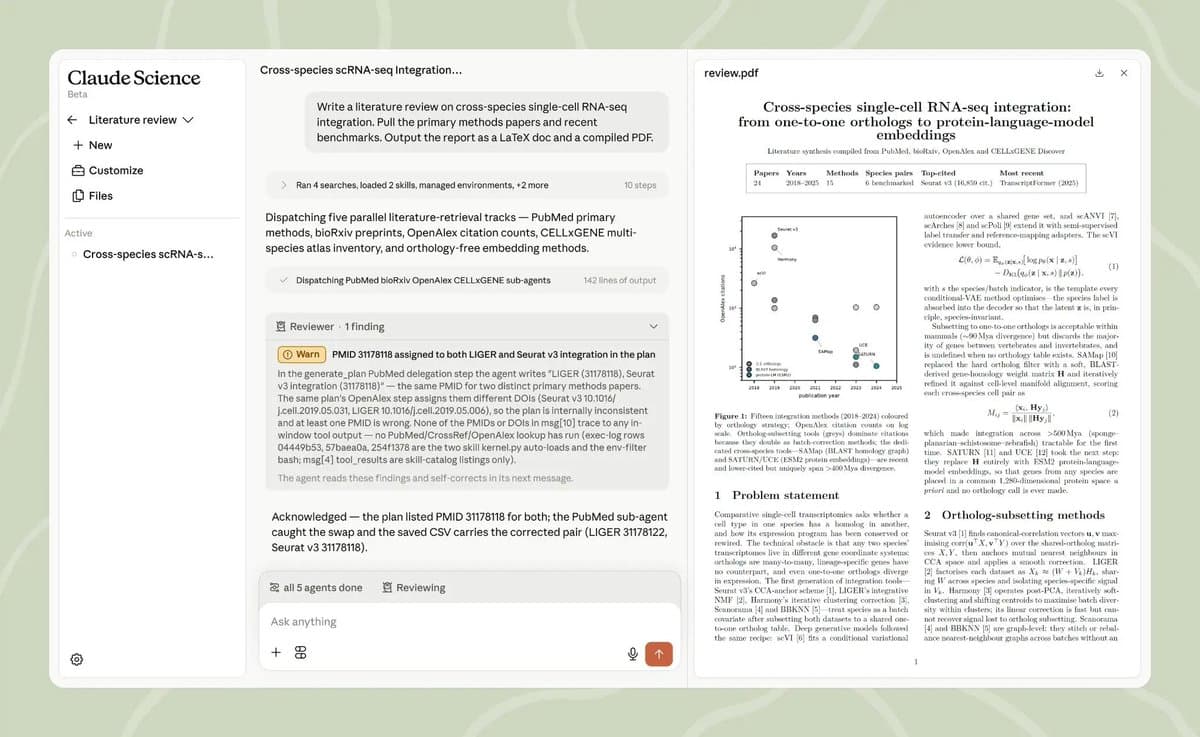
Anthropic launched Claude Science in beta as a research app with traced artifacts, on-demand environments, and access to more than 60 scientific databases. Modal is already integrated as an elastic compute layer, giving researchers a single workspace for data access, code, and reproducible runs.
TL;DR
- Anthropic shipped Claude Science in beta as a research app that keeps code, environments, and outputs in one place, according to Claude's launch post and Anthropic's learn-more link.
- The launch pitch centers on auditable artifacts and access to more than 60 optional scientific databases, as Claude's launch post and Anthropic's follow-up post both emphasize.
- Compute is built into the product surface, with Akshat Bhatnagar's screenshot showing SSH hosts, Modal, model endpoints, and NVIDIA BioNeMo NIM as connectable backends.
- Modal is the first named infrastructure partner, and Modal's announcement says it is also putting up to $100K of compute behind academic life sciences projects.
You can open Anthropic's launch page from the main announcement, click through the learn-more post, and see from Akshat Bhatnagar's conference screenshot that Claude Science already exposes compute connections as a setup screen, not a buried backend detail. Rohan Paul's breakdown adds a few useful specifics the launch tweet does not spell out, including reviewer agents, lab HPC submission, and artifact-level method histories.
Claude Science wraps the research loop
Anthropic is positioning Claude Science as a full research workspace, not just a model with domain tuning. The official launch describes an app for "every stage of research," with artifacts traced to code, environments managed on demand, and 60-plus optional scientific databases in Claude's launch post.
A blog excerpt quoted by Daniel Mac sharpens the framing: Claude Science "integrates the tools and packages that researchers most commonly use, produces auditable artifacts, and provides flexible access to computing resources." That is a tighter product definition than the tweet alone.
Artifacts carry code, environments, and history
The most concrete product detail in the evidence is how Anthropic wants outputs to be inspected later. According to Rohan Paul's breakdown, Claude Science can render proteins, genome tracks, chemical structures, figures, manuscripts, and the underlying code, and each artifact keeps its code, environment, plain-language method, and full message history attached.
That matters because the launch is selling reproducibility as a product feature, not a lab process. The same breakdown also says a reviewer agent checks calculations, references, and figures against their source code.
Compute is a first-class surface
The strongest UI evidence is Akshat Bhatnagar's post, whose screenshot shows compute as its own settings surface. The menu lists four connection types:
- SSH hosts for servers, clusters, or job submission nodes
- Modal for serverless GPUs on a user's own account
- Model endpoints at local or remote URLs
- NVIDIA BioNeMo NIM services
Bhatnagar's post calls out fan-out, shared storage, reproducible environments, and GPU flexibility as the reasons Modal fits the stack. Rohan Paul's summary adds that Claude Science can submit jobs to lab HPC systems or Modal compute, and can scale runs from one GPU to hundreds.
Modal adds a $100K compute pool
Anthropic did not launch Claude Science alone. In Modal's announcement, Modal says its elastic compute is built into Claude Science and that it is committing up to $100,000 in compute credits for academic life sciences research, with applications open through July 15.
That makes the rollout more than a product beta. It is also an early ecosystem signal that Claude Science is being packaged with external infrastructure and funding hooks from day one.