
Claude Managed Agents adds memory in public beta with file-backed session state
Anthropic put memory into public beta for Claude Managed Agents, storing retained context as files developers can export and edit. The change lets agent state persist across sessions without a separate memory service.
TL;DR
- Anthropic put memory for Claude Managed Agents into public beta, and claudeai's launch post says agents can now retain context across sessions.
- According to claudeai's thread reply, those memories are stored as files that developers can export and manage through the API.
- RLanceMartin's summary adds that the files are shared across sessions and can be edited directly, which makes this look closer to persistent filesystem state than to a separate opaque memory service.
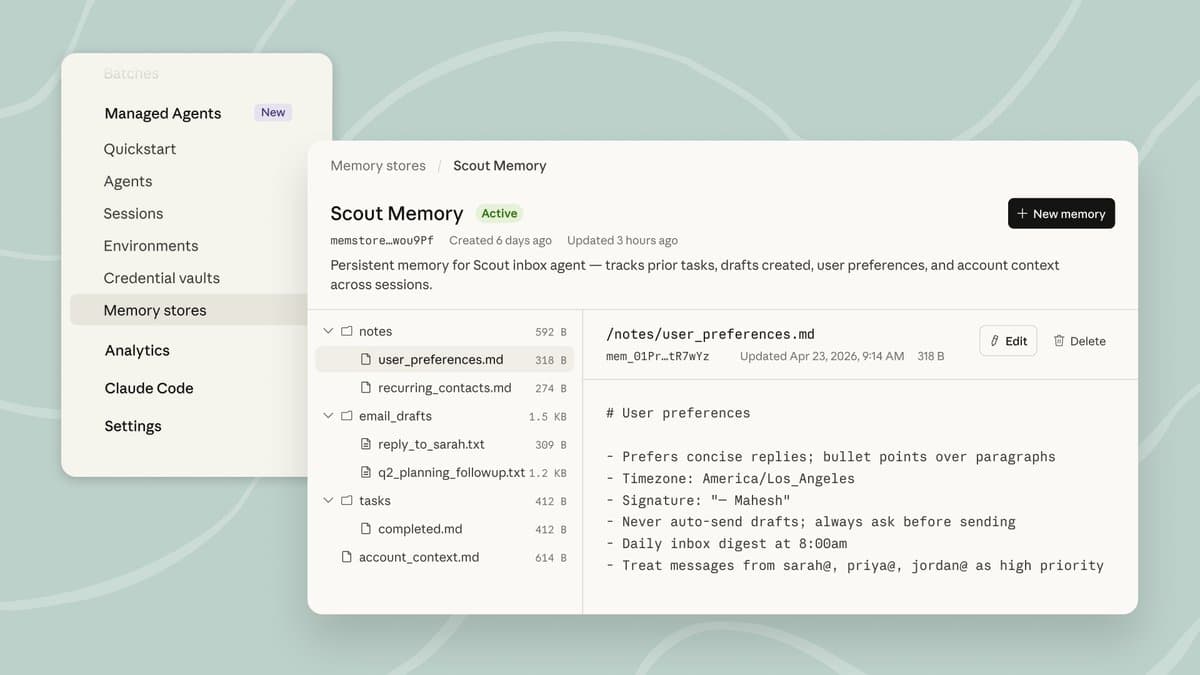
- Screenshots in testingcatalog's Workbench post and WesRoth's screenshot show a dedicated Memory stores UI with folders like
notes,email_drafts, andtasks.
You can read Anthropic's launch post, skim the managed agents memory docs, and compare that design to Lance Martin's earlier write-up on how stronger Claude models use the filesystem to externalize working memory.
File-backed memory
The core product change is simple: managed agents now keep long-term state as files. In claudeai's follow-up, Anthropic says developers can export those files, manage them via API, and keep control over what the agent retains.
That file-backed design is the interesting bit. It means persistence sits in the same primitive developers already inspect and version, instead of hiding behind a separate memory abstraction.
Memory files
RLanceMartin's post says the files are managed by Claude, shared across sessions, and easy to export or edit. The Workbench screenshot in testingcatalog's post shows the shape of that store:
notesfor retained user and task contextemail_draftsfor generated artifactstasksfor ongoing work items- Markdown files like
user_preferences.mdfor explicit durable state
The sample preferences shown in WesRoth's screenshot include formatting style, timezone, signature, inbox rules, and a scheduled digest time, which is a much more concrete memory model than a generic "agent remembers things" claim.
Context files were already the pattern
Before Anthropic shipped managed-agent memory, power users were already approximating it with hand-written context files. coreyganim's onboarding thread breaks that setup into a workspace, connected tools, global instructions, and named files for about-me, brand-voice, and working-preferences.
A second thread from coreyganim's three-file post reduces the same idea to three durable text files. Anthropic's beta effectively productizes that pattern inside managed agents.
Workbench surfaces memory stores
testingcatalog's Workbench post says managed agents are already available in Anthropic Workbench, and the UI shown in both posts exposes memory as a first-class store with status, folders, and editable markdown. TestingCatalog also speculated that Conway may get the feature later, but the concrete day-one fact is that Anthropic is not treating memory as background magic, it is exposing the retained state directly in the platform surface.