
Cognition launches SWE-1.7 in Devin at 1,000 tok/s
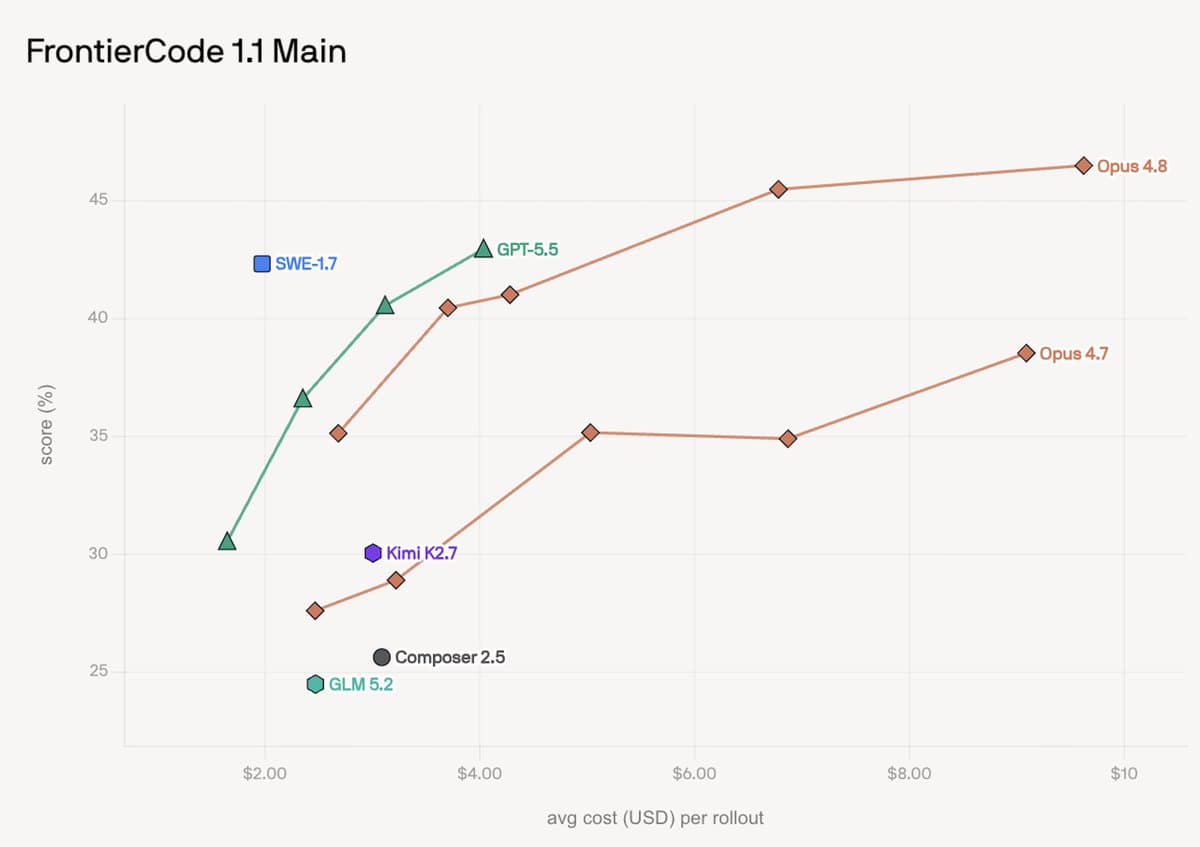
Cognition says SWE-1.7 was trained with RL on a Kimi K2.7 base and now runs in Devin at 1,000 tok/s. It reports 42.3% on FrontierCode at $1.97 per task and released revised grading rules.
TL;DR
- SWE-1.7 is a Kimi K2.7-based coding model, and Cognition reports 42.3% on FrontierCode 1.1 Main at $1.97 per task.
- Devin now serves it across Web, Desktop, and CLI at 1,000 tok/s; Cognition's pricing post says paid users get it free for the next month and adds a Lightning mode on Cerebras.
- The RL run was engineered around stability problems: Cognition named entropy collapse and trainer/inference drift, then the training recipe post listed Muon, staleness controls, off-policy correction, replay, and quantization-aware training as fixes.
- Longer-horizon behavior changed in a concrete way: Cognition's harness note says SWE-1.7 investigates longer before editing and touches a wider file scope.
- FrontierCode itself changed too: Cognition's FrontierCode 1.1 post says the methodology now has clearer fair-internet-use rules and refined grading criteria.
Cognition put the model writeup in its SWE-1.7 blog post, while the FrontierCode 1.1 post revised the benchmark used for the cost-performance claim. The infrastructure bit is the fun one: Cognition says rollout inference ran across four datacenters on three continents by syncing compressed weight diffs through object storage. The awkward but important bit is the base model: Cognition says SWE-1.7 was built on Kimi K2.7, and swyx highlighted Cognition's separate propaganda and censorship eval around Chinese open-source models.
What shipped
SWE-1.7 is live inside Devin, not as a standalone API launch in the evidence pool.
- Model: SWE-1.7 was built on top of Kimi K2.7, according to Cognition's model post.
- Surfaces: Web, Desktop, and CLI, per Cognition's availability post.
- Speed: 1,000 tok/s in Devin, per the same post.
- Promo: free for paid users for the next month, according to Cognition's follow-up.
- Fast tier: SWE-1.7 Lightning is served on Cerebras at 1,000 tokens per second, according to that follow-up.
- Posted price: dabit3's hands-on post lists SWE-1.7 Fast at $2.50 per MTok input and $12.50 per MTok output.
Cognition's tweet did not define exactly what "Kimi K2.7 base model" means; eliebakouch asked whether it refers to a Kimi K2.7 code checkpoint.
Benchmark scores
Cognition's benchmark claim is about cost-performance, not top absolute score.
- FrontierCode 1.1 Main: SWE-1.7 scored 42.3%, 0.7 points behind GPT-5.5 and 4.2 points behind Opus 4.8, in Cognition's table.
- Terminal-Bench 2.1: SWE-1.7 scored 81.5%, 0.5 points above GLM-5.2, 2.7 points behind GPT-5.5, and 5.4 points behind Opus 4.8, in the same table.
- SWE-Bench Multilingual: SWE-1.7 scored 77.8%, 1.0 point above GPT-5.5 and 6.6 points behind Opus 4.8, in the same table.
- FrontierCode cost: Cognition reports $1.97 per task on the Main set.
The table makes SWE-1.7 look closest to GPT-5.5 on FrontierCode and SWE-Bench Multilingual, while Opus 4.8 remains ahead on all three shown rows.
FrontierCode 1.1
Cognition changed the yardstick alongside the model launch. The stated changes are clearer guidelines for fair internet use and refined grading criteria.
In eliebakouch's overlay, FrontierCode v1.1 appeared to improve models relatively equally across reasoning effort, with similar output tokens, costs, and tool calls. The follow-up note said those plots covered the Main subset, not Extended, according to eliebakouch's plot note.
That early read lowers the odds that v1.1 is just a one-model benchmark boost, though it still means SWE-1.7's headline score lives on a newly revised benchmark.
RL stability stack
Cognition framed the release as a post-training result: RL kept scaling after the team changed the training recipe.
The two failure modes named by Cognition were:
- Entropy collapse, where policies stop exploring and plateau.
- Numerical instability from drift between trainer and inference engines.
The recipe in Cognition's training post combined:
- Muon optimizer
- Staleness controls
- Off-policy correction
- Importance sampling
- Top-p sampling replay
- MoE routing replay
- Quantization-aware training
That is the most useful technical claim in the launch: Cognition is saying the gain came from making long RL runs stable, not from a new base model alone.
Four-datacenter rollout inference
The distributed training setup had a clean separation: only the trainer needed tight collective communication.
Rollout inference was distributed across four datacenters on three continents, combining Cognition GPUs with inference-provider compute from Fireworks, according to Cognition. The rollout engines synced through compressed weight diffs in object storage.
That architecture turns cheap, distributed inference capacity into RL data generation without forcing every rollout worker into the same tightly coupled training cluster.
Devin harness behavior
Cognition trained SWE-1.7 inside the Devin harness and taught it to self-compact on longer-horizon tasks.
The behavioral change is specific:
- It spends more time investigating and researching before editing.
- It handles longer-horizon tasks with self-compaction.
- It touches a larger scope of files as reasoning increases.
The larger file scope is the buried caveat for coding-agent users. More reasoning is buying longer runs, but it is also widening the blast radius of edits.
Real-time async
The 1,000 tok/s claim changes the feel of agent work more than the benchmark table does.
dabit3 described a middle mode where the task is technically async but fast enough that the user watches instead of walking away, and his video compared SWE-1.7 against GLM-5.2 Max. imjaredz framed the product target as "Real-World Coding": speed, cost, and specific intelligence rather than a general "AI Gods" push.
Devin's routing also appears composable. In a reply, dabit3 said users can plan with Fable, delegate with SWE, or combine models plus SWE.
Propaganda and censorship eval
The Kimi base model choice triggered the security and geopolitics footnote that most launch posts would rather avoid.
Attached to swyx's post, Cognition's blog screenshots say the team evaluated Chinese open-source model risks with a multilingual propaganda and censorship eval. The described setup sampled five responses to each of 145 politically sensitive questions across English, Simplified Chinese, and Traditional Chinese.
The judge graded six axes:
- Active propaganda rate
- CCP narrative alignment
- Refusal rate
- Deflection rate
- Completeness
- Factual accuracy
The same screenshots say Cognition chose Kimi K2.7 Code as a starting point because it showed strong coding ability and neutrality, then added measures during SWE-1.7 development to improve neutrality further. swyx's read was blunt: the hard part was productionizing a Chinese open model with a propaganda eval, post-training correction, and cheap 1,000 tok/s serving.