
Cursor SDK supports 11 integrations across Gmail, Chrome, CI, and multi-repo agents
Developers posted 11 early Cursor SDK integrations, including QA agents, Gmail-to-Chat handoffs, Chrome extensions, CI autofix, doc sync, and multi-repo orchestration. The demos show Cursor agents moving outside the IDE into existing team workflows with reusable cloud-agent patterns.
TL;DR
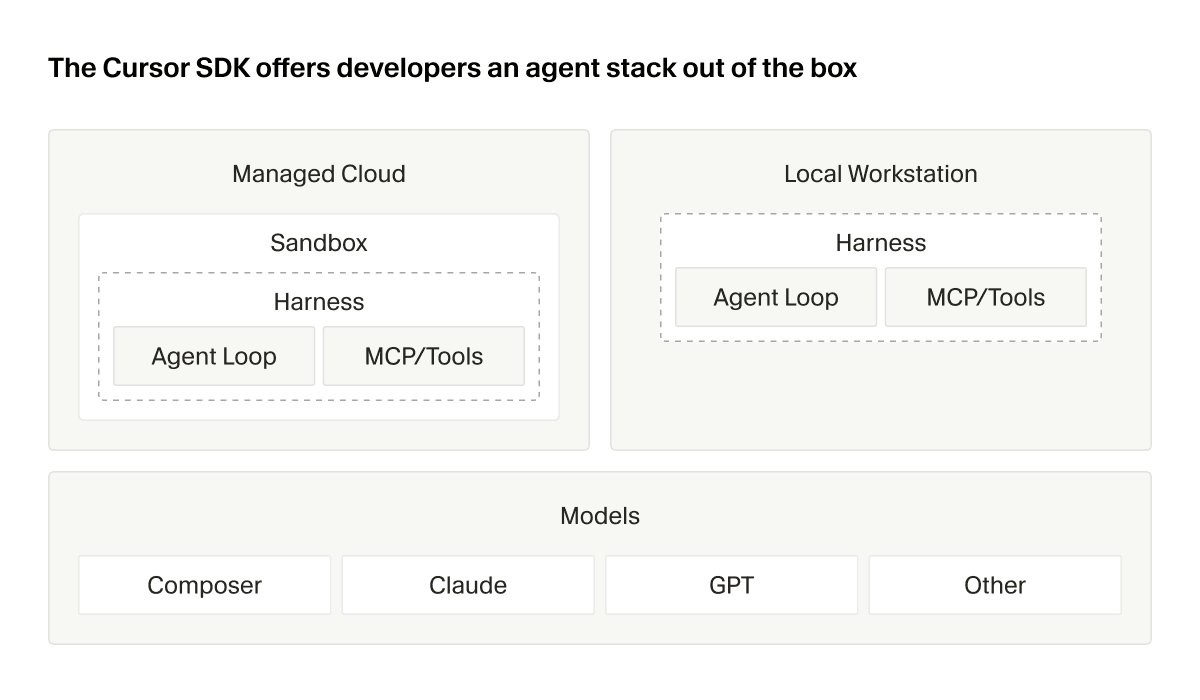
- Cursor shipped a public beta TypeScript SDK that exposes the same agent runtime, harness, and models used by the Cursor app, according to Cursor's launch post and the TypeScript docs.
- Within a day, ericzakariasson's launch thread had already collected 11 projects spanning Gmail, Chrome, CI, terminal tooling, docs checks, and multi-repo orchestration.
- The early demos clustered around one pattern: cloud agents handling long-running work, while local agents handled repo-aware checks like ericzakariasson's docsync example and the docs' local runtime examples in the SDK reference.
- Cursor also open-sourced starter projects, with Cursor's cookbook post pointing to a coding-agent CLI, a prototyping app, and an agent kanban board in the cookbook repo.
- The SDK is not a thin local wrapper, because cramforce's note about API keys and ericzakariasson's clarification both point out that local and cloud runs still connect to Cursor's API, a detail the docs confirm via
CURSOR_API_KEYrequirements in the auth section.
You can read Cursor's launch post, skim the TypeScript docs, and browse the cookbook. The weirdly useful bit is how fast the examples escaped the IDE: a Gmail to Google Chat handoff routed requests into cloud agents, a CI autofix demo pushed fixes back to feature branches, and a multi-repo orchestrator example treated agents like composable workers across repos.
What shipped
The official pitch is simple: the SDK makes the same Cursor agent programmable from TypeScript, across local runs, Cursor-hosted cloud VMs, and self-hosted cloud pools, per the launch post and docs.
A few concrete details matter more than the marketing copy:
- Public beta, installed with
npm install @cursor/sdk, per the launch post - One interface for both
localandcloudruntimes, per the TypeScript docs - Cloud agents get a dedicated VM, cloned repo, and configured environment, per the launch post
- Cloud runs can survive laptop sleep or network drops, per the launch post
- The starter set in the cookbook includes a quickstart, prototyping tool, kanban board, and coding-agent CLI
Cursor also claimed customer use at launch. According to Cursor's customer examples post, Rippling, Notion, C3 AI, and Faire were already using the SDK for background agents, ticket-to-PR flows, and what Cursor called self-healing codebases.
Day-one integrations
The first-day thread reads like a map of where coding agents go once they stop living inside an editor.
- QA agents with browser access, parallel runs, and proof of work, according to ericzakariasson's QA example
- Gmail and Google Chat routing, where a message tags an agent and streams the result back, according to ericzakariasson's Gmail flow
- A Chrome extension for non-technical teammates to ask questions or create tickets with repo context, according to ericzakariasson's Chrome extension example
- Screenshot-to-agent flows for fixing audit findings or web vitals issues, according to ericzakariasson's screenshot example
- CI autofix that triggers on build errors or failing tests and pushes back to the feature branch, according to ericzakariasson's CI autofix example
- A journaling app called mesen and ericzakariasson's mesen example, which is not a coding workflow at all, but shows the same runtime being used outside repo maintenance
ryolu_'s ryOS demo pushed the point further. ryOS added the SDK so the OS could be edited by chatting with its assistant, and ryolu_'s follow-up said the integration was built by pasting the SDK docs into Cursor.
Cloud-agent patterns
The strongest first-day pattern was not chat UX. It was orchestration.
The multi-repo example linked from ericzakariasson's thread points to Cursor-CA-Orchestrator, a TypeScript CLI that spins up multiple Cursor Cloud Agents across repos, uses a bootstrap repo as coordination state, and converges the outputs back into PRs.
The official starter projects line up with that pattern. The cookbook includes a kanban board for viewing cloud agents by status or repository, previewing artifacts, and creating new agents from a repo and prompt, matching the workflow shown in ericzakariasson's kanban board demo.
Cursor's own docs also expose the underlying shape of those runs:
Agentis the durable container that keeps conversation stateRunis one prompt submission with its own stream, status, and cancellation- cloud runs can return git branch and PR metadata, per the TypeScript docs
- cloud agents can list and download artifacts, per the TypeScript docs
That is why the early projects look less like chatbot wrappers and more like job systems that happen to use a coding agent as the worker.
Local tooling and wrappers
A second cluster showed up around developer tooling built on top of the SDK itself.
According to ericzakariasson's custom CLI example, one custom cursor-cli already added streaming, slash commands, session resume, @file mentions, image paste, themes, and MCP support. ericzakariasson's docsync example linked to docsync, which reads staged diffs, finds relevant docs, asks a local Cursor SDK agent whether the docs are stale, and writes a report.
Community wrappers started almost immediately too. nicoalbanese10's repo link points to cursor-ai-sdk-provider, an unofficial proof-of-concept provider that adapts Cursor agents to the AI SDK interface for generateText and streamText. ericzakariasson's effect-cursor-sdk example shows the same thing from another angle, adding Effect-style resource management, tagged errors, and observability hooks around the TypeScript SDK.
These are small projects, but they reveal the likely shape of the ecosystem: thin adapters, repo-local automation, and custom terminals rather than one giant framework.
Harness effects showed up immediately
The reaction from practitioners was not mostly about model access. It was about the harness.
According to altryne's WolfBench note, Cursor was already the best harness WolfBench had tested before the SDK launch. Vtrivedy10's harness thread made the same point more explicitly, arguing that agent performance depends heavily on the harness, evals, prompts, tools, and subagent design rather than just the underlying model.
Hands-on posts also hinted at features sitting adjacent to the SDK launch. kevinkern's multitask post described Cursor's quietly shipped /multitask orchestration mode, where a main agent can split work into async subagents for inspection, planning, coding, review, and test work, then merge results back into the main chat. That fits neatly with the SDK's own support for project MCP, hooks, and subagents in the launch post.
Cursor keeps the control plane
The most important caveat in the launch is that local execution still runs through Cursor's control plane.
cramforce's API key observation flagged that the SDK requires a Cursor API key, unlike some rival agent SDKs that mostly wrap model APIs and can stay local apart from inference. ericzakariasson's clarification replied that the SDK works like Cursor's CLI or desktop app in local or cloud environments, but still connects to the Cursor API.
The TypeScript docs back that up directly:
- both local and cloud modes use
CURSOR_API_KEY - SDK runs follow the same pricing, request pools, and Privacy Mode rules as the IDE and Cloud Agents
- spend is tracked in the team usage dashboard under an SDK tag
- Team Admin API keys are not supported yet, while user and service-account keys are
That makes the SDK a platform extension of Cursor's existing runtime, not a detachable agent kit.