
DeepSeek V4.1 Flash 1017 ranks ahead in independent open-model tests
Browser Use, Parallel and Arena report leading open-model results for DeepSeek V4.1 Flash 1017 across browser, search and web-development tests. Practitioner reports show mixed coding reliability.
TL;DR
- Flash 1017 tied Opus 5.5 at 75/100 in Browser Use’s long-horizon test, with reported costs of $0.22 versus $2.35 per task, about 10.7x cheaper.
- Search performance reached the top 10 overall and led measured open models, according to Parallel’s announcement, but task costs increased.
- Web-development performance rose 52 points to 1,670, placing Flash #12 overall in Arena’s update. Arena named it the leading open model.
- Coding improvements remain task-dependent: ZhihuFrontier’s report found stronger frontend execution, while teortaxesTex reported abandoned modules and incomplete implementations.
DeepSeek ran its terminal benchmark inside Claude Code’s agent loop. Browser Use’s current benchmark description covers 180 long tasks on live websites, scored against rubrics rather than binary success alone. Parallel’s research-cost breakdown assigns 36% of Flash 1017’s bill to page extraction.
Browser Use
Flash 1017’s maximum-effort run improved from the previous Flash’s 70.9 to 75.0, a 4.1-point gain, matching Opus 5.5 at high effort.
The listed $0.22 versus $2.35 task costs imply 10.7x lower cost; the post’s headline claims 19x. Flash’s low-effort run scored 74.0 at $0.12 per task, which does work out to roughly 19.6x cheaper than Opus.
The low-effort result is the bargain: nearly the same score for about half the maximum-effort cost. Browser Use characterized the small score differences as “basically statistical errors away” in a reply.
Parallel search
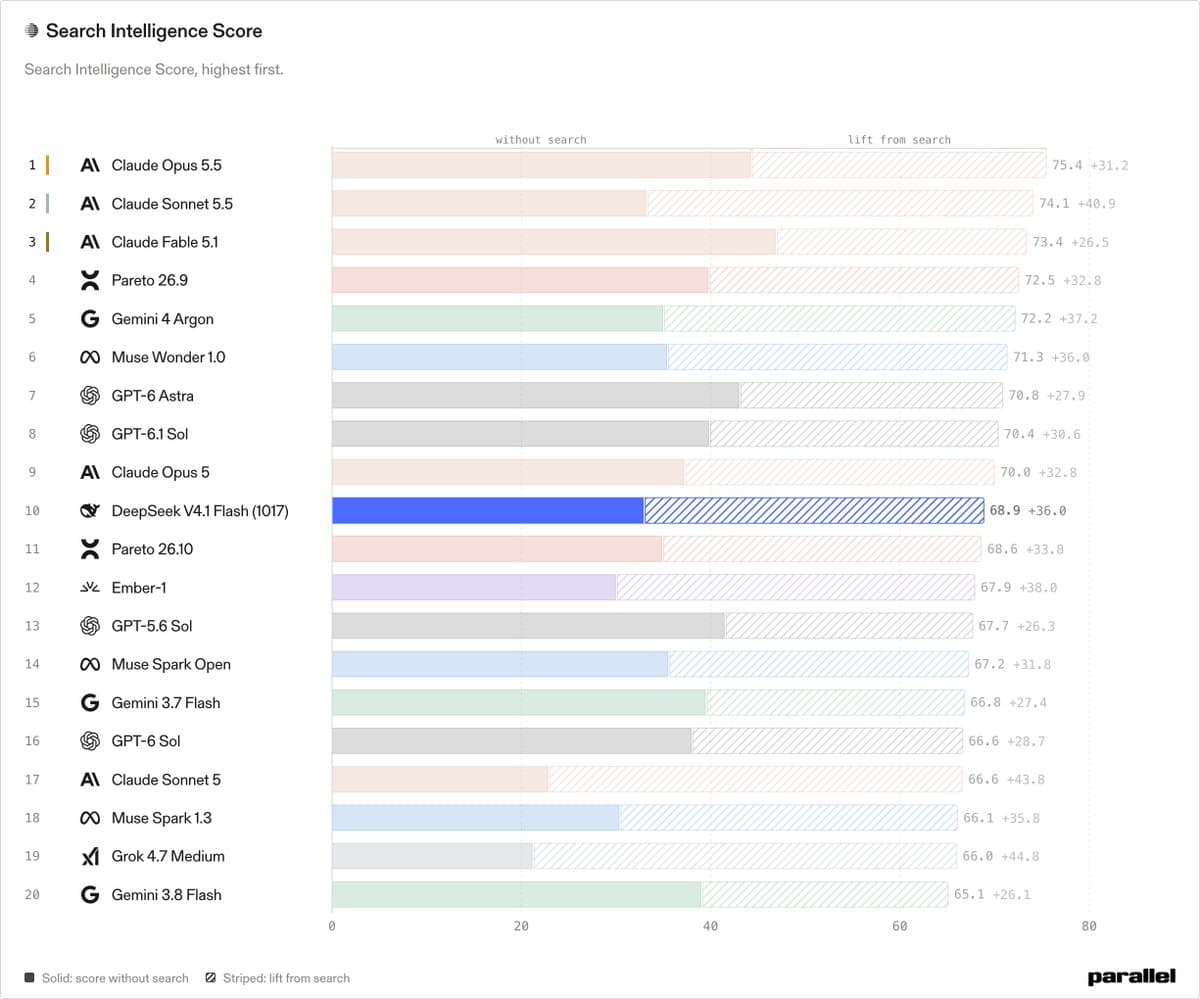
Flash 1017 became the first open model to enter Parallel’s top 10 across open and closed models, according to the evaluator’s announcement. Its published results show a substantial cost increase alongside the accuracy gain:
- Search score: 62.7 → 68.9, +6.2 points.
- Cost per 1,000 tasks: $35.80 → $125, approximately 3.5x higher.
- Search lift: 32.9 without search → 68.9 with search, +36.0 points.
The score equally weights accuracy on DSQA, HLE and WISER. GPT-6.1 Sol remains 1.5 points ahead at a similar $130 per 1,000 tasks on the full leaderboard.
Code Arena
Arena reported Flash 1017 at #1 among open models and #12 overall, with 1,670 points, up 52 points from the September 10 version. That puts it 15 points ahead of Kimi K3 at maximum effort.
Arena priced Flash at $0.30 per million input tokens and $1.20 per million output tokens, describing it as roughly one-tenth Kimi K3’s cost. The Code Arena leaderboard ranks frontend builds using developer votes, a different workload from repository maintenance or terminal automation.
The comparison also depends on effort settings: Flash sits above Opus 5 High at 1,658, while Opus 5 Max scores 1,690.
Coding efficiency
DeepSeek reports larger terminal and automation gains in its own evaluation:
- Terminal-Bench 4.0: 31.2 → 42.3, +11.1 points.
- Automation-Bench: 54.8 → 60.5, +5.7 points.
Zhihu contributor toyama nao ranked Flash 1017 ahead of Kimi K3 overall in hands-on testing, finding more consistent coding across technology stacks. The report separates three behaviors:
- Frontend validation: one animation task used just 20% of the previous version’s steps, largely through more efficient validation rather than repeated testing-and-patching cycles.
- Detail-sensitive tasks: fewer hallucinations sometimes accompanied token use falling by half or more.
- Exploration-heavy reasoning: token use could rise 30–40% without improving scores.
October’s round used DeepSeek Harness 0.2.1 in standard mode; September’s tests did not. That comparison changes both the model and its harness.
Coding reliability
In a playable Roadster simulation, rauchg reported spending about $0.30 on an AI Gateway run that improved the existing project.
Flash built modules it subsequently dropped when implementing an Opus 5.5-written design specification, according to teortaxesTex. The same tester still preferred Opus for coding and complex instruction execution, while crediting Flash with occasionally better aesthetic judgment.
Stopping remains a separate problem. Flash completed roughly 90% of a turtle task quickly, then got stuck on microscopic polishing in a same-prompt animation test. That report describes faster initial implementation followed by a long refinement tail.
Access and model IDs
DeepSeek shipped the update on its website, app and API, with MIT-licensed weights on Hugging Face and ModelScope. Its announcement specifies DeepSeek Harness v0.2.1-rc.1 or later for the updated model.
Hosted access includes several distinct model identifiers and prices:
- Venice: the existing app model was upgraded, with API identifier
deepseek-v4-1-flash-1017, according to its availability announcement. - Morph:
deepseek-ai/DeepSeek-V4.1-Flash-1017is live; its launch thread shows OpenRouter pricing of $0.09 per million input tokens and $0.55 per million output tokens. - Ollama Cloud: the explicit versioned tag is
deepseek-v4.1-flash:1017-cloud, with launch commands for its CLI, Claude Code and OpenCode.
Prompt encoding
Self-hosted deployments get no Jinja-format chat template, according to the model card. DeepSeek supplies two implementations of its prompt format:
encoding.py: a self-contained Python reference covering multi-turn conversations, tool calls, thinking mode, numeric reasoning effort, mid-conversation system messages and interleaved images.deepseek-recipe: Rust libraries with Python bindings that convert Messages, Chat Completions and Responses requests into DeepSeek’s conversation format, encode prompts or token IDs, and parse complete or streamed outputs.
The production toolkit leaves model inference, tool execution and HTTP transport to the caller.