
Fable 5 users report Opus 4.8 fallbacks and $600 Max quota rotations
Fable 5 users reported Opus 4.8 fallbacks, $600 Max-account rotations, slow browser automation, and token-saving subagents. Watch routing opacity, quota burn, and latency before relying on it for long-running agent work.
TL;DR
- Claude's launch thread said Fable 5 is back globally, while Claude's safeguards post said flagged requests get a visible Opus 4.8 response when the updated safeguards fire.
- bridgemindai's $321 receipt showed one coding session sending $242.24 of work to Opus 4.8 and $78.38 to Fable 5, while NickADobos's session screenshots showed two projects routing 4x to 10x more tokens through Opus than Fable.
- BridgeBench's rerun reported debugging falling from 86.2 to 25.9, refactoring from 73.6 to 38.4, and hallucination handling from 75.9 to 61.7; Arena's preview found mostly consistent before-and-after scores outside that coding-heavy rerun.
- bridgemindai's quota math put the $200 Max Fable slice at roughly 3.3 heavy sessions, and bridgemindai's follow-up said he bought a third Max subscription to rotate through weekly limits.
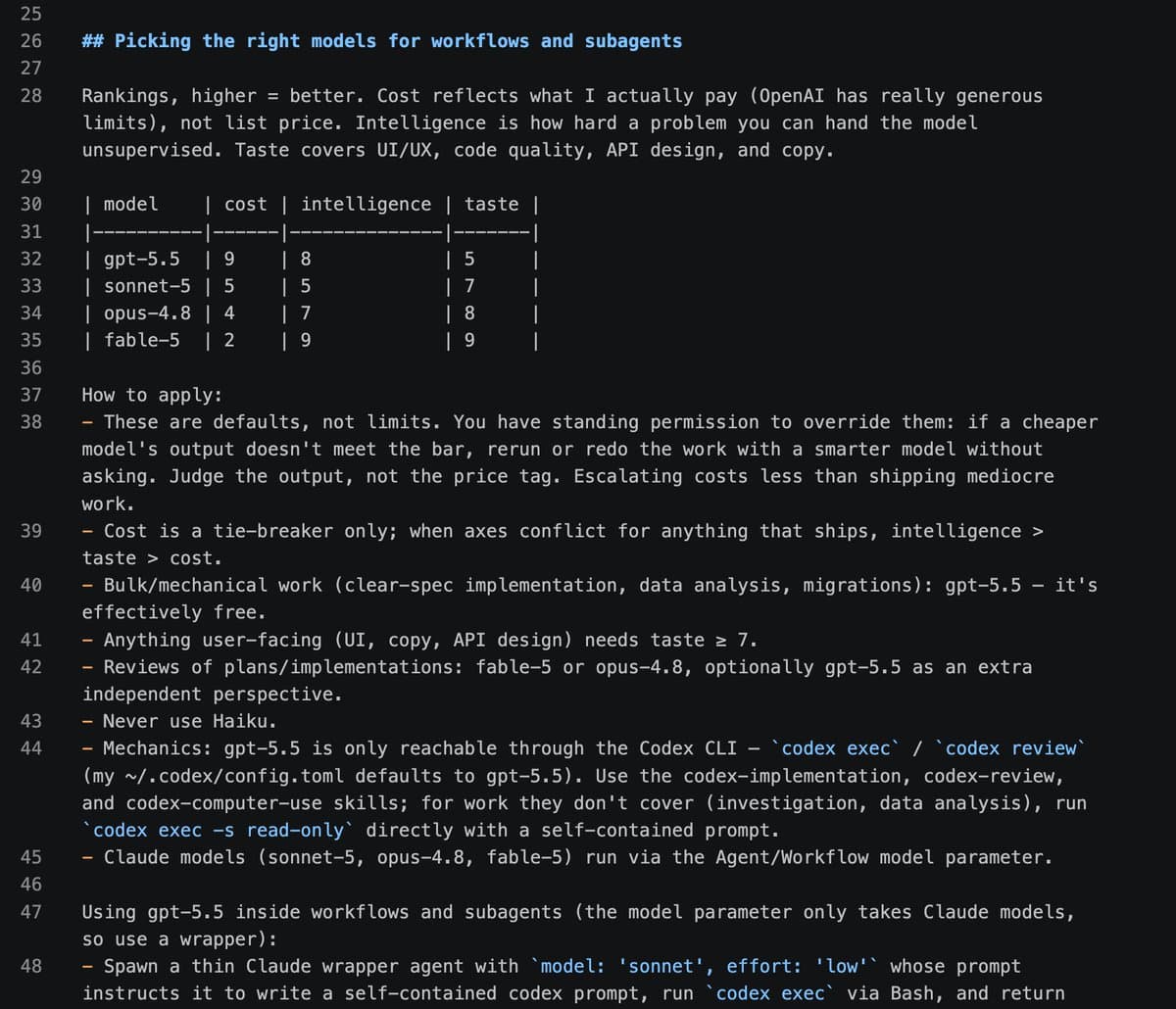
- theo's workflow post, simonw's delegation tip, and daniel_mac8's plugin all converged on the same workaround: use Fable for judgment, planning, review, or orchestration, then delegate implementation to cheaper models.
In Anthropic's redeployment post, the company says the June 12 export controls were lifted, Fable 5 returned July 1 across Claude Platform, Claude.ai, Claude Code, and Claude Cowork, and Pro, Max, Team, and select Enterprise users get it only up to 50% of weekly limits through July 7. The more technical safeguards explainer says the new cyber classifier blocks the Amazon-reported technique in over 99% of cases, but also increases benign coding and debugging false positives. Simon Willison's note turns that constraint into a pattern: let Fable decide when to use lower-power subagents. The community also shipped machinery fast, including daniel_mac8's fable-advisor plugin and an Hacker News thread arguing the 50% limit nudges users toward architecture with Fable and implementation elsewhere.
Fable 5 behind a router
Anthropic's official framing is that Fable 5 returned after talks with the US government, with updated cybersecurity safeguards and a near-term false-positive tradeoff. Claude's safeguards post says users are notified when a request is flagged, and the response comes from Opus 4.8 instead.
The access window is narrow:
- Fable 5 is available through July 7 on paid plans with included usage, per Claude's access post.
- It can consume up to 50% of weekly subscription usage, per Claude's access post.
- After that slice is gone, users can continue through usage credits, per Claude's access post.
- Anthropic's post says AWS, Google Cloud, and Microsoft Foundry access would be re-enabled as quickly as possible.
Thariq Shihipar, posting from the Claude Code team, framed the coding issue as a small fraction of routine coding and debugging requests falling back to Opus. The messy part is that a "small fraction" at product level can still dominate a particular debugging-heavy session.
Fallback receipts
The clearest receipt came from bridgemindai: a $321.53 coding session with $78.38 attributed to Fable 5, $242.24 to Opus 4.8, and 75% of the spend on the fallback model.
NickADobos reported two projects where Opus handled 4x to 10x more tokens than Fable, with Fable doing about 20% of the work. In a follow-up, NickADobos said the projects were a notes app and an RTS game, not an obvious cyber workload.
WesRoth put the measurement problem cleanly: once the classifier interrupts Fable and hands work to Opus, WesRoth's routing post argued developers are benchmarking a routing system, not one model.
BridgeBench vs Arena
BridgeBench's rerun produced the most viral before-and-after table:
- Debugging: 86.2 to 25.9, down 60.3 points.
- Refactoring: 73.6 to 38.4, down 35.2 points.
- Hallucination handling: 75.9 to 61.7, down 14.2 points.
The BridgeBench account later said the underlying model behaved like the June 12 model when tasks actually reached Fable. The reported debugging score came from only 3 of 12 tasks running without fallback, according to bridgemindai's benchmark reply.
Arena's early read pointed the other way. Arena's preview said thousands of votes across Text, Vision, Document, Code, and Agent arenas showed mostly consistent scores before and after redeployment, with the roughly 20-point Frontend drop still inside confidence intervals.
That split is useful because it names the failure mode: broad preference arenas can look stable while a benchmark that hits the router's sensitive regions collapses.
Quota wall
Fable 5 did not just return with a router. It returned with a hard weekly slice.
bridgemindai estimated the $200 Max plan gives about 90 minutes of Fable per 5-hour window and about 3.3 heavy sessions before the Fable weekly allocation is gone. rohanpaul_ai's promo-access summary noted a second catch: earlier weekly model use reduces the remaining Fable allowance, because the promotion draws from the same weekly subscription pool.
That turned into the weirdest user-side pricing hack of the relaunch. bridgemindai said he bought a third $200 Max subscription, bringing the monthly spend to $600, because the weekly Fable limit died in about a day of active building.
Claude also added a dedicated Fable usage line. That small UI change matters more than the modal copy, because users now have a separate meter for the model that burns faster than Opus 4.8.
Fable as coordinator
The strongest positive reports moved Fable out of the implementation loop. theo said he used Fable on high effort, taught Claude Code to use Codex for implementation tasks, added model-routing guidance to CLAUDE.md, and offloaded token-hungry computer use and codebase analysis to other models.
Simon Willison described the same pattern in one sentence: tell Fable to use its judgment to pick a lower-power model and run it in a subagent. His blog post says Claude saved that instruction as a project memory file.
The ecosystem response was immediate:
- daniel_mac8 released a free Claude Code plugin that makes Fable an advisor while Sonnet or Opus writes the code.
- dzhng used Fable for planning, orchestration, and review, with Codex as implementer.
- thdxr described an orchestrator plus minion pattern, using Fable as the primary agent and GLM as background subagents.
- mattlam_ pointed to an
/orchestratorskill that spawns Opus workers under Fable.
This is the post-relaunch meta: Fable is treated like a scarce senior reviewer, not a default autocomplete engine.
Long-running agents
GergelyOrosz gave Fable a non-coding office task: quarterly accounting with bank statements, invoice downloads, and expense recording. He found the browser automation clunky, slower than doing it manually, and quota-hungry before the work was complete.
Ethan Mollick said Fable in Claude Code can do impressive work for non-coders, but the interface is not designed for 5-hour autonomous tasks where users need to observe, intervene, and understand progress before the final output.
Hands-on reports split by surface and task shape:
- RayFernando1337 said Fable 5 plus Cursor Multitask built iOS onboarding, pricing research, a paywall, an AI proxy, screenshots, and bug fixes overnight.
- zeeg's long-session report said a $423.70 session produced more correct code but not obviously better interface design, abstractions, or maintainability.
- zeeg's follow-up described 1 to 2 hour human-in-the-loop sessions turning into 6+ hour inspection loops.
- GergelyOrosz's follow-up separated model slowness from tool slowness, saying Claude Cowork made it hard to tell whether the bottleneck was Fable or browser integration.
Biology and chemistry classifiers
Anthropic said the biology and chemistry classifiers were unchanged from the initial Fable launch, and still broader than the company wants. The same post says they trigger Opus 4.8 fallbacks on basic biology-adjacent questions, with improvements coming soon.
cedric_chee posted a model picker over "Unanswered cancer research questions" with Opus 4.8 selected and Fable 5 marked "Included until July 7," then said biomedicine was still blocked. That is a separate constraint from the cyber classifier drama, and it leaves scientific users with a different failure surface than coding users.