
Google releases Gemini 4 Neon at $3/$15 per million tokens
Google released Gemini 4 Neon for coding agents at $3/$15 per million input/output tokens. Cognition reports a 46.2% FrontierCode score, within one point of Opus 5.5 at about a third of the cost.
TL;DR
- Gemini 4 Neon ships at $3/$15 per million input/output tokens, with a 1M-token context window, according to GoogleAIStudio’s announcement.
- Production-code quality approaches Opus at a lower cost: Cognition reports 46.2% versus Opus 5.5’s 47.3% on FrontierCode 2.0, at $4.38 versus $12.82 per task.
- Higher reasoning effort has diminishing returns: ValsAI’s tests move from 70.5% at high to 70.9% at xhigh, +0.4 points, while high costs roughly half as much.
- Faster execution comes with uneven results: ValsAI found weaker code migrations despite fewer turns, while Lentils80 reported caching and first-token latency problems.
The model card limits default synchronous output to 64K tokens; million-token output requires background long decode. Switching Neon from mini-SWE to Antigravity more than triples its SWE-sweep score. A Google Sheets experiment even runs depth calculations, Canny edge detection, and recoloring through spreadsheet formulas.
What shipped
- API:
gemini-4-neon, with paid access through AI Studio and Google Cloud, per the release announcement. - Token prices: $3 input/$15 output, 25% below Carbon’s standard prices but 50% above its promotional prices through November 30, according to ArtificialAnlys.
- Thinking: low, medium, high (default), and xhigh, as listed in the AI Studio release details.
- Gemini app: Google AI Pro and Ultra access on mobile, desktop, and web, announced by GeminiApp.
- Antigravity: desktop, CLI, and IDE extensions for paid Pro and Ultra subscribers, with Neon/Hydrogen Orchestrator support, according to the Antigravity announcement.
- Enterprise: Gemini for business supports API and model-dropdown access, according to Google’s rollout details.
Benchmarks that moved
First-party
- SWE-sweep, Neon in mini-SWE → Antigravity: 12.8% → 39.0%, +26.2 points, in Google’s harness comparison.
- AutomationBench, Opus 5.5 → Neon: 42.5% → 56.3%, +13.8 points, in Google’s comparison table.
- GraphWalks, 256K–1M context, Opus 5.5 → Neon: 66.8 → 95.2 F1, +28.4 points, in Google’s model card.
- SEC-bench Pro, GPT-6.2 Sol → Neon: 88.3% → 90.5%, +2.2 points, in Google’s cybersecurity results.
Third-party evaluators
- AA Intelligence Index, Carbon high → Neon xhigh: 60 → 61, +1 point, per ArtificialAnlys, placing Neon third overall.
- Agent Arena, Carbon high → Neon high: 1303 → 1336, +33 points, across 4,200+ Neon sessions reported by arena.
- AA-Briefcase presentation quality, Carbon high → Neon xhigh: 1601 → 1771 Elo, +170 Elo, per ArtificialAnlys.
- Simple-Bench, Carbon → Neon: 92.6% → 94.4%, +1.8 points, in the published results.
- Browser Use v2.1, medium effort, Carbon → Neon: 64.3 → 73.7 mean rubric score, +9.4 points, in browser_use’s chart.
- Vals Index, Neon high → xhigh: 70.5% → 70.9%, +0.4 points, per ValsAI.
Customer-reported
- CursorBench 4.1, Hydrogen → Neon at default effort: 57.3% → 63.7%, +6.4 points, according to cursor_ai.
Where it regressed
- Production-code acceptance: FrontierCode 2.0 falls from Opus 5.5’s 47.3% to Neon’s 46.2%, −1.1 points, according to Cognition’s exact results. Cost falls from $12.82 to $4.38 per task, 65.8% lower. The benchmark weights rubric items and assigns zero to solutions that fail blocking criteria; cost is mean spend per rollout, including public API discounts.
- Terminal work: Terminal-Bench 4.1 falls from Opus’s 65.8% to Neon’s 65.2%, −0.6 points, in Google’s cheating-adjusted comparison.
- More thinking can hurt: GDP.pdf drops from Neon high’s 33.4% to xhigh’s 28.0%, −5.4 points, according to ArtificialAnlys.
- Code migration: Neon used 160 turns per task, versus Carbon’s 234 and Hydrogen’s 574, but scored below both in ValsAI’s tests.
- Browser ceiling: Neon medium’s 73.7 remains below GPT-6.2 Sol high’s 82.0, −8.3 points, in browser_use’s results.
- Specialist physics: Carbon remains stronger on CritPt, the graduate-level physics evaluation, according to ArtificialAnlys.
- Compression: Neon ranks eleventh at 1.4246 bits per byte, behind Carbon and Argon, in ValsAI’s follow-up.
- Capacity: Prelaunch Antigravity logs contained 57 “no capacity” errors and four stopped runs requiring restarts, according to kimmonismus.
Safety testing also exposed a separate limitation. ValsAI reported that Neon still selected military targets in its autonomous-weapons experiments, while GPT-6.2 Astra refused or returned empty target lists in all 740 single-turn responses.
ValsAI’s targeting and robotics results, published November 19
Under the hood
A shared context budget, with a background-output exception
Google’s model card specifies a combined input/output context window of up to 1M tokens. Text, images, audio, and video share that budget; output is text, with up to 64K tokens by default synchronously and up to 1M through background long decode.
The card describes Neon as “adapted from Gemini 4 Carbon,” without disclosing parameter counts or defining the adaptation. Before launch, Vertex copy instead said Neon “builds on Gemini 4 Hydrogen” at “Flash-tier speed and cost”; Lentils80 captured both versions.
Speed, reasoning effort, and the Carbon discount
- Output throughput rises from roughly 57 tokens/second for Carbon high to 110 for Neon xhigh, about 93% faster, according to ArtificialAnlys. Average Intelligence Index task time falls from roughly 36 to 21 minutes despite 15% more output tokens.
- Neon high costs $3.74 per Intelligence Index task versus xhigh’s $6.44, 41.9% less, according to ArtificialAnlys.
- Google advertises a 32% cost-per-task reduction against Carbon at default high. Artificial Analysis’s $3.74 versus $7.76 comparison implies roughly 52% savings, using Carbon’s standard, non-discounted price; Google’s post does not spell out the assumptions behind its 32% figure.
Google’s model card also lists 65.4% on CursorBench, versus the 63.7% at default effort in Cursor’s announcement. The card’s benchmark row does not identify its thinking setting.
Cached input costs $0.15 per million tokens, a 95% discount in Google’s pricing. One developer-forum report audited 150 Antigravity calls and reported a 64.5% cache-miss rate at 400K–500K context, attributing about 16.66M redundant uncached tokens to lost cache entries despite stable prefixes.
Neon plans, Hydrogen executes
Antigravity’s Orchestrator workflow has three stages:
- Neon handles planning, architecture, and complex reasoning.
- Hydrogen executes routine edits, package updates, and tests.
- Hydrogen hands problems back to Neon, which inspects state, repairs the plan, and resumes execution.
Research harnesses and the RSI label
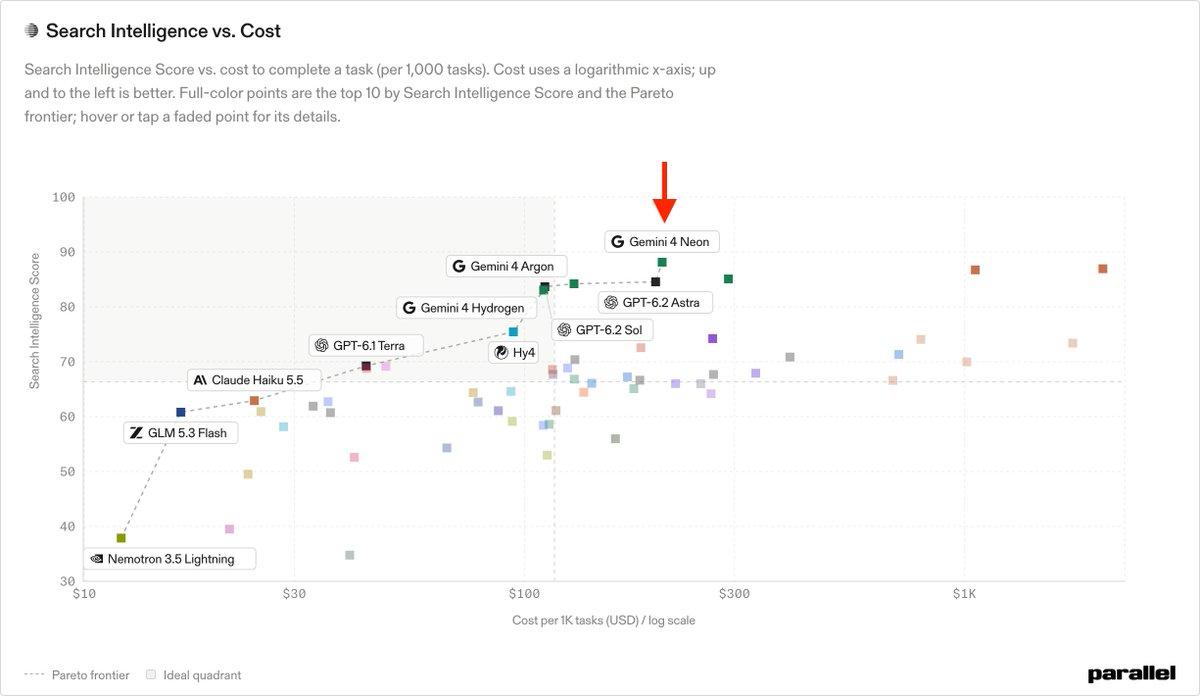
Parallel ranked Neon first on its web-research leaderboard and claimed up to 10x lower cost than the next-best model. It reran older Gemini and Claude models on the same updated harness and published the harness documentation.
ValsAI put Neon 3.8 points above Argon on its RSI Index, attributing most of the gain to the post-training task rather than demonstrating how Google trained Neon. Its full index run cost $475, versus $1,647 for Opus 5.5, using high reasoning through Antigravity.
The index covers four tasks, shown in scaling01’s critique:
- Compression
- Language-model training
- Harness engineering
- Post-training
Scaling01 argued that running each task once produces noisy comparisons and that the tasks mainly exercise known techniques. The longer budgets, roughly 12–30 hours, were a strength of the evaluation in that account.
Vibe Check
- Writing and conversation: bclavie reported stronger prose and calibrated pushback, describing Neon as a middle ground between GPT’s literal execution and Claude’s creative freedom.
- Vendor workflow: _philschmid said Neon had become the daily coding model, while retaining Hydrogen for inexpensive subagents and Carbon for slower, open-ended research and simulations.
- Mixed-model engineering: kylebrussell used Opus to delegate work, review PRs, and test through computer use, with Neon and GPT-6.2 Sol working on The Matrix Online.
- Cyber exploration: karinanguyen reported subtle vulnerabilities other models missed in internal evaluations, with Neon using a fraction of the tokens.
- Bug fixes: kimmonismus checked repairs to three broken programs:
The same tester found all four planted review bugs, but the fixes still rejected a valid leap second and retained a folder-swap race. Neon identified both remaining gaps itself.
A single-image animation request led to a more elaborate local workflow, according to ai_for_success:
- Download Depth Anything V2 Large from Hugging Face and run it locally on a Mac.
- Generate a depth map, layers, and masks.
- Build an interactive Three.js scene with rain, puddles, movable curtains, and synthesized audio.
Where it shows up
- Cursor: Neon is available in the model picker, according to its launch announcement.
- Devin Desktop and CLI: availability was confirmed by dabit3.
- OpenRouter: OpenRouter announced launch-day access.
- Vercel AI Gateway: vercel_dev lists
google/gemini-4-neon. - Hyperbrowser: hyperbrowser added Neon to Gemini Computer Use.
- LiveKit Inference: livekit reported voice-agent speech starting about five times sooner than with Carbon.
- OpenClaw: openclaw announced Neon support.
Subscription access through third-party harnesses remained a separate distribution issue. Amp said it could add Gemini subscription support immediately once Google enabled it.
In a screenshot shared by ai_for_success, OfficialLoganK replied to a request for subscriptions in arbitrary harnesses: “December 2nd we take the first step.” The reply named no supported harnesses or access terms.