
Gemini API adds Managed Agents with sandboxed Linux, web access, and file I/O
Gemini Managed Agents can spin up a sandboxed Linux environment with code execution, web access, and file I/O from one API call, and early examples now include W&B and LlamaIndex workflows. That gives builders a higher-level runtime for long tasks while third-party templates start to define the first production use cases.
TL;DR
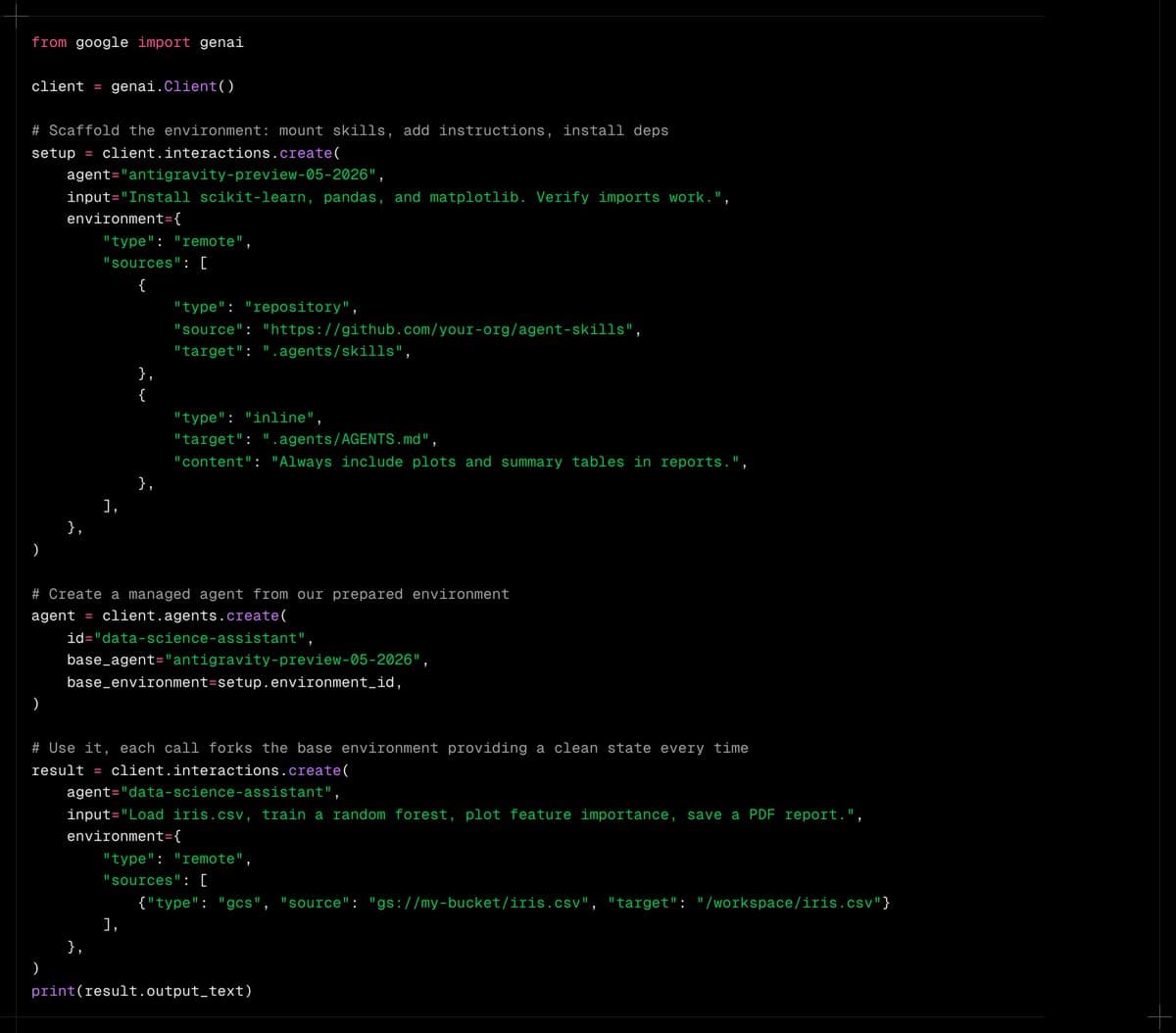
- _philschmid's launch post says Gemini API Managed Agents can start a sandboxed Linux runtime with code execution, web access, and file I/O from one API call.
- The linked official quickstart, surfaced in _philschmid's docs link, frames Managed Agents as a reusable agent layer rather than a raw model call.
- Early examples arrived fast: wandb's bug hunter demo used Managed Agents to find silent repo bugs, while jerryjliu0's repost pointed to a LlamaIndex template built around document parsing.
- wandb's follow-up adds a production detail that matters more than the sandbox headline: every step, tool run, and output can be traced in Weave instead of leaving only a final answer.
You can jump straight to the quickstart, skim Phil Schmid's walkthrough thread, and inspect W&B's longer production write-up. The early use cases are already pretty specific: repo bug hunting from wandb's demo and document parsing pipelines from jerryjliu0's post.
Managed Agents
The core pitch is higher-level orchestration. According to _philschmid's launch post, one call gives the agent a sandboxed Linux environment plus code execution, web access, and file I/O, while the official quickstart packages that into a reusable agent abstraction.
algo_diver's repost of Phil Schmid adds one extra implementation clue: the stack is described as Gemini 3.5 Flash plus an Antigravity harness and a remote Linux sandbox. That makes this feel closer to a hosted agent runtime than a thin API wrapper.
Early templates
The first public examples are already splitting into concrete workflows instead of generic toy demos.
- wandb's demo pitches a coding agent that scans a repo for bugs that pass tests and review.
- wandb's follow-up says the run keeps full reasoning, code execution, outputs, and final report artifacts.
- jerryjliu0's repost points to a LlamaIndex template that combines LlamaParse with Managed Agents.
- jerryjliu0's post narrows that second example to document parsing, which is a very different workload from code analysis.
That spread matters because it shows Google shipping a runtime that partners are immediately bending toward both software engineering and document workflows, not just chat-style assistants.
Tracing artifacts
The most useful detail in the early partner posts is observability. In wandb's follow-up, W&B says each step is traced in Weave, including the reasoning, code executed, outputs seen, and final report.
That is a more concrete production story than the launch tweets alone. Long-running agents usually fail in the gap between answer quality and inspectability, and W&B's example fills in what artifacts a Gemini Managed Agent run can leave behind via its linked report.