
Google releases Gemini Omni 1.2 Flash with 15-second video clips
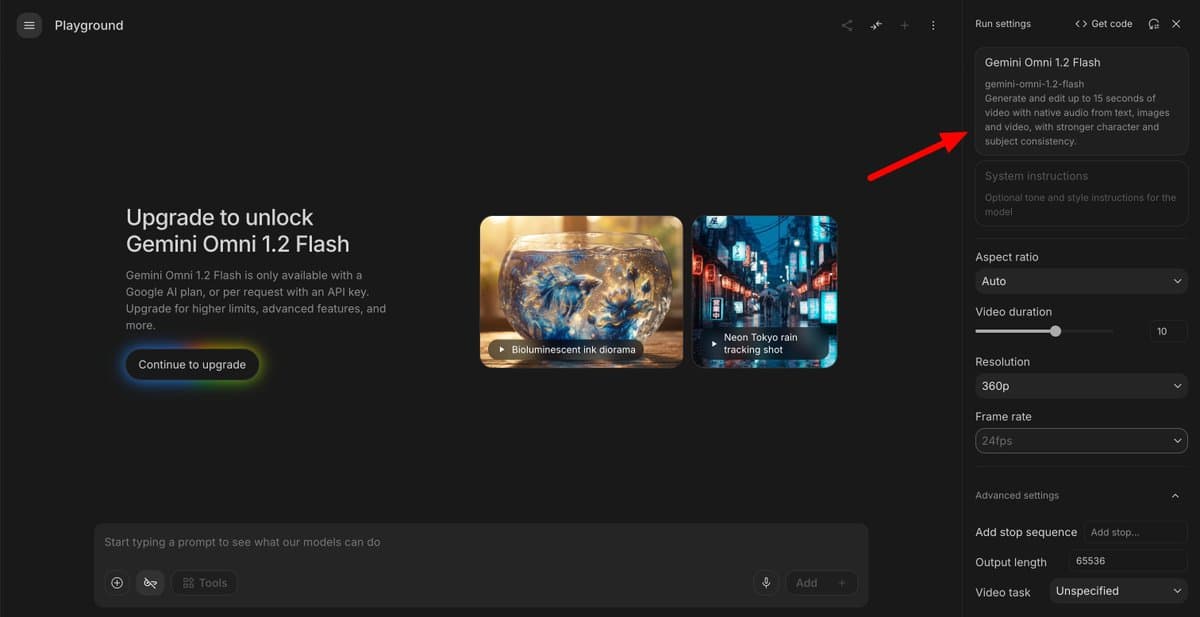
Google released Gemini Omni 1.2 Flash with conversational video editing and clips up to 15 seconds. Drafts at 360p or 720p cost $0.07 per second, which Google says is 30% below its predecessor.
TL;DR
- Native clips now reach 15 seconds, with exact 3–15-second durations and conversational editing in Google's launch announcement.
- 720p video costs about $0.07 per second, 30% below the predecessor, according to kimmonismus.
- Omni 1.2 Flash ranks first for text-to-video and image-to-video, and third for editing, in Arena's launch results.
Google's demo gallery combines one model photo and front-and-back shots of three outfits into a 15-second virtual try-on. The API price sheet bills video by tokens, while the Cloud model reference lists an integration gotcha: no GenerateContent support.
15-second clips and token pricing
Omni 1.2 raises the native generation and editing limit from 10 to 15 seconds. Durations come in one-second increments, as WesRoth noted.
The “up to 4K” output advertised by testingcatalog uses upscaling. Google describes drafting at 360p or 720p before producing higher-resolution versions.
Google's pricing sheet lists these effective video-output rates, including upsampling at higher resolutions:
| Output resolution | Approximate cost per second |
| --- | ---: |
| 360p | $0.023 |
| 720p | $0.070 |
| 1080p | $0.104 |
| 4K | $0.209 |
At 720p, video consumes 5,792 output tokens per second, billed at $12 per million tokens. A 15-second output therefore costs roughly $1.04 before input or text-output charges; text, image and video inputs cost $1.50 per million tokens.
Conversational editing
The edit loop is the standout: follow-up prompts can revise an existing 15-second clip without restarting from the original brief.
Vercel's AI Gateway implementation chains follow-up refinements through previousInteractionId.
Reference fidelity, dialogue and camera control
Google says 1.2 reduces visual drift across frames and camera transitions. Its official comparison uses the same poster and animation prompt for both versions.
The launch gallery demonstrates several distinct controls:
- Reference conditioning: Character, product or style images can be combined with motion clips up to three seconds long and audio cues.
- Multi-shot sequencing: One style frame becomes a four-shot, 15-second explainer with motion-tracked labels in Google's bee-hive demo.
- Dialogue: Google claims clearer lip-sync and distinct multi-speaker conditioning. Its animated conservatory example assigns four one-second voice references to the corresponding characters.
- Camera movement: Continuous FPV flythroughs, zoom-outs and orbits have fewer unwanted jump cuts, according to Google. Its Pantheon example uses two architectural reference photos for an uninterrupted flight through the building.
Arena rankings
Before the announcement, chetaslua shared a Dragon Ball-character demo and called 1.2 a “minor update.” Arena subsequently reported gains across three categories:
- Text-to-video: Omni 1.1 Flash, 1,514 → Omni 1.2 Flash, 1,541, +27 points, ranking first.
- Image-to-video: Omni 1.1 Flash, 1,486 → Omni 1.2 Flash, 1,502, +16 points, ranking first.
- Video editing: Original Omni Flash, 1,375 → Omni 1.2 Flash, 1,395, +20 points, ranking third.
Arena's advertised +39-point image-to-video improvement uses the original Omni Flash's 1,463 score as its baseline.
The debut scores had 1,742 text-to-video votes and 2,745 image-to-video votes in the launch-day screenshots.
Google rollout and gateways
- Google products: Cloud, Flow, Vids, Ads, AI Studio and the Gemini API appear in Google's rollout announcement.
- Gemini app: The updated model is rolling out to all Google AI subscribers, while 15-second creation and editing are available to Ultra subscribers, according to GeminiApp.
- OpenRouter: OpenRouter says it offers direct-Google pricing through the same API used for chat.
- Vercel AI Gateway: The model slug is
google/gemini-omni-1.2-flash. Its launch announcement lists up to six reference images for edits, native audio, portrait or landscape output, and extensions reaching 30 seconds total.
Interactions API and December migration
On Google Cloud, Omni 1.2 supports the Interactions API, according to the model reference shared by _philschmid. Its restrictions include:
- GenerateContent and Chat Completions APIs are unsupported.
- System instructions, structured output, function calling and batch inference are unsupported.
- First-and-last-frame interpolation remains limited to 3–10 seconds.
- Extensions add 3–10 seconds per call, using up to the last 10 seconds of the input video.
Google also acknowledges continuing work on fast sports action, rapid script changes and complex physics in its launch post. Generated outputs carry an imperceptible SynthID watermark.
The pricing page schedules an automatic migration for December 3, 2026: requests to gemini-omni-1.1-flash will route to gemini-omni-1.2-flash and use the newer model's rates.