
Google DeepMind introduces SkillSmith for KV-cache skill composition in Gemma 3 4B
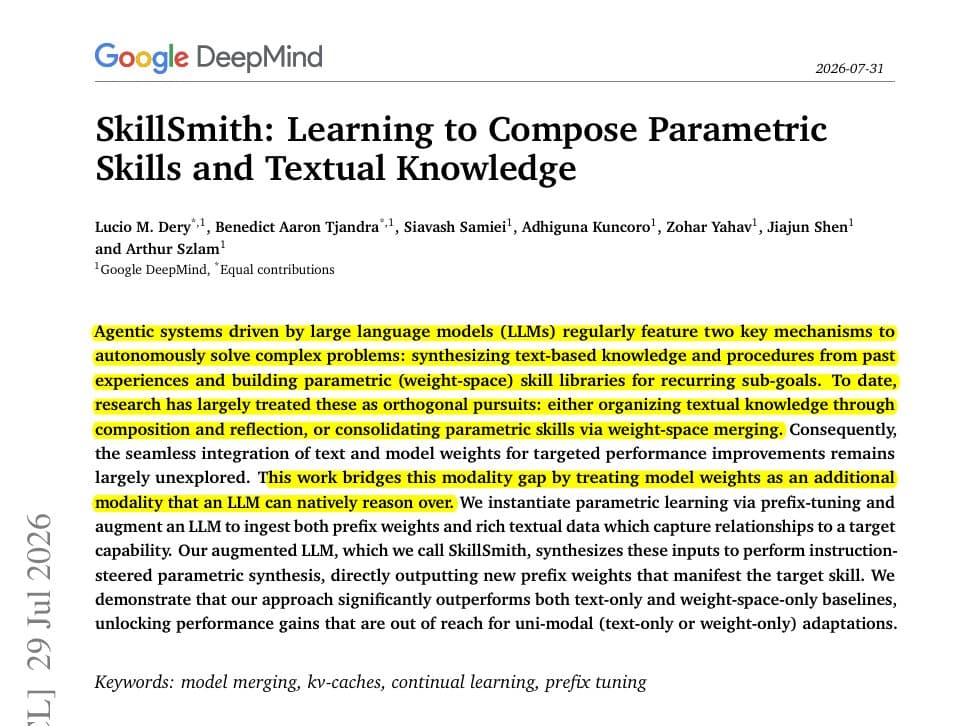
Google DeepMind introduced SkillSmith, a method that treats prefix weights or KV-cache states as an input modality so a frozen Gemma 3 4B model can synthesize new skill prefixes at inference time. Reported Composite-SNI Elo improved when cache composition was combined with text descriptions, making it a research artifact rather than a deployable runtime.
TL;DR
- SkillSmith treats prefix K-V caches as a model-readable input, and omarsar0's post describes the method as an LLM ingesting existing prefix weights plus text that explains a target capability.
- The cleanest number is the mixed-modality ablation: Composite-SNI Elo moves from 1,455 with K-V caches only and 1,622 with text only to 1,714 with both, according to rohanpaul_ai's breakdown.
- The one-forward-pass claim is about synthesizing a new prefix cache for a frozen model, with rohanpaul_ai's follow-up framing it as combining prior abilities and a written explanation into a task-specific skill.
- SkillSmith changes the initialization point for adaptation, not the need for training, as rohanpaul_ai's breakdown notes in its fine-tuning caveat.
The arXiv paper is worth opening for the architecture, not just the headline: Section 3.3 describes an input K-V adapter, <src_start> and <kv_start> control tokens, placeholder latent tokens, inverse RoPE de-rotation, and an output K-V adapter. The benchmark story is also narrower than “models learn skills at inference time”: Composite SNI is a synthetic set generated with Gemini 2.5, while MMLU-ProX is a 29-language reasoning benchmark used as an out-of-distribution check. For background, Hugging Face's PEFT docs define prefix tuning as learned task-specific vectors inserted while the pretrained model stays frozen.
Prefix weights as a modality
Google DeepMind's paper starts from a useful split in agent memory: text artifacts such as reflections and procedures are easy to compose but expensive in context, while PEFT modules are compact but usually combined with shallow weight arithmetic. SkillSmith makes the prefix cache itself something the LLM can read and write, according to the arXiv paper.
The paper instantiates the weight side as prefix tuning, where each prior task has a learned K-V prefix cache plus task metadata. The model then receives both the prefix weights and text describing how source skills relate to the target task.
Forward-pass skill synthesis
The architecture is a co-processor around a frozen Gemma 3 4B downstream model, per the paper. The forward pass is structured, not a free-form prompt trick:
- Source task bundles: task text plus adapted K-V cache blocks.
- Composition text: a description, rationale, or few-shot examples for the target task.
- Generation block: placeholder latent tokens after
<gen_start>mark where new K-V states are synthesized. - Output path: the generated K-V states are isolated, de-rotated to remove positional information, then passed through an output K-V adapter.
The output is a new prefix module m_new that modulates the frozen base model on the target task. That makes SkillSmith closer to a learned hypernetwork for prefixes than a deployment-time fine-tune.
Composite-SNI ablation
Composite SNI is the paper's controlled composition test. The paper says the team prompted Gemini 2.5 to generate tasks that require the combined skills of two input tasks from Super Natural Instructions, giving them known source-to-target relationships.
The ablation that matters:
- K-V caches only: 1,455 Elo.
- Text only: 1,622 Elo.
- K-V caches plus text: 1,714 Elo.
That is +259 Elo over the weight-only path and +92 Elo over the text-only path. The result is the whole pitch in one table: the text tells the model how to combine the parametric artifacts, and the artifacts carry something the prompt alone does not.
Fine-tuning boundary
The paper does not claim that training disappears. SkillSmith-generated prefixes are presented as stronger initializations for downstream fine-tuning, especially on harder, data-sparse MMLU-ProX tasks, according to [rohanpaul_ai's breakdown]rohanpaul_ai's breakdown.
The boundary shows up on simpler SNI tasks with roughly 1,000 examples each, where fine-tuned methods converge. That makes the result more interesting for low-data transfer than for ordinary task adaptation with enough examples.
MMLU-ProX and retrieval
The evaluation is not only Composite SNI. The paper also reports experiments on SNI and MMLU-ProX, and the MMLU-ProX project page defines that benchmark as 11,829 parallel questions per language across 29 languages, plus a 658-question lite version.
SkillSmith also includes a retriever setting for cases where the true source-task mapping is unknown. In that setup, the paper says retrieved candidate source tasks replace oracle source tasks, then SkillSmith tries to extract the relevant signal from noisy bundles before generating the target prefix.