
Google releases Gemini 3.8 Live with bidirectional voice
Gemini 3.8 Live and its Extended Thinking variant add bidirectional voice, visual grounding, multilingual speech, and asynchronous tool calls. Google is rolling both models out through its API with audio watermarking via SynthID.
TL;DR
- Google shipped two native speech-to-speech models, Gemini 3.8 Live and Gemini 3.8 Live Extended Thinking, for real-time dialogue and background task execution, as GoogleAIStudio's developer announcement says.
- Extended Thinking can reason and make multi-step tool calls in the background while continuing to speak, according to Google's Extended Thinking post.
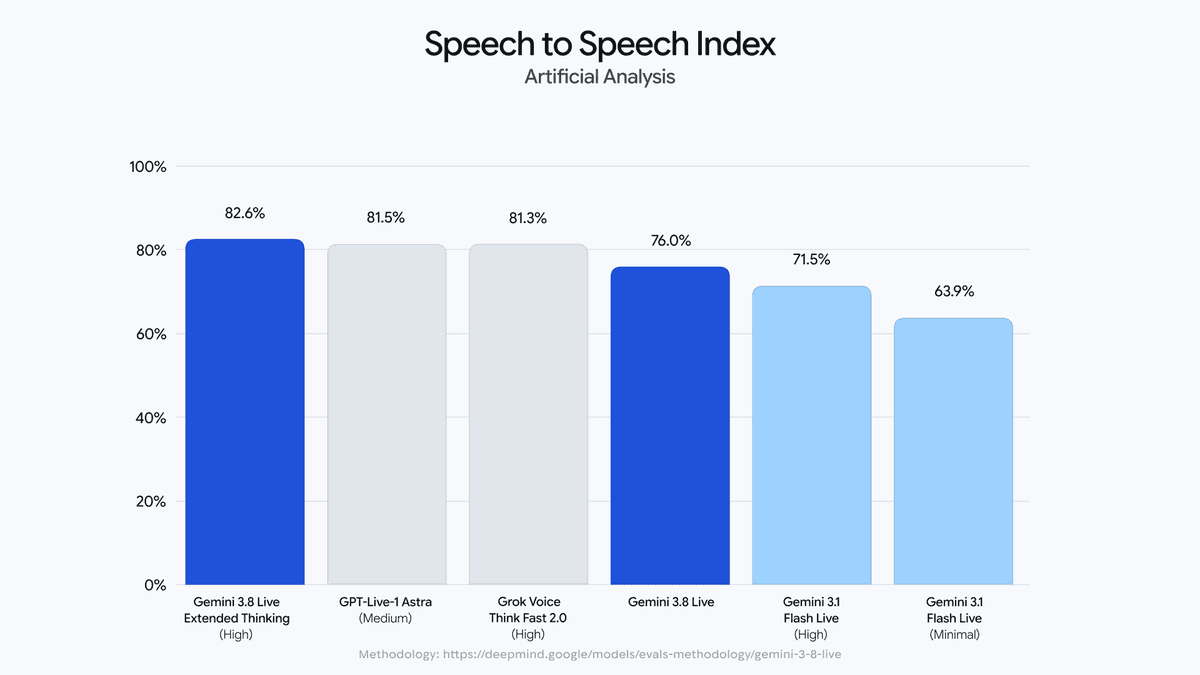
- Independent tests put Extended Thinking at 82.6 on the Speech to Speech Index and 68.6% on τ-Voice, in ArtificialAnlys's evaluation thread.
- The rollout spans consumer apps, the public-preview API, enterprise previews, and Workspace, while Google's rollout post says generated audio carries SynthID watermarking.
The developer launch post singles out confirmation codes, claim numbers, and other alphanumeric strings as a target capability. The model card ties both SKUs to Gemini 3 Pro and sets a January 2025 knowledge cutoff, while the standard-model reference calls regular Live the low-latency default.
What shipped
- Google introduced Gemini 3.8 Live and Gemini 3.8 Live Extended Thinking as its new advanced audio models in Google's product announcement.
- The standard SKU prioritizes scale, cost efficiency, fluid dialogue, and visual grounding, per Google's standard Live post.
- Extended Thinking targets complex multi-step work, reasoning and speaking simultaneously with early verbal progress cues, in Google's Extended Thinking post.
- Google characterizes the pair as voice agents that can take turns seamlessly, think through complexity, and converse naturally in koraykv's launch post.
- Input audio is listed at $0.005 per minute and output audio at $0.018 per minute in the developer launch post.
- All audio generated by Google's AI products is SynthID-watermarked, Google's rollout post says.
Benchmarks that moved
First-party
- Sierra τ³-Banking: 11.3% → 35.1%, +23.8 points, in GoogleDeepMind's launch charts.
Third-party evaluators
- Speech to Speech Index: 71.5% → 82.6%, +11.1 points, in ArtificialAnlys's evaluation thread.
- τ-Voice: 37.7% → 68.6%, +30.9 points, in ArtificialAnlys's τ-Voice results.
Customer-reported
- Iris workflow report: no baseline score → no new score, no point delta, in ai_for_success's early-access post.
Where it regressed
The regular 3.8 Live model posted 1083 Elo in ArtificialAnlys's blind Speech Agent Arena, versus 1096 for Gemini 3.1 Flash Live, -13 Elo. Extended Thinking at High registered 990 Elo and 89.1% task success, while standard Live reached 93.2% and Grok Voice Think Fast 2.0 High led that task-success measure at 94.6%, according to ArtificialAnlys's arena results.
The model card lists hallucinations, ongoing jailbreak-resistance work, occasional slowness or timeouts, and the January 2025 knowledge cutoff as limitations.
Under the hood
Google's standard-model reference lists text, images, audio, and video as inputs, with text and audio outputs. The model card sets both variants at up to 128K input tokens and 64K output tokens.
- Standard Live supports interleaved reasoning, asynchronous function calling, session content updates, and built-in audio streaming, according to the API reference.
- Extended Thinking adds configurable background reasoning for multi-step work while audio keeps streaming, as Google's Extended Thinking post describes.
- The developer announcement specifies background API and tool calls, visual context, 97-plus language coverage, and incremental content updates in the developer launch post.
- AlanCowen's launch reflection framed parallel reasoning with audio as a way to align responses with human preferences during the conversation.
A browser prototype from Simon Willison's Weblog connects directly to the BidiGenerateContent WebSocket endpoint and uses Web Audio API capture and playback, with no libraries.
Vibe Check
ai_for_success said early access had already put the models behind daily internal tools. Their Iris avatar uses Gemini 3.8 Live for conversation and tool-selects a facial expression before speaking, so its voice and expression originate in the same interaction loop, according to ai_for_success's early-access post.
- The builder chose standard Live for Iris because routine back-and-forth needed speed rather than deep reasoning, in ai_for_success's explanation.
- Their personal Iris tool, connected to a Hermes agent, had also moved to 3.8, ai_for_success's follow-up says.
- They described tool calls as more responsive in ai_for_success's reply.
- Iris could smile but did not laugh in the shown build, according to ai_for_success's reply.
Where it shows up
- Search Live gets Gemini 3.8 Live, while Gemini App Live gets Extended Thinking, per Google's rollout post.
- Developers can use both through the Gemini API public preview and Google AI Studio, as GoogleAIStudio's developer announcement says.
- Google AI Pro and Ultra subscribers get Extended Thinking in Docs, Gmail, and Keep; Gemini Enterprise Agent Platform is in private preview, according to Google's rollout post.
- Vercel AI Gateway added
google/gemini-3.8-liveandgoogle/gemini-3.8-live-extended-thinking, in vercel_dev's Gateway post. - LiveKit Agents exposes
gemini-3.8-livefor low-latency audio and the extended model for async reasoning, livekit's launch note says.
The developer launch post also lists Agora, Fishjam, LangChain, Pipecat, Vercel, and Vision Agents as Live API integration partners.
Deep Research handoff
Google's Gemini Live integration can start a Deep Research report by voice, then keep working after the chat closes or the screen locks; it sends a notification when the report is ready, according to Google's Deep Research announcement. The conversation can then continue over the completed report.
Quota-page preview
Before the public release, testingcatalog's quota-page report showed both gemini-3.8-live and gemini-3.8-live-extended-thinking in a Google Cloud Console quota filter.