
Google plans to test four TPUs in orbit with Project Suncatcher
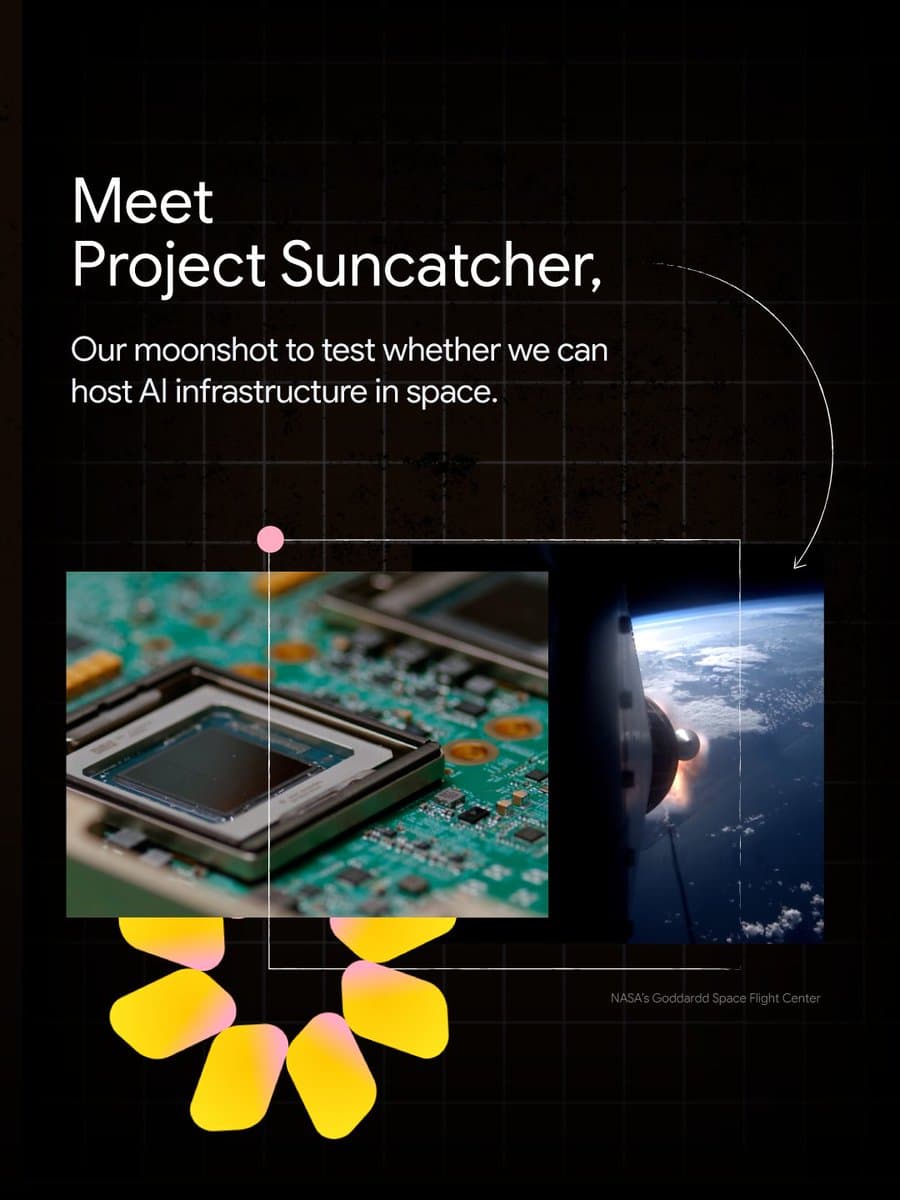
Google and Planet plan to launch a prototype satellite carrying four TPUs. The mission will collect data on whether ML hardware can operate under orbital conditions.
TL;DR
- Google will fly a Planet-built prototype carrying four TPUs on SpaceX’s Transporter-18, Google’s four-TPU mission post says; an Ars Technica report dates the launch to October 1.
- The first Project Suncatcher flight is a hardware-survival experiment, not a scale-out deployment: Google’s Project Suncatcher announcement says it will measure how TPUs hold up in orbit.
- Ground work has already put Trillium TPUs under proton-beam radiation while running AI workloads; Google’s project update describes initial results above a five-year mission’s total ionizing dose.
- Cooling makes the payload a burst-mode experiment. An Ars Technica report says Gemini runs must stop after roughly 15 minutes, while DynamicWebPaige’s quote describes the intended workload as simple Gemini queries.
- Google’s 2027 target is a two-satellite laser-link test, the distributed-compute plan that rohanpaul_ai’s overview summarized as satellites operating together.
Google will accompany the flight with an engineering video series, according to Google’s launch follow-up. Its official project post puts a sharp number on the ascent problem: a roughly 10-minute trip to low Earth orbit can impose 50 to 100 g on individual components, even when spacecraft-level loads reach about 10 g.
MVP payload
The refrigerator-sized satellite, called MVP, uses Google accelerators inside a spacecraft supplied by Planet, Ars Technica reports. Google’s stated job for the flight is to collect in-orbit data on the combined physical stress of launch, radiation, and thermal extremes.
Vibration and radiation
Google tested the satellite by shaking it on all three axes to reproduce launch frequencies. Its engineering post says the hardware held up, although orbital flight is the first test that combines launch stresses with the radiation environment.
At UC Davis’s Crocker Nuclear Laboratory, the team ran AI workloads on TPUs during proton-beam exposure and watched for errors such as bit flips. Google says its initial Trillium result exceeded the total ionizing dose expected over a five-year mission.
Cooling loop
Vacuum removes convection from the design. Google is testing heat pipes and radiators in a thermal-vacuum chamber; Ars Technica reports that malleable thermal-interface material couples the chips to aluminum and copper heat pipes before a radiator emits the heat.
The current radiator configuration only supports roughly 15-minute compute spurts before the TPUs shut down for recovery. That operational detail makes this a thermal-management test as much as an accelerator test.
Laser-linked clusters
Google’s intended scale-up uses satellites with dozens of TPU chips flying in clusters. The official project post says each satellite must know its position relative to its neighbors so laser links can carry high-bandwidth traffic over short distances.
Google plans to test that pointing and interconnect problem with two satellites in 2027. Its comparison is unusually concrete: keeping the link aligned resembles hitting a coin-sized target from miles away while both endpoints move.