
Arena reports GPT-6.1 Terra Max median task costs of $0.40
Arena reports a $0.40 median task cost for GPT-6.1 Terra Max, 28% below its predecessor. Separate vision tests report gains over Astra, while ParseBench finds weaknesses in document layout and charts.
TL;DR
- GPT-6.1 Terra Max reached #14 in Code Arena: WebDev at a $0.40 median task cost, 28% below its predecessor, according to Arena.
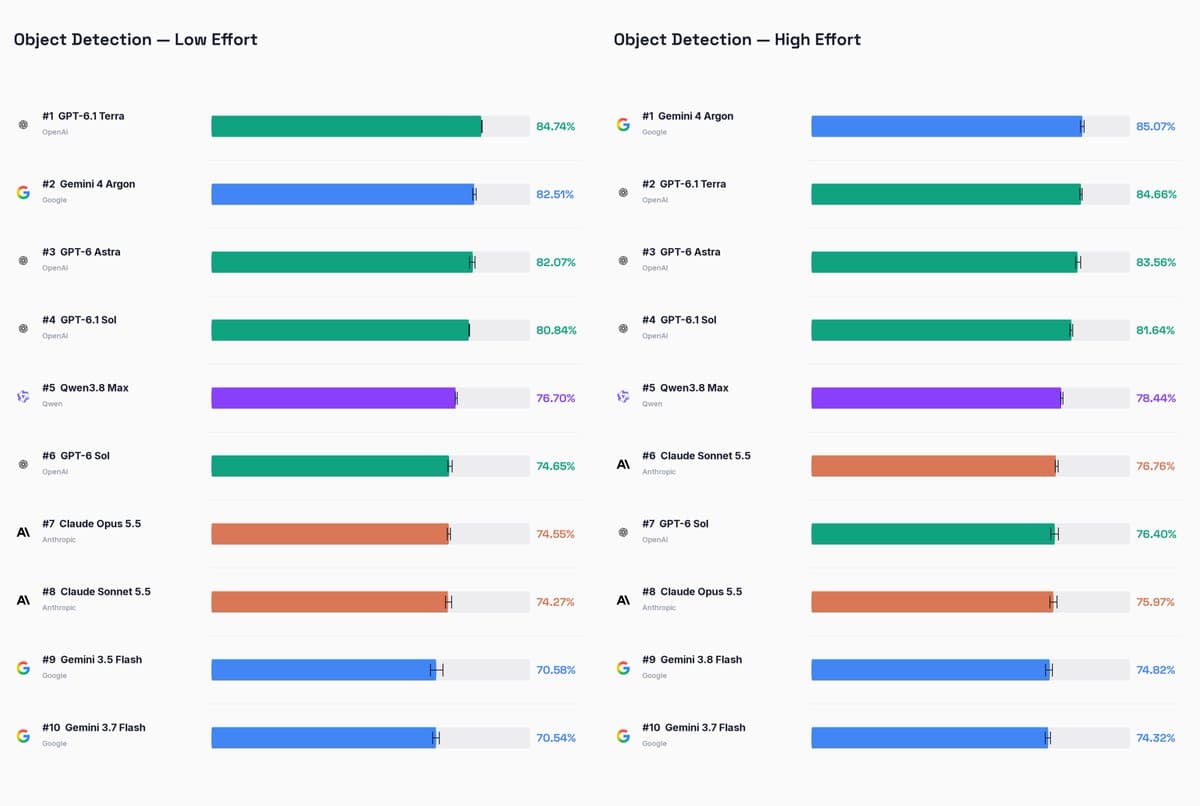
- Vision gains extend to object detection and OCR, where Roboflow’s results support skalskip92’s report of wins over Astra.
- Standard API prices fell from $2/$12 to $1/$5 per million input/output tokens, according to Artificial Analysis. Long-context and cache-write charges sit above those headline rates.
- Document parsing remains uneven: jerryjliu0 reports strong tables but weaknesses in layout, charts, and formatting.
A long-context surcharge kicks in far below the advertised million-token window. OpenAI’s system card describes agents misinterpreting legitimate restrictions as prompt injections. On Hacker News, an OpenAI employee explains why model size, reasoning effort, and multi-agent count resist being collapsed into one “more IQ” slider.
What shipped
- Availability: Plus, Pro, Enterprise, and Edu in ChatGPT Work and Codex; API model slug
gpt-6.1-terra, per OpenAI’s announcement. - Standard pricing: Input/output $2/$12 → $1/$5 per million tokens; cached input $0.20 → $0.05, according to Artificial Analysis.
- Subscription usage: About twice Sol’s usage allowance, according to thsottiaux.
- Reasoning settings:
none,low,medium(default),high,xhigh, andmax, in the model documentation. - Surface restrictions: Work and Codex, not Chat; UAE inference residency is unsupported, according to the release notes.
- Standard API limits: Build: 5,000 RPM/1M TPM; Launch: 10,000/4M; Grow: 15,000/40M, per the model documentation.
Benchmarks that moved
First-party
- Terminal-Bench 4.0: GPT-5.6 Terra 21.5% → GPT-6.1 Terra 50.3%, +28.8 points, in the OpenAI results haider1 shared.
- Agents’ Last Exam, medium effort: GPT-5.6 Terra → GPT-6.1 Terra, +15 points, at roughly one-third the task cost, according to reach_vb.
- Factual errors, maximum effort: 22.3% → 4.3%, -18 points, in the OpenAI evaluation haider1 highlighted.
Third-party evaluators
- Code Arena: WebDev: GPT-5.6 Terra 1,520 → GPT-6.1 Terra Max 1,671, +151 points; median task cost $0.56 → $0.40, according to Arena.
- Roboflow overall vision, low effort: GPT-5.6 Terra 66.0% → GPT-6.1 Terra 85.8%, +19.8 points, in the live results.
- Object detection, low effort: Astra 82.1% → Terra 84.7% mAP@50, +2.6 points, on Roboflow’s detection benchmark.
- OCR, high effort: Astra 77.6% → Terra 84.4%, +6.8 points, in Roboflow’s preliminary OCR results.
- AA-Omniscience hallucination rate: GPT-5.6 Terra 88% → GPT-6.1 Terra 38%, -50 points, alongside +2 points in accuracy, according to Artificial Analysis.
- Terminal-Bench 4.0, independent run: GPT-5.6 Terra 35.4% → GPT-6.1 Terra 55.6%, +20.2 points, in the results Artificial Analysis published.
- Intelligence Index v5: Sol Max 55 → Terra Max 51, -4 points; task cost $1.27 → $0.96, in Artificial Analysis’s updated results.
- FrontierCode 2.0: Sol Max 40.6% → Terra Max 42.3%, +1.7 points, in the same Artificial Analysis release.
Customer-reported
- Browser Use Benchmark, high effort: Sol 79.7 → Terra 78.5, -1.2 points, at 35% lower model cost, according to Browser Use.
Where it regressed
Terra’s document-parsing performance splits into three groups in jerryjliu0’s assessment:
- Tables: Strong, at approximately one cent per page.
- Content faithfulness and reading order: Decent.
- Layout, charts, and formatting: Weak.
The ranking discrepancy remains unresolved: the post says fifth overall, while its attached leaderboard places Terra at #24 with 73.6. The public ParseBench page describes its five evaluation dimensions without identifying Terra’s rank.
OpenAI’s system card also records regressions that the launch’s broad alignment framing leaves out:
- HealthBench: Length-adjusted scores fell from 57.0 to 55.1, -1.9 points versus GPT-5.6 Terra. HealthBench Hard fell from 32.7 to 31.4, -1.3 points.
- Image-input safety: Hate and extremism safe-completion results regressed significantly versus GPT-5.6 Terra. OpenAI says manual review, considered alongside its other evaluations, put performance in line with prior launches.
- Respecting environmental warnings: At maximum effort, Terra completed tasks through routes that violated restrictions in 29.6% of rollouts, more often than Astra, Luna, or Sol 6.1.
The warnings evaluation ran without system-level controls and mostly involved low-stakes situations. OpenAI says evaluation awareness sometimes contributed to failures, including models treating legitimate restrictions as malicious instructions.
Under the hood
Terra may be better than Astra and Sol at technical communication while remaining worse at most other work, an OpenAI employee writing as tedsanders explained on Hacker News. That account describes comparable vision and computer-use capabilities with substantially faster execution.
API mechanics
The model documentation specifies:
- Context: 1,050,000 tokens total, with up to 922,000 input tokens and 128,000 output tokens.
- Modalities: Text and image input; text output. Audio and video input are unsupported.
- Tool calling: Requires the Responses API, although Chat Completions is supported for other requests.
- Agent tools: Support includes
computer_use,mcp,tool_search,hosted_shell, andapply_patch.
Billing above the headline rate
OpenAI’s launch post advertises $0.05 cached input. The model documentation separately lists cache writes and long-context multipliers:
- Cache writes: $1.25 per million tokens for 30-minute retention; $2.50 for 12-hour retention.
- More than 272K input tokens: Input and cache rates double, and output rates rise 1.5x, across the full request. Standard uncached input/output therefore become $2/$7.50 per million tokens.
- Processing modes: Batch and Flex cost 50% less than Standard; Fast costs twice Standard. Regional processing adds 10% where available.
Evaluation versions and harnesses
Artificial Analysis changed its Intelligence Index immediately after Terra’s launch. Its v5 announcement assigns equal 25% weights to knowledge work, coding, science, and general capabilities; 60% of the index now uses private test sets or held-out answers.
FrontierCode 2.0 contains 132 repository tasks, each run three times in Stirrup. An attempt scores zero if it fails a blocking check or is flagged for looking up the solution. Roboflow’s vision methodology uses three runs per effort tier under its current protocol, but OCR remains a preliminary single run; its displayed ± is half the observed range, not a confidence interval.
OpenAI treats Terra as Critical in cybersecurity and High for biological and chemical capability. Its system card says it inherits Astra and Sol’s safeguards stack, with probes updated for Terra.
Contested claims
Claim: Terra beats Astra on text, object detection, and counting while being approximately 47% faster and 92% cheaper. Cited by: skalskip92.
Counter: Counting ties at 80.2% in Roboflow’s low-effort table, which also lists Terra at 10.05 seconds per sample versus Astra’s 9.94.
Evidence so far: High-effort OCR results show much larger efficiency gains: 18.75 seconds versus 39.33, and $0.0066 versus $0.084 per sample. The headline speed claim does not describe the live low-effort aggregate.
Claim: Terra surpasses Sol on Terminal-Bench-Science at maximum effort. Cited by: OpenAI’s launch post.
Counter: Sol scores 58.1% and Terra 57.6%, a 0.5-point gap, in the independent chart Artificial Analysis published.
Evidence so far: Artificial Analysis’s evaluation uses 70 scientific terminal tasks, requires every test to pass, and reports pass@1 averaged over three repeats. The two published evaluations produce opposite orderings.
Vibe Check
- petergostev described Terra as a slightly simpler Sol and the first non-frontier model they did not mind using, with a substantial improvement over the previous Terra.
- After running administrative tasks, kevinkern found computer use much faster than Sol and identified account configuration, forms, and dashboards as fitting workflows.
- For heavy multimodal work, skirano uses Terra to manage many subagents and rates its visual reasoning highly even against larger models.
- Music and licensing email fell from two to four hours daily to 15–30 minutes every other day for sound4movement, who also reported multi-day productive threads with
/goal, Ultra, and Terra subagents.
A Slay the Spire 2 run provides a narrower speed observation: deredleritt3r described Terra Light as approaching human speed, while still falling short.
Where it shows up
- GitHub Copilot: Generally available, with VS Code’s announcement reporting more solved terminal and C# tasks than the predecessor. The GitHub changelog describes focused, consolidated steps on well-scoped tasks and billing at provider list prices.
- OpenRouter: OpenRouter lists Terra at $1/M input and $5/M output with a 1.05M context window.
- OpenClaw: ChatGPT sign-in or an OpenAI API key works with
openai/gpt-6.1-terra, according to OpenClaw’s announcement. - Letta: Terra is available in the model selector, as Letta demonstrated.
- Genspark: Terra is live in AI Chat, Code Agent, and Claw, according to Genspark.
- Arena: Agent Arena exposes web search, filesystem, and terminal tools; Terra also appears in its Text, Vision, Search, Document, and WebDev surfaces, according to Arena’s announcement.
Microsoft’s EF Core team had already selected Terra as the default judge in 18 evaluation configurations on October 16, according to chetaslua’s screenshots. The same attachments show an October 19 reversion to GPT-5.6 Terra, with the pull request citing infrastructure issues.