
LangSmith launches Sandbox, LLM Gateway, and Engine for agent execution, spend tracking, and eval triage
LangSmith added sandboxed execution, spend-aware gateway routing, and Engine to surface recurring agent failures from traces. The bundle gives teams one place to run agents, control token spend, and turn production issues into debugging and eval loops.
TL;DR
- the Sandboxes GA post and the Sandboxes docs position LangSmith as a managed runtime for agents that need to write code, touch files, keep state, and survive long-running sessions.
- the spend-limits post and LangChain's LLM Gateway launch post show a private beta proxy that can cap spend, redact sensitive data, and centralize provider keys without adding a separate gateway stack.
- the Engine launch steps and the Engine product page frame Engine as an always-on trace reader that clusters failures, proposes fixes, and can open GitHub PRs.
- the Studio deploy post ties the bundle together: LangSmith is pushing from tracing and evals into execution and deployment, with a new Studio deploy button feeding directly into LangSmith Deployment.
You can read the gateway launch post, skim the sandboxes docs, and watch Mukil Loganathan's Interrupt keynote for the microVM details. The most useful buried bits are in the snapshot docs, where sandbox snapshots can capture a live environment and branch it, and in Fleet's access profiles docs, where outbound requests get credentials injected by proxy instead of by prompt. LangChain also used the Harmonic case study to show the intended stack shape: one frontier model, tool access, long-horizon execution, trace debugging, and Engine-based failure detection.
Sandboxes
LangChain is pitching Sandboxes as the missing "little computer" for agents, a place where they can install packages, edit files, pause, resume, and come back later, according to the main Sandboxes announcement. The official Sandboxes docs add the operator details: filesystem images from Docker, authenticated service URLs, credential injection for outbound requests, workspace-level access control, and Python or TypeScript SDK control.
Mukil Loganathan's Interrupt keynote adds the architectural claim that matters most: each sandbox runs in a hardware-virtualized microVM, with persistent state and network controls, and the talk says P50 spin-up is about 0.98 seconds. That same talk frames the threat model around model-written code, user scripts, container escapes, prompt injection, and malicious MCP servers.
The snapshot system is the sharpest workflow detail. the snapshots post says teams can capture a running sandbox, fork parallel branches, and restore a prior state when an agent goes off track. The snapshot docs describe those snapshots as reusable filesystem bundles that can be built from Docker images or from a live sandbox after packages and data are already in place.
LLM Gateway
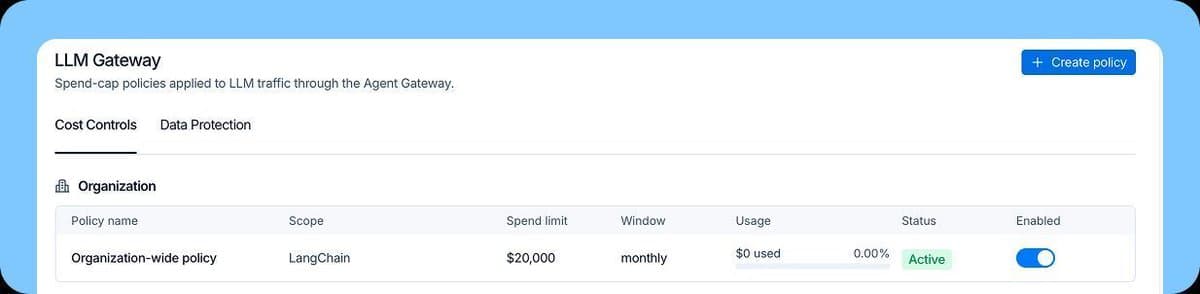
Gateway is LangSmith's governance layer, not another tracing feature. The launch post says the setup is a base URL swap, provider keys move into LangSmith workspace secrets, and policies get configured in the UI.
According to the spend-limits post and the LLM Gateway docs, the concrete controls break down into four buckets:
- Spend limits at the org, workspace, user, or API key level.
- Real-time cost rollups by workspace, user, and API key.
- PII and secrets redaction before requests hit the upstream model.
- Audit logs and trace continuity inside the same LangSmith workspace.
The docs also make the availability line explicit: Gateway is still private beta. They list Anthropic, AWS Bedrock, Baseten, Fireworks, Gemini, Vertex AI, and OpenAI as supported provider paths, and say blocked requests return a 402 when a cap is hit.
Engine
Engine is LangChain's attempt to turn observability into an automated repair loop. the future-of-Engine post describes a system that runs continuously, resolves well-understood issue types without manual triggers, and gradually makes harnesses smarter over time.
The Engine page and the launch steps describe that loop in three stages:
- Detect: analyze production traces, cluster related failures, and prioritize issues.
- Fix: summarize the failure mode, write prompt or code changes, and optionally open a GitHub PR.
- Prevent: generate tests, suggest online evaluators, and recommend examples for offline eval datasets.
That pitch lands because LangChain has a real pain point to point at. In Vtrivedy10's trace-reading post, a team member says he manually read thousands of traces before Engine, and the Listen Labs customer clip frames the product around surfacing systemic issues instead of burying them in raw traces.
Fleet and Deployment
The launch wave was broader than three product pages. Fleet picked up shareable skills, which the skills demo post describes as workspace-level knowledge for specialized tasks, and the linked demo says those skills can start as prompts, templates, or GitHub imports before being shared across agents.
Fleet also picked up stricter access controls for computer use. The access profiles docs say agents can call authenticated external APIs through a proxy that injects headers from OAuth connections or workspace secrets, so credentials do not sit in prompts or model context. the Fleet security post is marketing copy, but the docs spell out the mechanism.
Then there is the deployment path. the deploy-button post says Studio now has a Deploy button, and the deployment quickstart says the same Studio surface stays attached after deploy, with checkpoint replay, state editing, and node-by-node inspection against the live deployment. That is new product surface, not just packaging, and it pushes LangSmith further from "observability tool" into full agent runtime.