
Meta says AIRA3 wins gold, ranks eighth in NVIDIA Kaggle competition
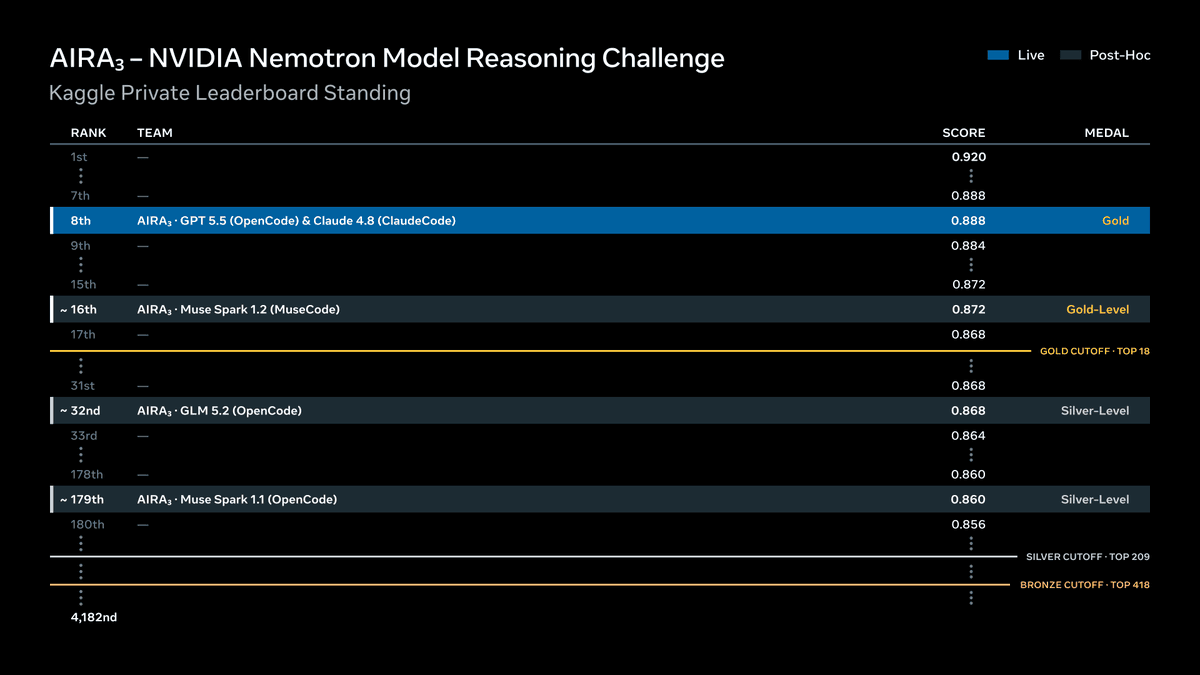
Meta says AIRA3 placed eighth among roughly 4,000 teams in a live NVIDIA Kaggle competition. The system used many long-running agents to fine-tune a 30B Nemotron model on a private test set.
TL;DR
- AIRA₃ placed eighth of roughly 4,000 teams and earned Gold in a live NVIDIA-run Kaggle contest, Meta’s competition report says.
- The reasoning-focused fine-tuning challenge used a 30B Nemotron model and a private external test set, as Meta’s account describes it.
- AIRA₃ coordinates long-running model-and-harness pairs through a forum and shared filesystem, according to Meta’s architecture post.
- The live Gold entry combined GPT 5.5 with OpenCode and Claude 4.8 with Claude Code, while Meta’s model breakdown reports separate post-hoc runs with three other configurations.
The coordination layer is unusually spare: Meta’s description assigns hypotheses and findings to a forum, and solution artifacts to a filesystem. The model list is stranger still: Meta’s follow-up separates the live ensemble from three later configurations scored against the same private test set.
The eighth-place run
Meta says it entered AIRA₃ in June to improve reasoning by fine-tuning a 30B Nemotron model. All teams had the same information, and the competition used external grading on a private test set.
The system reached eighth place and Gold. Meta characterized that result as evidence that AIRA₃ can improve a targeted model capability at a level similar to human experts.
Forum and filesystem
No central controller directs the system. Meta describes many long-running agents, each a model paired with a coding harness, operating in isolated environments and coordinating asynchronously.
Its shared substrates are:
- A forum for hypotheses and findings.
- A shared filesystem for solution artifacts.
Agents choose which discoveries to develop further. Meta says the resulting search strategies emerge dynamically as the accumulated work changes what later agents build on.
The model-and-harness matrix
Meta’s live contest submission used an ensemble of:
- GPT 5.5 with OpenCode.
- Claude 4.8 with Claude Code.
Its post-hoc evaluation ran the same AIRA₃ setup with:
- Muse Spark 1.2 with MuseCode, at Gold level.
- Muse Spark 1.1 with OpenCode, at Silver level.
- GLM 5.2 with OpenCode, at Silver level.
The follow-up confines the eighth-place rank to the live ensemble; the other results were post-hoc submissions on the same privately graded test set. The system therefore evaluates a model-plus-harness recipe, a combination that cwolferesearch highlighted as a path to task-specific specialization.
GPU kernels and Akkadian
Meta says AIRA₃ can shift domains by changing only the task specification. It offered two additional results:
- A 27% latency reduction on production GPU kernels in an internal benchmark.
- Gold-level performance in another Kaggle competition translating 4,000-year-old Akkadian clay tablets into English.
The same post identifies the GPU figure as an internal benchmark and supplies no workload mix or measurement methodology.
The AIRA naming mismatch
A Crypto Briefing report published the same day calls the system AIRA₂ in its headline and body while describing the eighth-place, roughly 4,000-team Kaggle result. Meta uses AIRA₃ in its results post and its architecture post.
Neither account explains the different suffixes.