
METR estimates Anthropic benchmark progress accelerated 1.9×
METR estimates Anthropic's benchmark progress has accelerated 1.9× and judges AI-assisted R&D likely drives most of it. Attribution remains uncertain, and much of the strongest evidence is redacted.
TL;DR
- Anthropic’s benchmark progress accelerated 1.9× after October 2025, with a 95% confidence interval of 1.5–2.8×, according to METR’s analysis.
- AI-assisted R&D likely drives most of the current acceleration, but METR reports substantial uncertainty and no consensus among Anthropic staff about attribution.
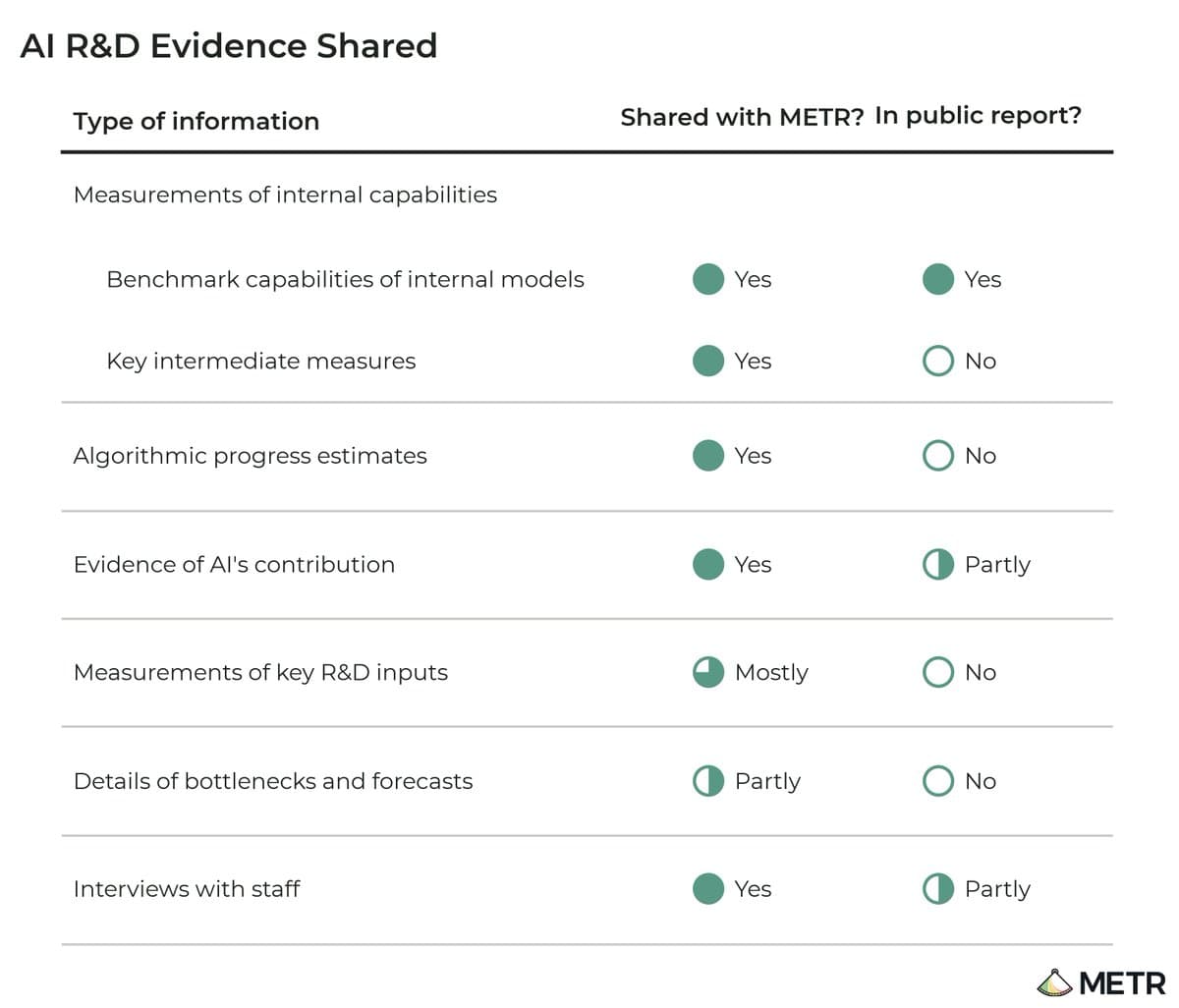
- Anthropic redacted most of the evidence METR considered most informative from its roughly 100-page assessment, the evaluator says.
The public report includes an unreleased “Model 4” and employee productivity polls reaching 12×. A separate review challenges how Anthropic presented its automated-R&D early-warning threshold.
AECI: 15 to 29 points a year
METR’s assessment ran from August 12 to October 29, using internal information across pretraining and reinforcement learning, including algorithmic-progress estimates described in its account of the access. AECI is Anthropic’s adaptation of Epoch’s approach to combining benchmarks of different difficulties into a latent capability estimate.
Including newer unreleased models raised the estimated acceleration from 1.7× in the Haiku 5.5 system card to 1.9× in METR’s assessment. A sustained slope change also predicted later models better than a one-time jump, with held-out error of 1.9 versus 3.9 AECI in METR’s comparison.
For capabilities on well-specified tasks, METR puts its broader judgment at around 2× acceleration and says 1.3–3× would not be surprising. That judgment includes evidence beyond the benchmark fit.
AI attribution and training compute
METR’s rough 80% estimate describes AI’s share of the current acceleration as of October 2026. In its causal assessment, the team considered hiring, compute scaling, data improvements, algorithmic discoveries, and resolved bottlenecks.
Non-AI factors likely contributed substantially in late 2025, and Anthropic staff disagreed about the causes, according to METR’s account. The authors were more confident about excluding faster growth in training compute as the explanation:
Model 4 and hard benchmarks
Model 4 finished training in September–October 2026, according to the internal-model inventory. These labels were supplied to METR and differ from Anthropic’s actual internal codenames.
Its 178.6 AECI score compares with 174.56 for Opus 5.5, a 4.04-point gap, using the matching baseline identified in deredleritt3r’s follow-up correction.
Calibration is becoming the awkward part. Changing the assumed link function between benchmark performance and latent capability moved the estimated acceleration from 1.1× to 2.9× in METR’s robustness analyses.
Research assistance and 12x self-reports
METR’s employee-productivity series combines targeted surveys, adjusted estimates, and informal Slack polls. The report calls the self-reports “only very loose evidence,” noting that the latest polls involved low-effort consideration.
The roughly 12× October figure measures individual self-reported productivity; 1.9× measures the pace of benchmark progress. METR says sustaining faster capability growth requires continued growth in inputs such as labor productivity because of diminishing returns.
The most important model-training contributions still relied on AI assistance, according to METR’s interviews. Researchers also described “signs of life” for fully autonomous contributions, with maturity varying by research area.
To quantify the experimental workflow, eliebakouch asked for:
- Ideas generated per researcher over time.
- Success rates for those ideas.
- Counts and success rates of ideas Claude generates autonomously.
Twelve-month bottlenecks
METR found no convincing bottleneck expected to bind within the next 12 months in four areas identified in its assessment:
- Algorithmic progress.
- Training compute.
- Experiment compute.
- Data.
The team repeatedly changed its understanding as more information arrived, and Anthropic redacted analyses of specific bottlenecks. METR consequently describes further acceleration as a risk with substantial uncertainty.
August risk thresholds
In its separate review of Anthropic’s August risk report, METR examined models deployed internally by July 15. Both teams leaned toward the acceleration threshold remaining uncrossed, but METR thought the public report understated the plausibility that it had been crossed.
The reviewers nevertheless agreed that direct catastrophic risks from automating R&D were low for those models. Even roughly 2× acceleration would likely fall short of what Anthropic’s catastrophic scenarios required, according to METR’s explanation.
Redactions and the canceled compute review
Anthropic said its redactions removed confidential information that could “accelerate other AI developers.” Missing material included detailed estimates of AI’s contribution at different training stages and a forecast for a future model.
Access was request-based: Anthropic could approve or reject requests, and METR did not directly sample the unreleased models. This engagement was separate from the later “employee-like access” assessment, as METR clarified.
Anthropic also canceled a planned verification of the compute split between capabilities and safety before METR reached substantial conclusions. The company said it wanted to keep the pilot focused on risk assessment and would revisit the compute review later.