
MiniMax H3 releases Hugging Face weights and fal video endpoints
MiniMax H3 now has Hugging Face weights, fal endpoints, AI Toolkit LoRA support, and reported single-RTX-5090 local runs. MiniMax also said deployment in the US, EU, UK, and South Korea is available through formal authorization.
TL;DR
- MiniMax shipped H3 weights for a 33B omni-modal video model that outputs 4 to 15 second clips at 24 FPS with 32 kHz stereo audio; MiniMax's release post announced public availability and multimodalart's Hugging Face post pointed to Diffusers and Comfy support.
- The downloadable release stops short of the full quality stack: MiniMax says H3-Context-IR and H3-Regenerate-2K remain API or hosted pieces for now, while kimmonismus called it “open weights” with a closed quality stack.
- Day-zero serving landed across ComfyUI, vLLM-Omni, SGLang Diffusion, and fal; ComfyUI's post listed five workflows and vLLM project's post exposed an OpenAI-compatible video endpoint.
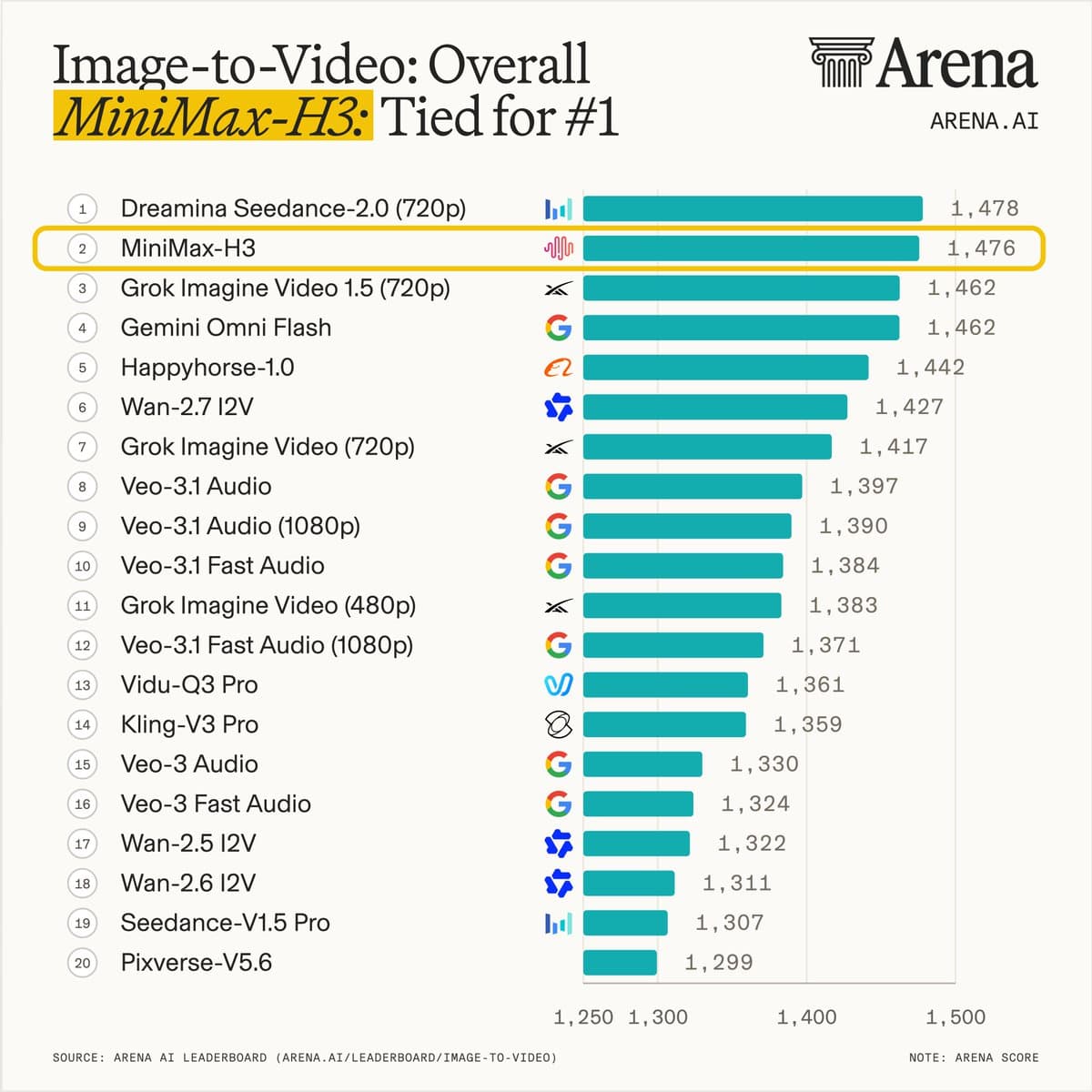
- H3 immediately led open video models in Arena's thread, with Arena's post putting it #1 among open models across text-to-video and image-to-video and Arena's follow-up giving text-to-video a 1,455 score.
- The US/EU/UK/South Korea license panic shifted from “forbidden” to “formal authorization”; ostrisai's license read raised the restriction and MiniMax's reply said organizations can apply for deployment licenses.
The Hugging Face model card says Context-IR performs instruction parsing, cross-modal association, temporal understanding, and logical reasoning before H3-Base sees the prompt. ComfyUI's day-zero blog says modulation-weight pruning plus int8 convrot quantization cut the smallest local footprint from 123.6 GB to 42.5 GB. vLLM's MiniMax H3 recipe says H3 is served from a local FL2VA or Ref2VA partition, not the Hugging Face ID directly. The license Q&A says the API is globally available while open weights are region-limited pending compliance review.
Hugging Face weights
MiniMax's official release describes H3 as a general-purpose omni-modal generation system for text, images, video, and audio in one context. The published specs are short enough to keep as a reference table.
The model card splits the release into two BF16 task families:
H3-Base-FL2VA: text-to-audio-video, plus first-frame, last-frame, or first-and-last-frame conditioning.H3-Base-Ref2VA: reference-to-audio-video with multimodal reference inputs.- Reference limits: up to 9 images, up to 3 video clips, up to 3 audio clips, and 12 mixed files total.
- Video and audio references must be 2 to 15 seconds, with 15 seconds total duration per reference type.
- Audio cannot be the sole reference input in the official Ref2VA spec.
Hosted Context-IR
The open-weight boundary is the important engineering detail. The model card says the complete H3 system has three modules:
H3-Context-IR: hosted preprocessing and orchestration that converts free-form multimodal inputs into Context Intermediate Representation.H3-Base: local 768p audio/video generation from Context-IR output.H3-Regenerate-2K: 768p-to-2K regeneration using the original context plus the low-resolution result.
Context-IR “relies on a multi-stage workflow and multiple hosted models and services,” according to the model card, so it is outside the open-source release. H3-Regenerate-2K is also outside the initial release, with MiniMax saying the full 2K workflow combines the Open Platform API with a locally deployed H3-Base.
The architecture notes bury two more constraints. H3-Base uses Qwen3-VL-32B as its encoder and passes layer-50 hidden states into the H3-Omni-Transformer, while sparse-attention inference is described as native but absent from the initial open-source drop.
Day-zero serving
The rollout had a real serving stack on day zero, which is Christmas come early for local video nerds.
- ComfyUI listed text-to-video, image-to-video, first-and-last-frame control, reference-to-video, and in-place editing in its launch post.
- vLLM-Omni serves H3 through an OpenAI-compatible
/v1/videosendpoint, with synchronous and async job polling described in vLLM's video API docs. - vLLM's MiniMax H3 recipe says one server process loads one partition, so FL2VA and Ref2VA are separate served paths.
- SGLang Diffusion surfaced NVIDIA, AMD, and RTX 5090 configurations in its MiniMax-H3 cookbook, while lmsysorg's post claimed local runs on 2 RTX 5090s or one RTX 6000.
- MiniMax amplified vLLM-Omni as step two after open weights, with its vLLM-Omni post calling out the OpenAI-compatible video endpoint.
fal endpoints
fal exposed H3 as three developer-facing endpoints on day zero:
- fal's text-to-video endpoint generates 2K MP4 clips from text prompts, with 5 to 15 second output windows.
- fal's image-to-video endpoint animates a single image or transitions between first and last frames.
- fal's reference-to-video endpoint accepts up to 9 images, 3 video clips, and 3 audio clips as references.
The fal endpoint summaries put 2K output at about $0.26 per second. The same summaries list image input as free, audio references as free, the first 5 reference images as free, each additional reference image at $0.08, and reference video at $0.26 per second.
Local hardware
MiniMax pushed the single-RTX-5090 angle immediately, and kimmonismus's overview said early 5090 tests produced five seconds at native 768p-class resolution in roughly 5.5 minutes with an optimized stack around 40 GB using dynamic RAM/SSD offload.
ComfyUI's day-zero blog gives the clearest local-inference trick list:
- Modulation weights, roughly 40% of parameters, pruned and replaced with a lookup table.
- int8 convrot quantization.
- Custom kernels to reduce peak VRAM.
- Dynamic VRAM offloading.
- Full-precision footprint reduced from 123.6 GB to 42.5 GB for the smallest model variants.
vLLM's single-GPU path uses model-level CPU offload so the Qwen3-VL encoder and DiT are not resident on the GPU at the same time. SGLang's cookbook lists RTX 5090 as a supported 32 GB consumer target and exposes layerwise offload as the relevant profile.
Video Arena scores
Arena put H3 at the top of the open-model video field in its launch thread.
- Overall open-model position: #1 across text-to-video and image-to-video, more than 280 points over Hunyuan Video 1.5, according to Arena's thread.
- Image-to-video: 1,476 points, 2 points behind Dreamina Seedance 2.0 at 1,478, according to the same thread. The public Image-to-Video leaderboard also lists
minimax-h3at 1,476±19 with the MiniMax H3 community license. - Text-to-video: 1,455 points, 3 points behind Muse Video at 1,458, according to Arena's follow-up.
- Previous MiniMax baselines in the thread were far lower: Hailuo-2.3 at 1,199 in the overall comparison and 1,260 in text-to-video, plus Hailuo-02-pro at 1,197 overall and 1,228 in text-to-video.
LoRA training
Ostris AI Toolkit added MiniMax H3 LoRA training support within the same release wave. The AI Toolkit commit added 4,096 lines across 28 files, including MinimaxH3Model, an extension package, and H3 entries in the diffusion-model registry.
The first pass is narrow. ostrisai's post says only text-to-video and image-to-video are supported for now, with reference support and more optimizations planned.
The replies are more useful than the announcement:
- Requirements depend heavily on video length and resolution, according to ostrisai's requirements reply.
- Experimental image-path support exists, but ostrisai's image-path reply says the model “doesn't really have an image path.”
- A quantization warning was just a small skipped layer, according to ostrisai's quantization reply.
Regional license gate
The license debate started with ostrisai's read that the public license barred use, and even downloading, in the USA, EU, UK, and Korea. MiniMax answered that deployment in those regions can be licensed through a formal authorization process, according to its reply.
The MiniMax license Q&A gives the split: API access is globally available with MiniMax-operated safeguards, while open weights are temporarily region-limited because independently deployed video models create different compliance problems.
The same Q&A says organizations in restricted regions can apply for a formal license after MiniMax reviews the deployment scenario and compliance controls. It also cites the EU AI Act, UK and South Korea regulatory uncertainty, US AI regulation, and MiniMax's ongoing US copyright-related legal proceedings around generative video AI.