
Posts cite Korean reporting: NVIDIA claims HBM4 supply for Vera Rubin from Samsung, SK hynix, Micron
Posts citing Korean reporting said NVIDIA qualified HBM4 from Samsung, SK hynix, and Micron for Vera Rubin and expanded memory co-design with SK hynix. The supply detail matters because HBM4 availability is the constraint behind next-generation AI systems.
TL;DR
- rohanpaul_ai's post said NVIDIA has now qualified HBM4 from Samsung, SK hynix, and Micron for Vera Rubin, a claim that lines up with a Bloomberg report mirrored by Yahoo Finance and Korean outlet iNews24.
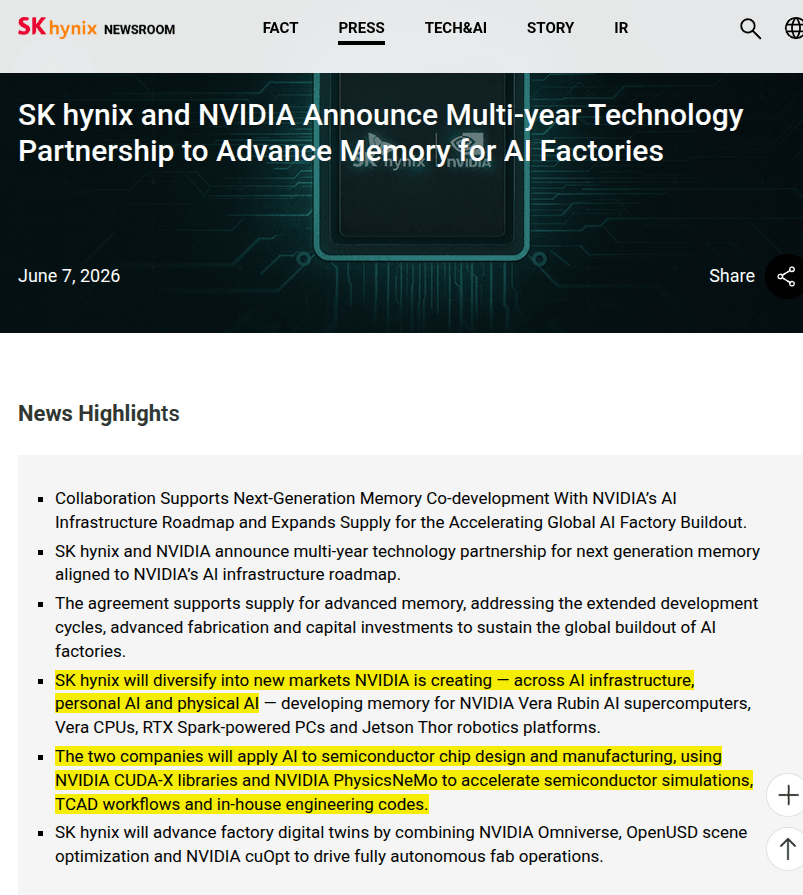
- rohanpaul_ai's thread also pointed to a new NVIDIA and SK hynix multiyear pact, which NVIDIA's newsroom and SK hynix's own announcement describe as joint memory codevelopment across Vera Rubin, Vera CPUs, RTX Spark PCs, and Jetson Thor systems.
- According to NVIDIA's announcement, the deal is not just about supply, because it also pulls NVIDIA software into chip design and fab operations through CUDA-X, PhysicsNeMo, Omniverse, OpenUSD, and cuOpt.
- The Korea JoongAng Daily added another useful detail: Samsung said it is already supplying HBM4 for Vera Rubin and discussing HBM4E and HBM5 with NVIDIA.
You can read NVIDIA's release, compare it with SK hynix's version, and then check how Korean reporting framed Jensen Huang's airport remarks about all three HBM4 vendors being qualified and already in production. The Korea JoongAng Daily also surfaced the next step in plain language, with Samsung talking publicly about HBM4E and HBM5 talks the same day.
HBM4 qualification
The core supply-chain reveal is simple: Jensen Huang said Samsung, SK hynix, and Micron have all qualified for Vera Rubin HBM4, and that all three are already producing parts, according to iNews24's Korean report and Bloomberg's Yahoo Finance mirror.
That matters because the HBM4 story had been drifting toward a single-winner narrative. Instead, the reporting now points to a three-vendor supply pool for Vera Rubin, even if rohanpaul_ai's summary says SK hynix still holds the largest share at roughly 60 to 70 percent, with Samsung at 25 to 30 percent and Micron taking the rest.
SK hynix co-design
NVIDIA and SK hynix turned the memory relationship into a formal multiyear codevelopment deal on June 7. In NVIDIA's newsroom post, the named targets are broader than GPU servers:
- Vera Rubin AI supercomputers
- Vera CPUs
- RTX Spark-powered PCs
- Jetson Thor robotic platforms
The interesting bit is timing. NVIDIA's statement says advanced memory now needs such long development cycles, fabrication planning, and capital investment that it has to be aligned with the infrastructure roadmap years in advance, which is much closer to platform code design than to ordinary component sourcing.
Fab digital twins
The last reveal sits outside the usual HBM supplier story. Both NVIDIA's release and SK hynix's announcement say the companies will use NVIDIA software inside semiconductor engineering and fab operations.
The announced stack breaks down into a few concrete pieces:
- CUDA-X libraries for semiconductor simulations and in-house engineering code
- PhysicsNeMo for AI-assisted physics and TCAD workflows
- Omniverse plus OpenUSD for fab digital twins
- cuOpt for factory logistics and autonomous operations
That pushes the partnership past memory supply and into how future memory gets designed, simulated, and tuned on the factory floor itself.