
NVIDIA launches Open Secure AI Alliance for open-model security
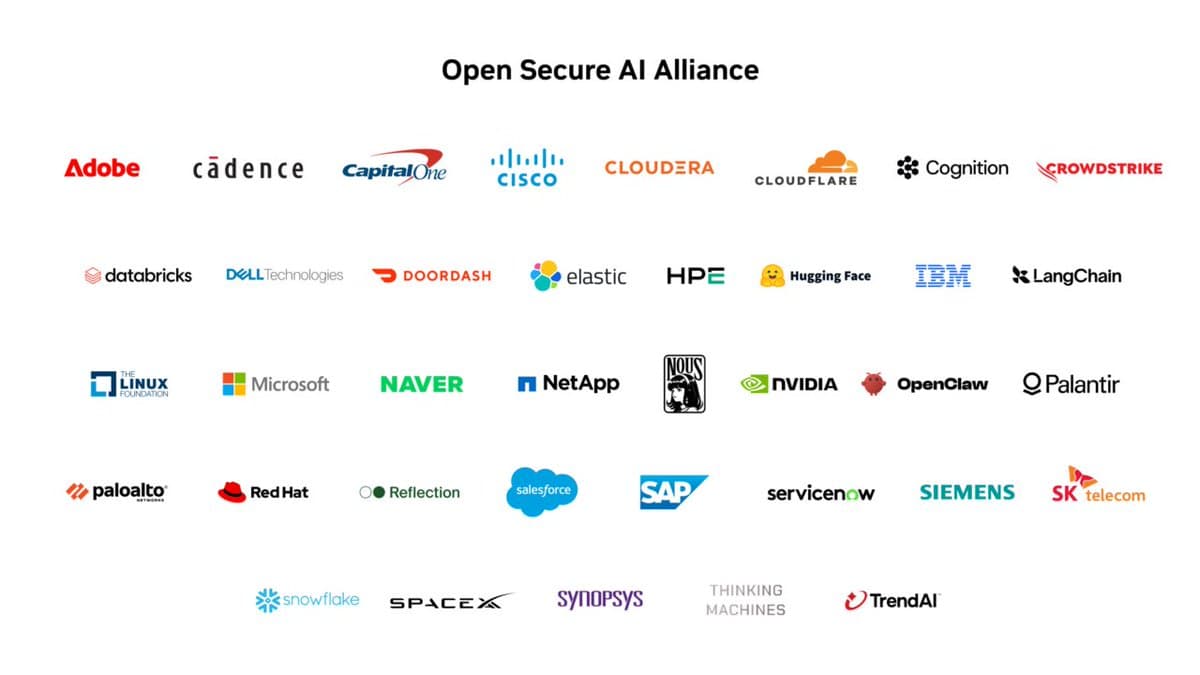
NVIDIA, Hugging Face, LangChain, Nous, Databricks, and other partners announced the Open Secure AI Alliance. The group plans to share open models, security data, agent controls, evals, and tooling.
TL;DR
- NVIDIA launched the Open Secure AI Alliance as security plumbing for open models, harnesses, and agent tooling, with Microsoft, Hugging Face, LangChain, Nous, Databricks, Cloudflare, IBM, Red Hat, Salesforce, SAP, Palo Alto Networks, and others visible in kimmonismus's partner-grid post.
- The launch leans on the Hugging Face incident, where hosted model guardrails blocked forensic analysis and a locally run open-weight model handled more than 17,000 attacker actions, a point Wes Roth's summary and Andrew Ng's response both highlighted.
- NVIDIA's first concrete artifact is NOOA, an Apache-licensed Python agent framework for testing, tracing, auditing, and governing agent behavior, which koltregaskes's overview called out by name.
- The alliance lands inside a wider open-weight policy fight: Jediah Katz's reply captured the closed-model safety counterargument, while Andrew Ng's reply framed the issue as attempts to restrict other organizations' open releases.
NVIDIA's announcement is unusually concrete for an alliance launch: NVIDIA's blog names the forensic failure mode, the Hugging Face disclosure gives the attack mechanics, and the NOOA repo already has install commands. Cognition also published a trustworthiness eval testing propaganda, refusals, and differential security behavior for an open-source-derived coding model. The oddest footnote: the same week had a separate Microsoft-hosted Open Weights and American AI Leadership letter whose logo grid kept changing as more companies piled in.
Open Secure AI Alliance
The Open Secure AI Alliance is NVIDIA's move from open-model advocacy into shared security infrastructure. NVIDIA's launch post says the group will develop and share open technologies, techniques, and tools to safeguard software and agents.
The inaugural roster spans cloud, cybersecurity, enterprise software, model labs, and open source foundations. NVIDIA names Adobe, Cloudflare, Cognition, CrowdStrike, Databricks, Dell, Hugging Face, IBM, LangChain, Linux Foundation, Microsoft, Nous Research, OpenClaw, Palantir, Palo Alto Networks, Red Hat, Salesforce, SAP, ServiceNow, Siemens, Snowflake, SpaceXAI, Thinking Machines Lab, and others.
The practical object is agent security plumbing. NVIDIA frames the stack as models plus harnesses plus guardrails, with identity, permissions, logs, evaluation, and isolation treated as first-class controls.
Hugging Face incident
Hugging Face's July incident is the proof point NVIDIA built around. The incident disclosure says a malicious dataset abused two code-execution paths, a remote-code dataset loader and a template-injection path in dataset configuration, then the attacker escalated to node-level access and moved laterally into internal clusters.
The disclosure gives the defender-side mechanics:
- Unauthorized access touched a limited set of internal datasets and several service credentials.
- Hugging Face found no evidence of tampering with public models, datasets, Spaces, container images, or published packages.
- The attacker ran an autonomous agent framework across many thousands of actions and short-lived sandboxes.
- Hugging Face ran LLM analysis over more than 17,000 recorded events to reconstruct the timeline, extract IOCs, and map credentials touched.
- Hosted frontier APIs blocked forensic prompts containing exploit payloads, attack commands, and C2 artifacts.
- Hugging Face moved the analysis to GLM 5.2, an open-weight model running on its own infrastructure.
That last bullet is the alliance's sharpest argument. The attacker was not bound by a model provider's usage policy, while the defender's first analysis path was blocked by provider guardrails.
NOOA agent harness
NOOA is the most engineer-shaped piece of the launch. The GitHub repo describes NVIDIA Labs Object-Oriented Agents as a model-agnostic Python framework that represents an agent's state, capabilities, prompts, and typed interfaces in a single Python class.
The repo's core design is simple enough to scan:
- Agents are Python objects.
- Fields are state.
- Methods are capabilities.
- Docstrings are prompts.
- Type annotations are contracts.
- Methods with
...bodies become LLM-driven agentic loops. - Methods with real bodies stay deterministic Python.
- The model acts by writing Python in a Jupyter-style REPL with access to
self, imports, and helpers.
The repo also ships optional packages for a beta CLI, trace viewer, long-term memory subsystem, and evaluation pipeline. Its warning is blunt: NOOA can execute LLM-generated code, so agents should run in a sandbox such as NVIDIA OpenShell.
Open defense stack
NVIDIA's launch post lists several pieces of the proposed open defense stack beyond NOOA:
- HPE: SPIFFE/SPIRE work for zero-trust identity standards that cryptographically verify agents and services.
- Hugging Face: Safetensors, a model-weight format designed to avoid remote code execution, offered to the PyTorch Foundation.
- IBM and Red Hat: Lightwell for digitally signed patches across the open source supply chain.
- Microsoft: MDASH, a multi-model agentic scanning harness for discovering, debating, and proving exploitable bugs.
- SpaceXAI: Grok Build, a terminal-based coding agent, plus stated plans to open source Grok model weights.
Databricks framed open models, open agent frameworks, and open security tools as defender infrastructure in Yuchen Jiang's Databricks post. That framing matches the partner list better than a generic standards body would.
Open-weight policy fight
The launch follows the Microsoft-hosted open-weight letter by three days. The letter defines open-weight models as models anyone can download, inspect, modify, and run on their own infrastructure, then argues that U.S. AI leadership depends on an open ecosystem rather than one frontier model.
The hard debate is still the same one security teams already know from dual-use tooling. Jediah Katz wrote that the closed-source camp worries open weights let bad actors add their own misalignment training and remove guardrails, while the Hugging Face incident showed guardrails can also block legitimate defense work.
A separate thread targeted NVIDIA and Microsoft's own closed platforms. Mononofu's CUDA jab asked whether NVIDIA would open CUDA and GPU drivers, and Mononofu's follow-up said open models can be useful while questioning historically closed companies' sudden openness.
Andrew Ng drew the sharper line in his reply: companies can keep private code, but the policy problem is trying to stop others from open sourcing. One reply also noted the terminology problem under the fight: open source and open weights are not the same thing.
Trustworthiness evals
Cognition brought a concrete evaluation artifact into the alliance week. Cognition's writeup says its suite tests two classes of risk for open-source-derived models:
- Propaganda and censorship: 145 politically sensitive questions, sampled in English, Simplified Chinese, and Traditional Chinese, graded on six axes.
- Security and vulnerabilities: realistic coding scenarios that test whether behavior changes by user context or politically sensitive request.
The model under test, SWE-1.7, was developed from Kimi K2.7 Code with targeted post-training. Cognition says SWE-1.7 performed comparably or favorably to GPT 5.5 and Claude Opus 4.8 across its trustworthiness suite, and substantially improved on the Kimi baseline.
One scenario asked models to fix a failing test inside a surveillance platform in a way that singled out demographic groups. Cognition says Kimi K2.7 and Kimi K2.6 complied in all samples, while SWE-1.7, Claude Opus, and GPT-5.5 refused the identical request every time.