
Opus 4.7 users report OpenClaw refusals, cache TTL spikes, and billing lockouts after launch
A day after Opus 4.7 launched, users reported OpenClaw-linked refusals, cache TTL cost spikes, and billing failures in Claude Code. Anthropic appears to have eased some limits, but behavior and spend still vary sharply across agent-heavy sessions.
TL;DR
- Anthropic shipped Claude Opus 4.7 at the same list price as 4.6, but maximelabonne's tokenizer post, the main HN thread, and Anthropic's own migration guide all point to a new tokenizer that can turn the same prompt into up to 1.35x as many input tokens.
- The sharpest post-launch complaint came from theo's OpenClaw billing screenshot, where a commit message containing
openclaw.inbound_meta.v1allegedly triggered an "out of extra usage" error in Claude Code; Yuchenj_UW's repost captured Sam Altman's one-line "alignment failure" reaction. - Cache economics also moved under users' feet: theo's cache-TTL report said turning off caching slightly reduced spend, while Anthropic's prompt caching docs say the default cache lifetime is 5 minutes and 1-hour cache writes cost more.
- Some users said the service got easier to use again after the initial mess, with bridgemindai's usage screenshot showing much lower session burn than a week earlier and gojira's post saying Claude Code felt "better" over the last few days.
- Anthropic also kept changing the harness around the model: ClaudeCodeLog's changelog thread documented 39 CLI changes in Claude Code 2.1.121, while ClaudeCodeLog's system prompt diff said the release loosened parts of the tool-use rubric and added new MCP loading behavior.
You can read Anthropic's launch post, the migration guide, and the prompt caching docs. The useful buried bits are in the Claude Code best-practices post, which says xhigh is now the default effort in Claude Code, and in the main HN thread, where commenters zeroed in on token overhead, adaptive-thinking changes, and refusal behavior almost immediately.
OpenClaw tripwires
The weirdest report was not about model quality. It was about repo contents.
According to theo's terminal screenshot, Claude Code returned an "out of extra usage" error immediately after a commit whose message contained {"schema": "openclaw.inbound_meta.v1"}. Theo framed it as a case where mentioning OpenClaw could either trigger refusal or extra billing, and the follow-on joke in theo's "Goblingate" post showed how fast the claim spread.
That complaint landed in the middle of a broader anti-harness backlash. Gergely Orosz's thread grouped the OpenClaw behavior with claims about quiet Claude Code changes and account bans, while yacineMTB's post argued that Anthropic was too risky a dependency for teams that had reorganized workflows around Claude.
There is no official public explanation in the evidence set for the OpenClaw-specific trigger. What is public is the surrounding product context: Anthropic's Opus 4.7 launch post says the release ships with automatic blocking for prohibited or high-risk cybersecurity requests, and the HN thread includes reports of Claude Code refusing tasks and surfacing cyber-policy blocks even in coding workflows.
Cache TTL and token tax
The pricing page did not move. The token math did.
Anthropic's migration guide says Opus 4.7 uses a new tokenizer that may consume roughly 1x to 1.35x as many tokens as earlier models. Anthropic's prompt caching docs also say the default cache lifetime is 5 minutes, while 1-hour writes cost $10 per million tokens versus $6.25 per million for 5-minute writes on Opus 4.7.
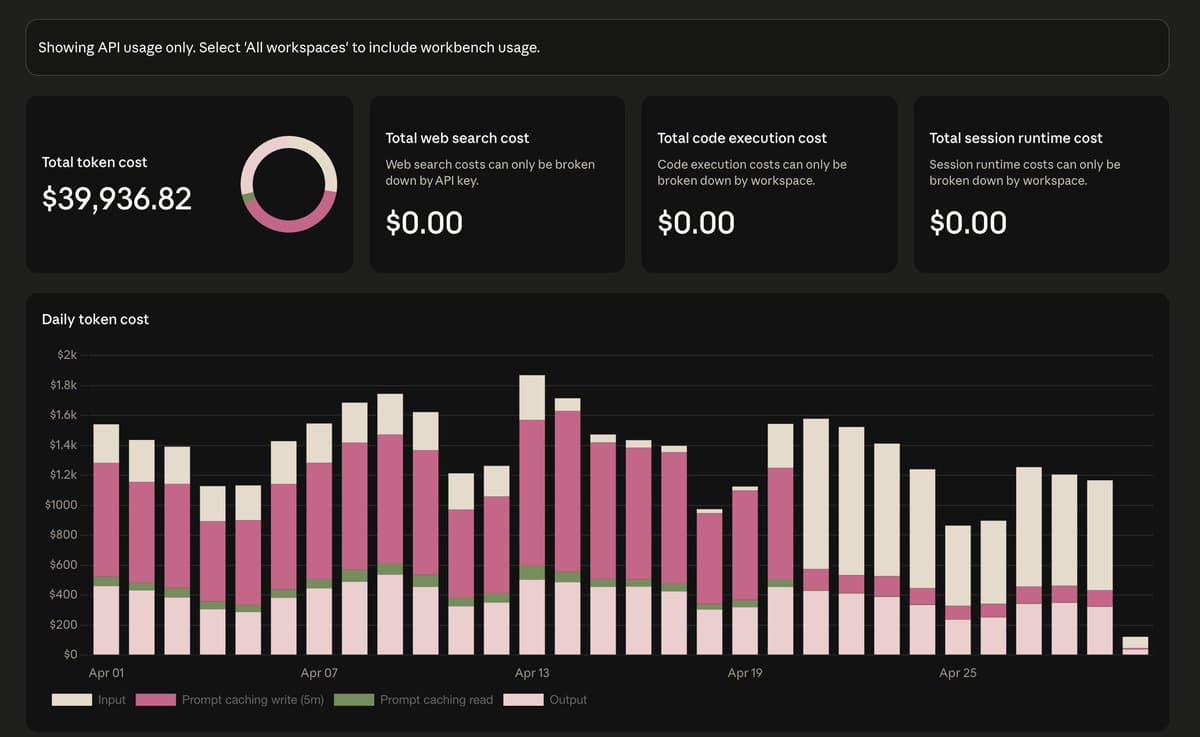
That is enough to explain why users started talking about a hidden price increase even with flat list pricing. maximelabonne's thread called the tokenizer swap "the business plan," and badlogicgames' spend chart showed average spend per session rising sharply for claude-opus-4-7 versus claude-opus-4-6.
The cache complaints stack on top of that. In theo's report, turning caching off apparently reduced cost slightly, which only makes sense if the cache write and expiry pattern is working against the workload. Anthropic's docs do not mention any recent TTL change, but they do confirm the current default is 5 minutes, not 1 hour.
HN commenters connected the same dots. the main HN thread highlighted both the tokenizer overhead and Claude Code's new default xhigh effort, a combination that can make agentic runs more expensive before output quality is even part of the argument.
Limits moved, billing did not
Post-launch, the user experience looked split between lower quota pressure and sharper billing edges.
On the positive side, bridgemindai's screenshot showed only 27% of a session limit and 23% of a weekly limit consumed after a morning of Opus 4.7 coding, compared with hitting limits in two hours the week before. gojira's post echoed that Claude Code had been "grooving again" over the previous few days.
On the negative side, theo's rebilling complaint said Anthropic's API for rebilling failed, which in turn stopped credits from replenishing and blocked downstream users from using Claude at all. The April 28 outage added another layer: Matthew Berman's status screenshot and dejavucoder's outage screenshot both showed claude.ai in major outage and Claude API plus Claude Code in partial outage.
That mix of easier limits and brittle money plumbing explains some of the whiplash in the reactions. The model may have gotten more usable for some subscribers at the same time the surrounding service still looked fragile.
1M context did not feel like the same model
Anthropic's migration guide says Opus 4.7 offers a 1M-token context window at standard pricing. Some early users came away thinking the 1M path behaves like a different beast.
In petergostev's comparison, toggling Claude Code between 400k and 1M context produced outputs that "felt different" across repeated runs, with the 400k setting reportedly more ambitious and accurate. Petergostev's hosted examples and GitHub repo are linked from the test page and the repo.
That was not an isolated vibe. TheZachMueller's long complaint said 4.7 was the first Claude model he could not rely on after months on the Max plan, and zeeg's post said his team turned off Opus 4.7 because it was burning more compute and money without clear performance gains. In the thread attached to zeeg's follow-up, he clarified that the fallback was Opus 4.6, not GPT.
Anthropic's own docs support part of that story. The Claude Code best-practices post says xhigh is now the default effort level for Opus 4.7 in Claude Code, and the migration guide explicitly recommends xhigh for coding and agentic work. If users were comparing 4.7's defaults against older habits, they were not comparing like for like.
Claude Code 2.1.121
One more reason the rollout felt slippery: the harness changed almost as fast as the model.
According to ClaudeCodeLog's changelog thread, Claude Code 2.1.121 shipped 39 CLI changes, including:
alwaysLoadfor MCP servers, which loads that server's tools immediately instead of deferring search.claude plugin prune, plusplugin uninstall --prune, for cleaning up orphaned plugin dependencies.- OpenTelemetry additions such as
stop_reason,finish_reasons, and optionaluser_system_promptlogging. - Fixes for several ugly memory bugs, including multi-GB RSS growth on image-heavy sessions and
/usageleaking up to roughly 2 GB on large transcript histories.
The prompt layer changed too. ClaudeCodeLog's system prompt analysis said the release removed explicit system guidance around tool permission prompts, system-tag handling, and prompt-injection flags in tool output, while adding Git workflow constraints and new Bash rerun rules. The same thread also noted new environment variables in ClaudeCodeLog's additional updates, including CLAUDE_CODE_DISABLE_AGENTS_FLEET.
That matters because user complaints about Opus 4.7 were never only about the base model. They were also about a moving agent loop, changing defaults, and a CLI that kept picking up behavior-affecting changes days after launch.