
Qwen3.6-27B releases with 77.2 SWE-Bench Verified and Apache 2.0
Alibaba released Qwen3.6-27B, a dense open model with multimodal input and thinking or non-thinking modes that beats Qwen3.5-397B-A17B across major coding benchmarks. Day-one support across vLLM, SGLang, Ollama, llama.cpp, GGUF, and MLX makes it ready for local and hosted coding agents.
TL;DR
- Alibaba_Qwen's launch thread introduced Qwen3.6-27B as an Apache 2.0 dense open model with thinking and non-thinking modes, while Alibaba_Qwen's multimodal post says the same checkpoint handles text, images, and video.
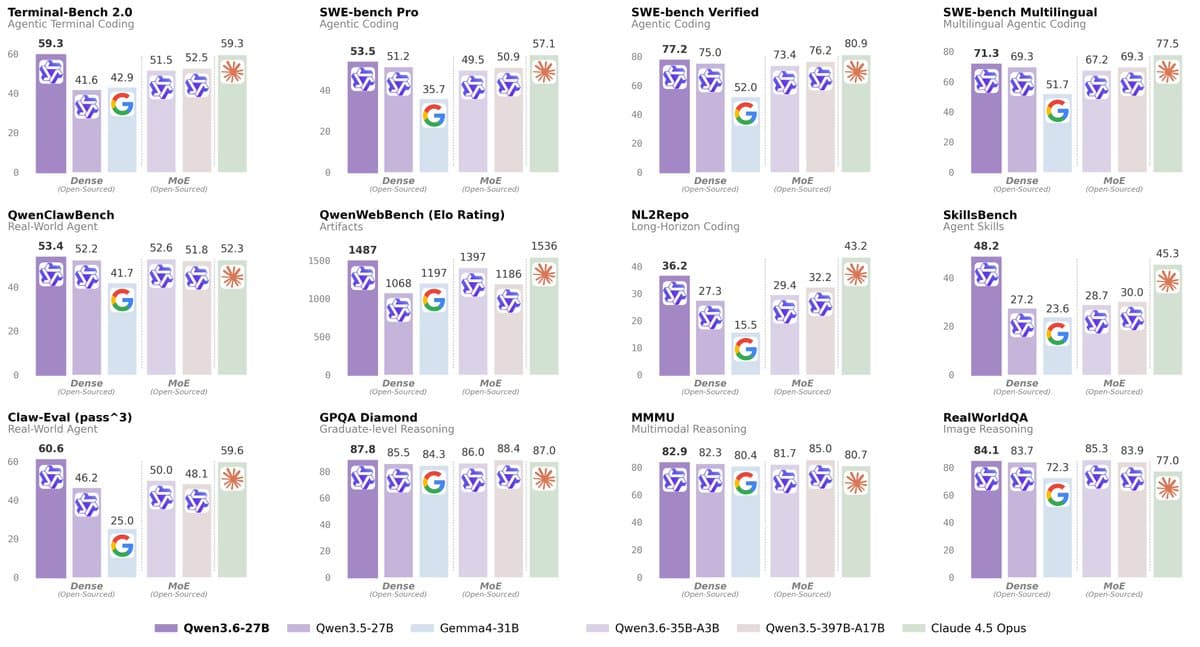
- On Qwen's own coding chart, Alibaba_Qwen's benchmark post puts SWE-Bench Verified at 77.2 versus 76.2 for Qwen3.5-397B-A17B, SWE-Bench Pro at 53.5 versus 50.9, Terminal-Bench 2.0 at 59.3 versus 52.5, and SkillsBench at 48.2 versus 30.0.
- The rollout landed with unusual day-zero coverage: vllm_project's support post, lmsysorg's SGLang post, and ollama's availability post all shipped same-day integrations.
- Local packaging showed up just as fast, because UnslothAI's GGUF post said the model can run in 18GB RAM, while ggerganov's llama.cpp command post and simonw's local test showed immediate local use.
- Early reaction split between excitement and benchmark skepticism: bridgemindai's critique called the coding numbers a sign of benchmaxing, while petergostev's BullshitBench update said reasoning-heavy settings hurt Qwen3.6-Plus on that separate benchmark.
You can read the official blog post, browse the GitHub repo, and pull the Hugging Face weights. The day-one serving trail is already broad, with vLLM recipes, an SGLang cookbook, and an Ollama model page. For local tinkerers, Simon Willison's write-up includes a full llama-server transcript and token-speed numbers.
What shipped
Qwen positioned the release as a 27B dense model aimed at coding first, not as another giant MoE flex. The official launch materials pair four claims in one package: Apache 2.0 licensing, agentic coding focus, unified multimodal input, and a switch between thinking and non-thinking modes.
The multimodal bit is more concrete than the headline makes it sound. According to Alibaba_Qwen's multimodal post, the same checkpoint handles vision-language thinking and non-thinking, plus document understanding, visual question answering, and video alongside text.
The release also landed across the usual official surfaces on day one: the Qwen Studio model page, the GitHub repo, Hugging Face weights, and an FP8 variant.
Benchmarks
Qwen's strongest hook is that a 27B dense model beat its older 397B total, 17B active MoE flagship on every coding benchmark it highlighted.
- SWE-Bench Verified: 76.2 to 77.2, +1.0 point, per Alibaba_Qwen's benchmark post
- SWE-Bench Pro: 50.9 to 53.5, +2.6 points, per Alibaba_Qwen's benchmark post
- Terminal-Bench 2.0: 52.5 to 59.3, +6.8 points, per Alibaba_Qwen's benchmark post
- SkillsBench: 30.0 to 48.2, +18.2 points, per Alibaba_Qwen's benchmark post
The SWE-Bench screenshot in the Hugging Face repost also placed Qwen3.6-27B at 77.2 on the public Verified leaderboard, ahead of Qwen3.5-397B-A17B at 76.4 and MiniMax-M2.5 at 75.8. That is the number likely to travel furthest, because it compresses the whole pitch into one line: smaller dense model, bigger coding score.
Day-one inference
This shipped with the kind of serving coverage that usually takes a week. vllm_project's day-zero post linked a recipe page whose screenshot exposed several practical details at once: 262,144 context, BF16 and FP8 variants, tool calling, reasoning support, and a vllm serve command that includes --enable-auto-tool-choice, a qwen3_coder tool parser, and a qwen3 reasoning parser.
SGLang matched it the same day through its cookbook page, and ollama's availability post pushed the model straight into Ollama with examples for plain chat, OpenClaw, and Claude Code launches. The result is less "weights are out" and more "the harness already exists."
Local runs
The local story is half the appeal here. UnslothAI's post said Dynamic GGUFs bring the model down to an 18GB RAM target, and UnslothAI's MLX follow-up added macOS MLX quants plus BF16 and Q8 uploads.
The ecosystem moved fast enough that a one-line llama.cpp invocation appeared from ggerganov's post, while ollama's launch post made the model available under ollama run qwen3.6:27b.
Simon Willison's blog post adds the most useful concrete datapoint from outside the vendor orbit: he ran the 16.8GB Q4_K_M quant locally with llama-server, generated a 4,444-token SVG transcript in 2 minutes 53 seconds, and reported 25.57 tokens per second during generation. His tweet in simonw's local SVG test is goofy, but the linked write-up is the rare launch-day post with an actual transcript and runtime numbers.
Modes and multimodality
Qwen is pushing a unified checkpoint story here, not a separate coder model beside a separate vision model. According to Alibaba_Qwen's post, Qwen3.6-27B supports both vision-language thinking and non-thinking modes inside one checkpoint, and it handles images and video as inputs.
The vLLM recipe screenshot in vllm_project's support post lines up with that framing. Its interface tags the model as dense, multimodal, and 262K context, then exposes reasoning and tool-calling toggles as first-class serving features rather than awkward extras.
That combination matters mostly because it narrows the gap between "good local coder" and "general-purpose local agent." Qwen's own materials are selling both at once.
Benchmark caveats
The loudest pushback showed up almost immediately. In bridgemindai's critique, the argument was not that Qwen's scores were fake, but that the benchmarks themselves are getting overfit badly enough for a laptop-runnable model to nearly match frontier closed models on agentic coding charts.
A second caveat came from petergostev's BullshitBench update, which was about Qwen3.6-Plus rather than 27B but still cuts against the easy "more reasoning, better model" read:
- Qwen3.6-Plus improved from 69% to 72% pushback without reasoning, per petergostev's BullshitBench update
- The same post says Qwen3.6-Plus dropped to 59% at xhigh reasoning, versus 78% for Qwen3.5 397B with high reasoning
- The underlying data viewer and code are public through the BullshitBench viewer and the GitHub repo
That does not refute Qwen's launch benchmarks. It does add one useful constraint: the release landed into a community that now treats benchmark wins and reasoning-mode gains as separate claims, not one bundled fact.