
Qwen releases Qwen3.8-Flash open weights: 125B MoE with 262K context
Qwen released Qwen3.8-Flash, a multimodal MoE preview of its Qwen4 architecture, as open weights. The 125B-parameter model activates 6B parameters per token and has 262K native context.
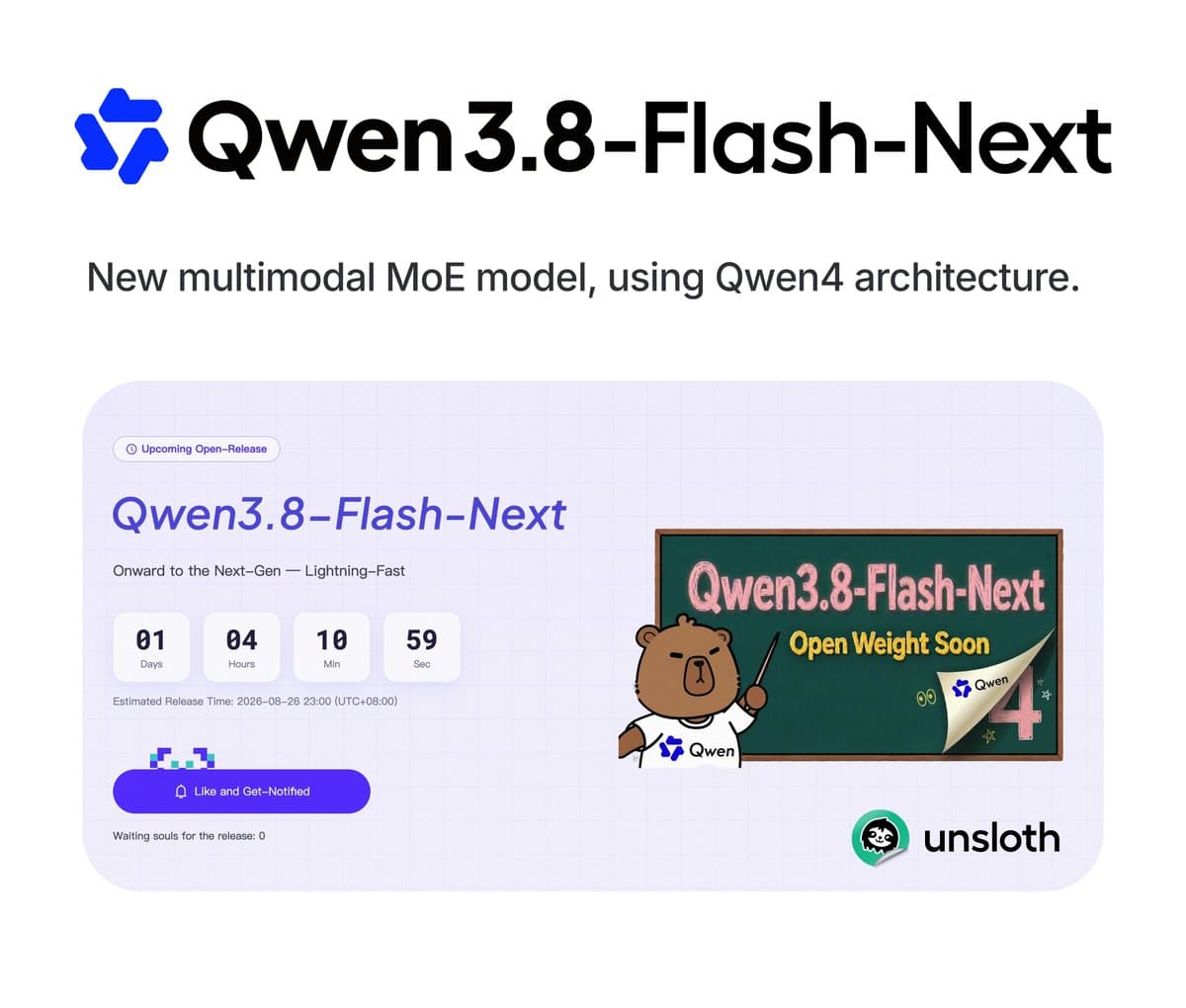
TL;DR
- Qwen's open-weight artifact is Qwen3.8-Flash-Next, an experimental Qwen4 architecture preview, while the production Qwen3.8-Flash API is a related version with 1M context by default and built-in tools, according to Qwen's model card.
- The checkpoint combines a 125B MoE main model with 6B active parameters, a 51B n-gram table, a 4B MTP head, and 262,144 native context, as [Qwen's release post] Qwen's release post and model card describe.
- Its main efficiency bet is a 3:1 Gated DeltaNet and Qwen Sparse Attention layout. Qwen reports up to 7.6x faster prefill, 4.9x faster decode, and 8.6x the Qwen3.7-Plus prefill throughput at 1M context with 90% prefix-cache hits Qwen's throughput post.
- Qwen's technical report says the model led its 397B predecessor on 8 of 14 pretraining benchmarks while using one-third the activated parameters and roughly one-ninth the training FLOPs technical report abstract.
- Open weights still require serious memory: Unsloth lists 75GB for its smallest 1-bit quant and 355GB for BF16 Unsloth's local-run guide.
The model card quietly treats the 51B n-gram table as an offloadable memory tier, not ordinary active compute. NVIDIA's deployment write-up reports more than 16K tokens per second per GPU on GB300 NVL72, while RAMGPT's implementation analysis says recurrent state handling and heterogeneous RAM and VRAM placement are the hard parts of a local port.
What shipped
- Qwen released Qwen3.8-Flash-Next as the first open-weight model under the architecture it says will underpin Qwen4 Qwen's release post.
- The weights appeared on Hugging Face and ModelScope alongside an official FP8 variant and technical report, according to [WesRoth's release summary] WesRoth's release summary.
- Qwen's pre-release framing called the checkpoint a first glimpse of Qwen4 AiBattle_'s preview, a description repeated in [the Qwen4 preview post] Qwen4 preview post and [danielhanchen's announcement] danielhanchen's announcement.
- The weights use the Qwen Community License 1.0, not Apache 2.0; CellCog's release tracker notes naming requirements above 100 million monthly active users or $20 million monthly revenue, plus a separate license for model-as-a-service and AI Work Assistant businesses.
- QwenCloud made the production Qwen3.8-Flash API available at $0.16 per million input tokens and $0.47 per million output tokens QwenCloud availability post.
- Day-one runtime coverage included vLLM and SGLang, with NVIDIA NeMo support for fine-tuning vLLM's support post SGLang's support post Qwen's NeMo support post.
- Vercel's AI Gateway exposed text and image input with a 1M-token context window Vercel's availability post.
- The launch followed Qwen's promotion of Qwen3.8-27B as the top open model in Image-to-WebDev Qwen's leaderboard post, while ClementDelangue amplified the countdown ClementDelangue's post.
Benchmarks that moved
First-party
- DeepSWE 1.1: Qwen3.7-Plus 16.5 → Flash-Next 58.7, +42.2 points, per [Qwen's benchmark table] Qwen's benchmark table.
- SWE-bench Pro: 55.8 → 62.5, +6.7 points, per [Qwen's benchmark table] Qwen's benchmark table.
- CoWorkBench: 65.1 → 73.9, +8.8 points, per [Qwen's benchmark table] Qwen's benchmark table.
- Toolathlon Verified: 50.6 → 73.5, +22.9 points, per [Qwen's benchmark table] Qwen's benchmark table.
- LiveCodeBench v6: 89.6 → 91.9, +2.3 points, per [Qwen's benchmark table] Qwen's benchmark table.
Third-party evaluators
- Code Arena: WebDev score, Qwen3.8-27B 1,595 → Flash-Next 1,617, +22 points, in [Arena's early AutoEval] Arena's early AutoEval.
Customer-reported
- OffgridAI's 600-case professional suite: no tools 95.25% → tools 98.05%, +2.80 points, then guided search 98.44%, +0.39 points, in [offgridai's test] offgridai's test.
Where it regressed
The comparison has real losses and methodological caveats. Qwen reports the highest DeepSWE result across Claude Code and mini-SWE-agent, uses Anthropic's published Opus number for SWE-bench Pro while re-evaluating the other baselines after task corrections, and uses an in-house CoWorkBench. Those details appear in Qwen's model card.
- MATH: Qwen3.7-Plus 74.38 → Flash-Next 72.78, -1.60 points, per [Qwen's benchmark table] Qwen's benchmark table.
- MultiPL-E: 81.68 → 79.09, -2.59 points, per [Qwen's benchmark table] Qwen's benchmark table.
- MMLU-Redux: 91.47 → 90.68, -0.79 points, per [Qwen's benchmark table] Qwen's benchmark table.
- INCLUDE: 78.90 → 78.40, -0.50 points, per [Qwen's benchmark table] Qwen's benchmark table.
- NL2Repo-Bench: Flash-Next 48.1 versus DeepSeek-V4-Flash 54.2, -6.1 points, per [Qwen's benchmark table] Qwen's benchmark table.
- HLE: Flash-Next 35.9 versus Claude Opus 4.6 at 40.0, -4.1 points, per [Qwen's benchmark table] Qwen's benchmark table.
Under the hood
The 48-layer decoder repeats three Gated DeltaNet layers followed by one Qwen Sparse Attention layer. That is the concrete 3:1 structure identified in [nrehiew_'s architecture read] nrehiew_'s architecture read and documented in the official model card.
- GDN and QSA: GDN compresses history into a recurrent state, while QSA uses a learned micro-block indexer to select up to 512 blocks, or 2,048 tokens, for full attention nrehiew_'s QSA explanation.
- MoE routing: The backbone has 512 experts, with 10 routed experts and one shared expert active per token; the 6B active count applies to the 125B main model, not the whole checkpoint Qwen's release post.
- N-gram memory: A 51.2B bigram and trigram table sits at layer 2 and can be prefetched from host memory, keeping the table's capacity separate from per-token matrix multiplication nrehiew_'s n-gram analysis.
- Gated Residual: Four persistent residual branches use a data-dependent read gate and per-branch scalar write gate. The model card lists a rank-320 bottleneck for that path Qwen's model card.
- Training recipe: Qwen applies Muon and AdamW to different parameter groups, removes batch-size warmup, and shifts toward larger learning rates and batch sizes nrehiew_'s training breakdown.
- Long-context speed: Qwen reports QSA attention-kernel gains of up to 7.6x in prefill and 4.9x in decode at 1M context, while SGLang reports 540 tokens per second on a B200 at batch size one with its NVFP4 checkpoint Qwen's throughput post SGLang's support post.
Vibe Check
The early hands-on record covers both the 27B sibling and Flash-Next itself. It is mostly workflow evidence, rather than a controlled cross-model evaluation.
Qwen3.8-Flash-Next
Qwen3.8-Flash-Next Another open weights model from Qwen. This one is "a multimodal MoE model that also serves as an early preview of the architecture used in Qwen4". It's pretty big: 125B tokens, but only 6B active which means it gets a significant performance boost. I've been trying it out on a DGX Spark using these Unsloth quantized models. I'm still exploring the model - so far I've tried the 72.5GB UD-IQ1_S one (producing these pelicans) and the 78.9GB UD-Q2_K_XL (producing these). My favorite so far was this xhigh reasoning effort one from UD-Q2_K_XL: Via Hacker News Tags: ai, generative-ai, llms, qwen, pelican-riding-a-bicycle, ai-in-china, nvidia-spark
Today I merged the first feature branch written entirely by my 4060Ti 16GB!
0 comments
- Simon Willison ran 72.5GB and 78.9GB quantized Flash-Next variants on a DGX Spark and used the model for image generation experiments Simon Willison's hands-on note.
- A 4060Ti 16GB user reported a first fully model-written feature branch with Qwen3.8-27B IQ3, including parallel tool calls, three context compactions, and a roughly 40-minute autonomous coding session o0genesis0o's coding report.
- PerceptualPeak reported Qwen3.8-27B running at roughly 48 tokens per second on a single RTX 4090 with a 229K context window, and said it was being considered as a primary assistant PerceptualPeak's local report.
- OffgridAI ran Qwen3.8-27B through 600 finance and real-estate certification tests, moving from 95.25% without tools to 98.44% with tools and search hints offgridai's test.
- A LocalLLaMA user found that disabling the model's default thinking mode reduced long responses and avoided some doom loops, while still preserving enough reasoning for an OpenCode workflow the thinking-mode report.
- Naiw80 ran Qwen3.6 and Qwen3.8-27B in a multi-agent harness for a C99 compiler project over six weeks, with context management and x86 opcode lookup as the main failure points Naiw80's compiler report.
Where it shows up
- vLLM's day-zero implementation runs on NVIDIA and AMD GPUs and supports moving the n-gram table to host memory with
VLLM_PLE_CPU_OFFLOAD=1vLLM's support post. - SGLang reports 23.5 GiB of VRAM saved per GPU by offloading the n-gram table, a 78.5% increase in KV capacity, a 2.05x fused-kernel speedup, and a 7.6% end-to-end gain SGLang's support post.
- NVIDIA documents support across SGLang, vLLM, TensorRT-LLM, TokenSpeed, NeMo AutoModel, and NeMo RL in its deployment report.
- Unsloth published GGUFs and a local-run path, while Qwen said the model could run in 75GB of RAM or unified memory in its [local support post] Qwen's local-support post.
- OpenRouter listed the model for coding assistants, agentic workflows, visual understanding, document and codebase analysis, desktop interaction, charts, and long-video analysis OpenRouter's availability post.
- Charm's Hyper support thread said Qwen3.8-Flash support was coming Charm's support reply, after its model picker displayed Qwen3.8-Flash among the available Qwen models Hyper's model picker.
- NVIDIA's NeMo AutoModel supports language-only SFT with the Qwen3.8-Flash-Next checkpoint, and NeMo RL recipes provide a path to reinforcement learning Qwen's NeMo support post.