
Qwen3.8-Max launches on OpenRouter with 1M-token context
Alibaba's Qwen3.8-Max is live on Venice and OpenRouter while open weights are still described as coming soon. Reports cite a 2.4T-parameter model with strong Vals and vision benchmark results.
TL;DR
- Qwen3.8-Max is live as a hosted model before weights drop; Alibaba_Qwen's launch thread says the API is available now and both Qwen3.8-Max weights and Qwen3.8-27B weights arrive next week.
- The spec is extreme sparsity at frontier scale: 2.4T total parameters, 95B active per token, and a 1M-token context window, according to ZhihuFrontier's launch digest.
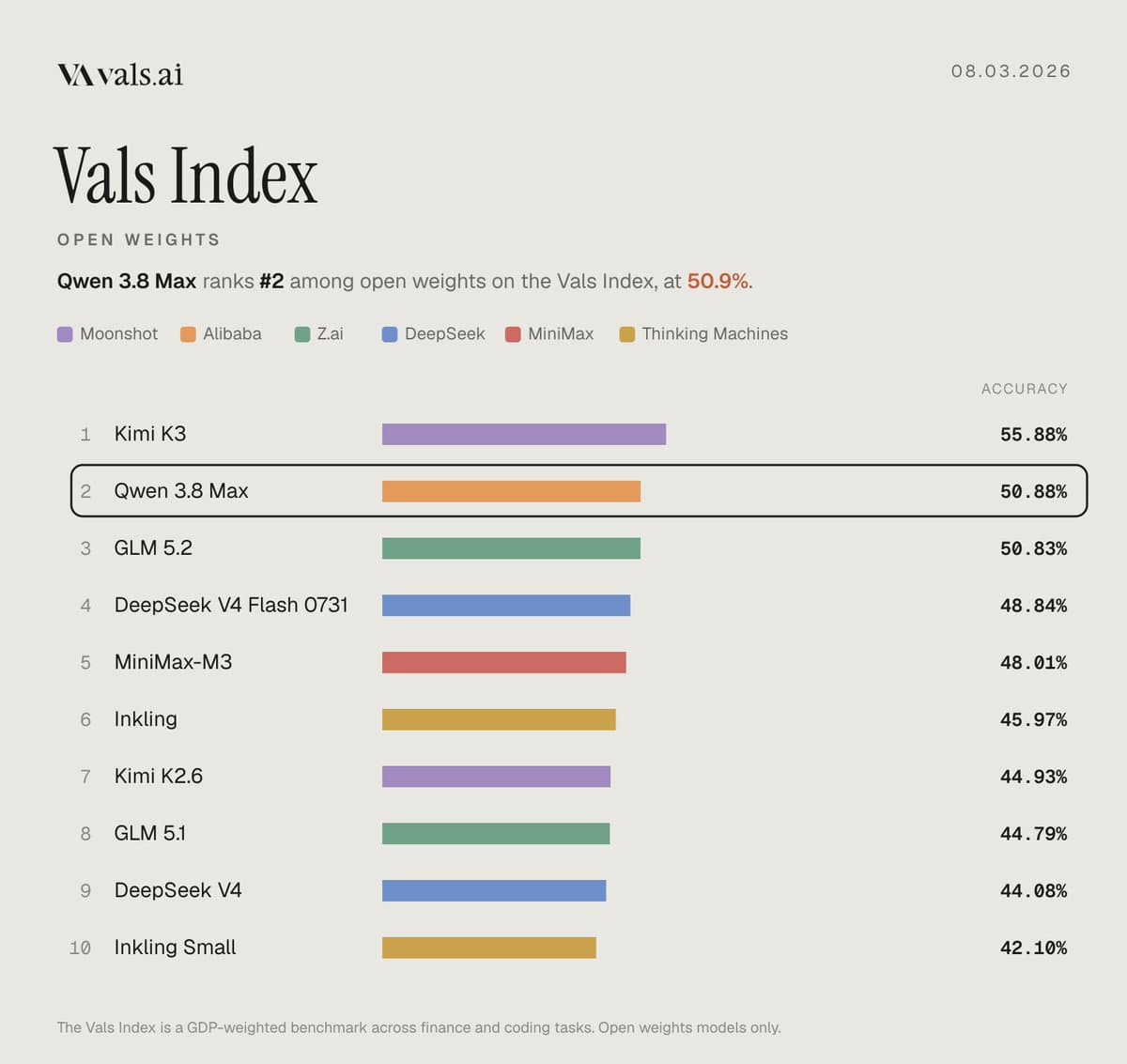
- Independent evals put it in the frontier band, not cleanly on top: ValsAI ranked it #2 among open-weight models and #10 overall, while ValsAI's cost note says it matched Claude Opus 4.7 on the Vals Index at 2.3x lower cost per test.
- Vision is the sleeper story: skalskip92's detection chart put Qwen3.8-Max at 77.1% mAP@50 on object detection, 8.5 points ahead of Gemini 3.5 Flash.
- The caveats are token bloat, regressions, and benchmark-method friction: ZhihuFrontier's hands-on digest reports 17% higher token use than Qwen3.7-Max, while teortaxesTex's regression note flags SciCode, AA-LCR, and AA-Omniscience drops.
Alibaba's official blog spends pages on a 16-day autonomous repo trace, a five-day paper-reproduction loop, and chip-design optimization that ran hundreds of turns deep. The OpenRouter model page shows the hosted path is simple: one provider, Alibaba Cloud Int., direct routing, $2 input and $6 output per million tokens. Artificial Analysis calls it leading and reasonably priced, but also notably slow and verbose. The Hacker News thread is already more excited about Qwen3.8-27B for local coding than about self-hosting the 2.4T Max checkpoint.
What shipped
- Qwen3.8-Max is GA via QwenCloud API, and Alibaba's official blog calls it the most capable Qwen model to date.
- Max weights are promised for next week, and Alibaba_Qwen's launch thread says Qwen3.8-27B is also going open-weight.
- Pricing is $2 per million input tokens, $6 per million output tokens, and $0.25 per million implicit cached tokens, according to Alibaba_Qwen's launch thread.
- The launch positioning is agentic work, not chat: autonomous coding, professional cowork tasks, long-horizon planning, and multimodal feedback loops are the four claims in Alibaba_Qwen's launch thread.
- Alibaba says the 16-day autonomous coding run produced 265 commits, 127 PRs, and 151 issues through an issue-to-code-to-test-to-repair loop, a claim kimmonismus's summary pulled into the pricing comparison.
The release is also a Max-class open-weight shift. ValsAI's model-size note says previous Max releases were proprietary and places Qwen3.8-Max alongside Kimi K3 and GLM 5.2 as one of the only open-weight models near this parameter scale.
Benchmarks that moved
First-party
- TerminalBench-2.1: Qwen3.7-Max 74.5 → Qwen3.8-Max 86.6, +12.1 points, per Alibaba_Qwen's LM table.
- PaperBench: Qwen3.7-Max 64.8 → Qwen3.8-Max 93.0, +28.2 points, per Alibaba_Qwen's benchmark grid.
- FrontierSWE: Qwen3.7-Max 40.7 → Qwen3.8-Max 73.5, +32.8 points, per Alibaba_Qwen's LM table.
- QwenReactBench: Qwen3.7-Max 1538 → Qwen3.8-Max 1724, +186 points, per Alibaba_Qwen's benchmark grid.
- JobBench: Qwen3.7-Max 31.3 → Qwen3.8-Max 53.4, +22.1 points, per Alibaba_Qwen's LM table.
- OSWorld-Verified: Qwen3.7-Max 73.3 → Qwen3.8-Max 86.1, +12.8 points, per Alibaba_Qwen's VL table.
- Vision2Web: Qwen3.7-Max 42.1 → Qwen3.8-Max 69.0, +26.9 points, per Alibaba_Qwen's VL table.
Third-party evaluators
- Vals Index: Qwen3.7-Max 57.5 → Qwen3.8-Max 66.1, +8.6 points, per ValsAI's predecessor comparison.
- Terminal-Bench 2.1: Qwen3.7-Max 61.0 → Qwen3.8-Max 67.4, +6.4 points, per ValsAI's Terminal-Bench note.
- SWE-bench: GPT-5.5 82.6% → Qwen3.8-Max 87.3%, +4.7 points, per ValsAI's SWE-bench note.
- Object detection mAP@50: Gemini 3.5 Flash 68.6% → Qwen3.8-Max 77.1%, +8.5 points, per skalskip92's detection chart.
- Frontend Code Arena: Kimi K3 Max 1676 → Qwen3.8-Max 1668, -8 points, per Arena's leaderboard post.
- Vision Arena: Claude Fable 5 High 1318 → Qwen3.8-Max 1305, -13 points, per Arena's leaderboard post.
Customer-reported
- No customer-reported benchmark delta surfaced in the evidence pool; the day-one partner posts were availability statements from Alibaba_Qwen's OpenRouter post, Baseten's reply, and Modal's day-zero post.
Vals adds the cleanest price-performance datapoint: Qwen3.8-Max matched Claude Opus 4.7 at 66.1 on the Vals Index, and ValsAI's cost note priced that run at $2.68 per test versus $6.17.
Where it regressed
Regression evidence is clustered in research, reasoning length, and benchmark setup.
- Research velocity: teortaxesTex's regression note says remaining gains over Qwen3.7-Max are mostly agentic coding, while SciCode fell 4 points, AA-LCR fell 4 points, and AA-Omniscience fell 11 points.
- Hallucination rate: the same teortaxesTex note attributes the AA-Omniscience drop to hallucination rate rising from 23% to 40%.
- Token use: ZhihuFrontier's hands-on digest says Qwen3.8-Max used about 17% more tokens than Qwen3.7-Max, with some constraint-solving prompts consuming 700% more tokens.
- Search behavior: ZhihuFrontier's digest says the model often relies on internal knowledge first and searches after getting stuck.
- Benchmark setup: ValsAI's Terminal-Bench note says Alibaba's reported Terminal-Bench 2.1 results modify timeouts, while Vals preserved the original benchmark timeouts.
- Visual generation: Ethan Mollick's shader test called Qwen3.8-Max solid, but below Kimi K3 in his early experiments.
The token bloat is the migration gotcha. Low list prices lose some force if long reasoning traces become the default output shape.
Under the hood
The model shape is a sparse MoE: 2.4T total parameters and 95B active per token. Alibaba's press release says Qwen3.8-Max uses Sparse MoE and hybrid attention to keep a 1M-token context window practical.
The access surface is unusually harness-friendly:
reasoning_effort: low, medium, and xhigh, according to ZhihuFrontier's protocol screenshot.- Protocols: OpenAI and Anthropic compatibility, according to ZhihuFrontier's protocol screenshot and eesel's access guide.
- Max output: 128k tokens, according to ValsAI's model note.
- OpenRouter slug:
qwen/qwen3.8-max, with one direct Alibaba Cloud Int. provider on the OpenRouter model page. - Cache pricing: OpenRouter lists $0.25 per million cache-read tokens and $0.17 per million five-minute cache-read tokens on the same model page.
Self-hosting Max will not look like running a normal local model. jaminball's hardware note points out that 2T-class open-weight models are huge enough to make memory the first bottleneck, while eesel's access guide says the promised weights still had no license, exact repo, or date as of August 3.
Contested claims
Claim: Open weights have surpassed closed models.
Cited by: Cline pointed to Qwen3.8-Max's 2% higher Terminal-Bench result than Fable 5 and called it a closed-model overtake.
Counter: ValsAI ranked Qwen3.8-Max #10 of 43 overall and #2 among open-weight models, while Arena's leaderboard post placed it behind Claude Opus 5 Max and Kimi K3 Max on Frontend Code Arena.
Evidence so far: Qwen3.8-Max leads or nearly leads selected long-horizon and vision tasks, but first-party tables still show Fable 5 ahead on SWE-bench Pro, QwenReactBench, MobileWorld, and JobBench, according to Alibaba_Qwen's LM table and Alibaba_Qwen's VL table.
The less flashy claim holds better: Arena's Pareto post says Qwen3.8-Max reshaped the cost-performance Pareto frontier in Frontend Code Arena, even while the absolute leaderboard still has closed and Chinese models ahead of it.
Vibe Check
Hands-on reports cluster around agent usefulness, visual strength, and occasional laziness.
- Agent execution: ZhihuFrontier's digest says every tested Qwen3.8-Max coding project passed the practical usability threshold and beat GLM-5.2 in those tests.
- Testing style: ZhihuFrontier's digest says the model used only smoke tests or a few headless screenshots, yet produced relatively few bugs in the tested projects.
- Math probing: suchenzang's test described the model as having GPT-5.6 Sol-like formatting and Opus-like reasoning laziness.
- Shader generation: Ethan Mollick's test found it solid but below Kimi K3 in early shader experiments.
- Hermes Agent: omarsar0's Hermes note argued the new open frontier models are catching up with closed frontier models, and Teknium's launch note said Qwen3.8-Max was featured running in Hermes Agent.
- Local anticipation: UnslothAI's 27B post claimed Qwen3.8-27B will run locally on 17GB RAM or VRAM setups.
Nathan Lambert did not frame the release as a settled leaderboard win. Nat Lambert's adoption note argued that pricing, license, release consistency, and feedback patching may decide the boundary between Qwen, Kimi, GLM, and DeepSeek.
Where it shows up
The day-one rollout is broad enough that the access story is part of the launch.
- QwenCloud API and Qwen Studio are the official paths in Alibaba_Qwen's launch thread.
- OpenRouter is live, according to Alibaba_Qwen's OpenRouter post and the OpenRouter model page.
- Venice has Qwen3.8-Max live, according to Alibaba_Qwen's Venice post.
- Command Code has it live, according to Alibaba_Qwen's Command Code post.
- Baseten said it will have Qwen3.8-Max, according to Baseten's availability reply and Baseten's serving reply.
- Modal said Qwen3.8-Max and Qwen3.8-27B are coming on day zero, according to Modal's day-zero post.
- vLLM said it will support Qwen3.8-Max open-source on day zero, according to vLLM's support post.
- Cline got a public "can't wait" reply from Alibaba_Qwen, according to Alibaba_Qwen's Cline reply.
- Hermes Agent is in the launch video orbit, according to Teknium's launch note and Alibaba_Qwen's Hermes reply.