
Ramp Sheets launches Fast Ask RL subagent with +4% exact-match gain over Opus at Haiku latency
Ramp and Prime Intellect launched Fast Ask, a small RL-trained spreadsheet retrieval subagent for Ramp Sheets. Ramp says it beats Opus by 4% exact match while running at Haiku latency, showing how narrow RL-trained agents can outperform larger frontier models on repetitive enterprise tasks.
TL;DR
- Ramp says RampLabs' launch post introduced Fast Ask, a small RL-trained retrieval subagent for Ramp Sheets that improves exact-match accuracy by 4 percentage points over Opus while running at Haiku latency.
- According to RampLabs' RL rationale, spreadsheet retrieval was a clean RL target because answers reduce to deterministic checks like a cent amount, date, invoice ID, yes or no, or row reference.
- In RampLabs' training details, the team says it built a synthetic environment with 14 finance task types, 3 tools, and a 15-turn budget so the agent could learn workbook navigation on its own.
- johannes_hage's partner post adds a second claim missing from the main launch tweet, Fast Ask is positioned as cheaper than frontier models while still hitting Haiku-like speed.
Ramp's Prime Intellect case study is the interesting part here, because the project is not about a new general model. It is a narrow subagent for one ugly enterprise bottleneck, spreadsheet retrieval, and RampLabs' training details says the team trained it in a synthetic finance environment instead of relying on prompt tweaks alone.
Fast Ask
Ramp frames Fast Ask as a subagent inside Ramp Sheets, not a replacement model. The target job is finding exact answers inside spreadsheets, and RampLabs' launch post says that narrow setup was enough to beat Opus on exact match while keeping Haiku-class latency.
The launch video attached to RampLabs' launch post shows the benchmark summary directly, including 90.4% accuracy and roughly 150 ms latency.
Deterministic rewards
Ramp's explanation for using RL is unusually concrete:
- answers can be checked exactly, per RampLabs' RL rationale
- the task repeats often inside finance workflows, again from RampLabs' RL rationale
- latency matters enough that a small specialist model is worth training, as RampLabs' RL rationale spells out
That makes Fast Ask a good example of where narrow post-training still has room to win. The reward is not vibe-based quality scoring, it is whether the model returned the right cell-level answer.
Synthetic workbook environment
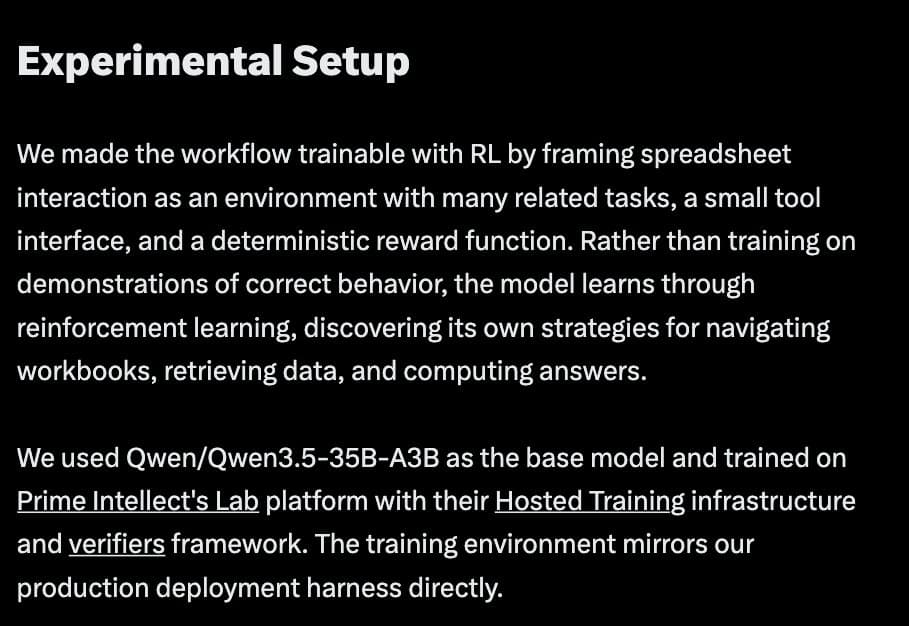
Ramp says the training harness used 14 finance task types, 3 tools, and a 15-turn limit. According to RampLabs' training details, the model learned how to navigate workbooks rather than just answer a fixed query format.
The same post says information retrieval had become a major bottleneck for the Sheets agent. That gives the project a more specific read than "RL for agents" in general, it is RL for one slow step inside a larger agent pipeline.
Prime Intellect Lab
Prime Intellect's Johannes Hage says his team helped train Fast Ask with Lab, and the linked Prime Intellect case study is the only public source in this evidence set that explicitly adds a cost angle. In johannes_hage's partner post, Hage describes the subagent as outperforming frontier models at Haiku-like speeds and at lower cost.
That detail matters because it hints at the actual product thesis: a spreadsheet agent does not need the biggest model on every turn if one specialized retrieval worker can handle the lookup step faster and cheaper.