
TypeSafe AI launches Jev for predefined choices, scores, and probabilities
Jev returns predefined choices, scores, and probabilities instead of free-form text for bounded software decisions. TypeSafe claims roughly 150 ms responses and lower inference costs for those tasks.
TL;DR
- Jev accepts unstructured context plus predefined answers, then returns a typed choice, ordered score, or truth probability with confidence, according to testingcatalog's launch rundown.
- TypeSafe claims 70 ms to 500 ms end-to-end response times and $0.042 per million input tokens, with output unmetered, for these bounded decision workloads, per rohanpaul_ai's launch explainer.
- TypeSafe's workflow evaluations use the averaged predictions of GPT-6 Astra and Fable 5.1 as reference probabilities rather than independently verified labels, a caveat imjustnewatai surfaced.
Jev supports up to 255 candidates in a direct choice. The official launch post says larger choices use a two-stage process: score candidates independently, then select explicitly. Its Doom demo made ten decisions per second from structured game-state text, not images, at a stated cost of about $7 an hour. Before the launch, Diogo Almeida, TypeSafe's founder, framed the company's work around reliability and automation in aiDotEngineer's link to his AI Engineer World's Fair talk.
Three output types
Jev exposes three response primitives:
- Choice: pick one of a supplied set of options, with a probability distribution and confidence.
- Score: assess context against ordered, described levels, with probabilities over those levels.
- Noul: return the probability that a statement is true, from 0 to 1.
The caller defines the output space before inference. TypeSafe says the contract makes schema mismatches mathematically impossible; it does not establish that a selected label is semantically correct.
Parallel decision batches
A request can contain dozens of questions, with each evaluated in isolation. The official launch post attributes Jev's latency to parallel sampling of all outputs in a query, rather than sequential token generation.
Every's Mini-Vibe Check put 21 AI-writing questions to 27 articles and 10 deliberately AI-styled counterparts, producing 777 judgments in under 0.7 seconds. The experiment described the result as an early signal, not a production accuracy validation.
Workflow evals and calibration
RLCD, short for Reinforcement Learning for Calibrated Decisions, is TypeSafe's training method for tying a reported confidence level to accuracy. The company defines the target plainly: higher confidence should mean higher accuracy.
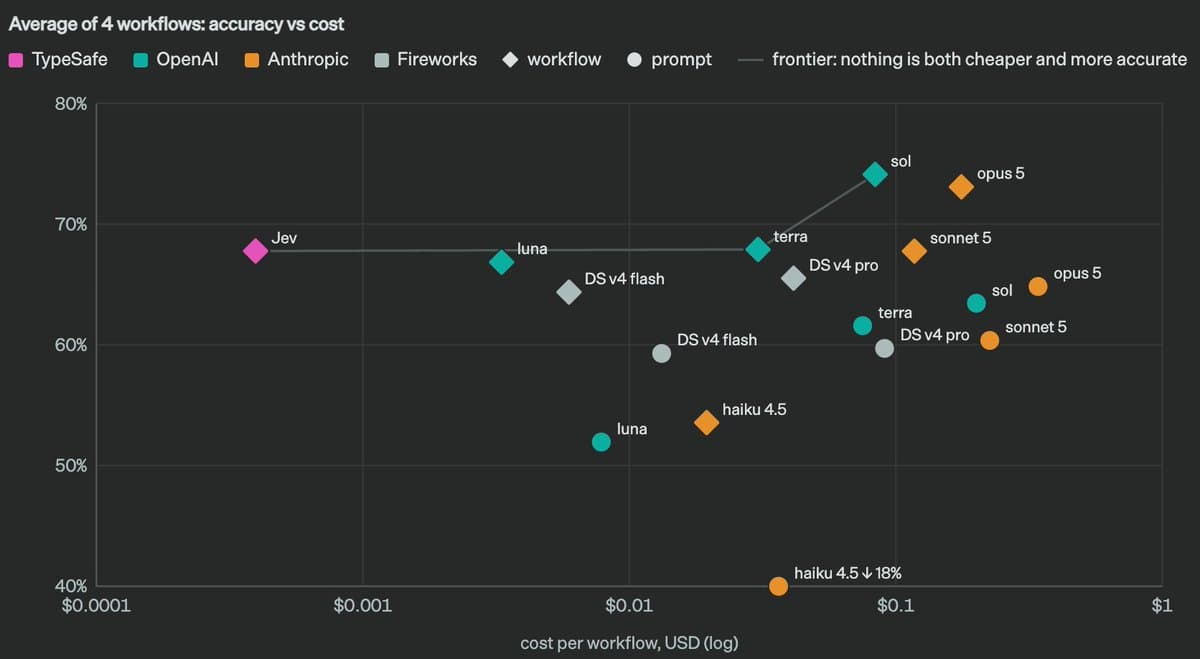
Its workflow evaluation does not score against a labeled ground truth. TypeSafe runs each model through the same code-defined workflow and treats the average output from Astra and Fable as the reference probability. The launch post reports 193.6 times faster and 444.6 times cheaper results from this setup, while saying those gains are likely near the high end of real-world outcomes.
TypeSafe also discloses that its capabilities team made the workflows, and that LLM baselines use its structured-output wrapper. The company says that wrapper is its most accurate LLM decision path, while adding latency and cost compared with asking an LLM for a decision without probabilities.
Architecture
TypeSafe calls Jev a new model architecture, but its public launch materials do not identify a model family or publish a reward equation, learning algorithm, or ablations for RLCD.
A public TypeSafe fork of LLaDA led scaling01 to speculate that Jev is a diffusion model. teortaxesTex's repository audit
API surfaces and DSPy
Jev is in early access through TypeSafe's waitlist. The initial surfaces are Python and JavaScript SDKs, a browser playground, and agent skills for Claude Code and Codex, according to testingcatalog's launch rundown.
A DSPy proof of concept linked by dbreunig adds an @typesafeify decorator to a signature. It routes booleans, choices, and scaled values through a TypeSafe path while leaving freeform fields on the standard DSPy model path; its side-by-side demo models a 15.9% speed gain and 30.1% lower per-ticket cost.