
BeatBandit launches MCP for screenplay, storyboard, and video actions
BeatBandit opened an MCP integration that lets Cursor and Claude Code call its story engine for scripts, revisions, storyboard images, and videos. The release moves story development tasks from a separate web app into agentic IDE workflows.
TL;DR
- BeatBandit shipped an MCP integration that lets agents call its story engine from code, and rainisto's launch post says the available actions span story development, screenplay writing, revisions, storyboard images, and video generation.
- The pitch is IDE-native creative work: according to rainisto's thread, the MCP plugs into Cursor and Claude Code, while rainisto's example shows BeatBandit creating a new project from a simple premise inside that flow.
- BeatBandit is positioning the MCP as a near-full surface wrapper around the web app, with rainisto's follow-up saying "almost everything" available on the site can now be done through MCP.
- The setup also keeps the BeatBandit account layer intact, because rainisto's launch post says projects, credits, and authentication are shared across the web app and IDE use.
You can jump straight to the BeatBandit MCP page, see rainisto's short-story example create a project from a prompt, and watch rainisto's character-design demo turn a hero description into both personality development and an image.
Story engine actions
BeatBandit is exposing the core creative pipeline through MCP instead of keeping it locked to its web UI. In rainisto's launch thread, the supported workflow breaks into five pieces:
- develop stories
- write screenplays
- make revisions
- generate storyboard images
- turn storyboard work into videos
That makes this a creator-tool launch more than an infrastructure one. The useful shift is that story beats, script drafts, boards, and video steps now sit behind the same agent interface.
Cursor and Claude Code flow
The thread's clearest demo is simple: an agentic IDE gets a premise, BeatBandit answers with its story creation logic, and a new project is created. rainisto's short-story example adds that the same project can then be opened in BeatBandit itself.
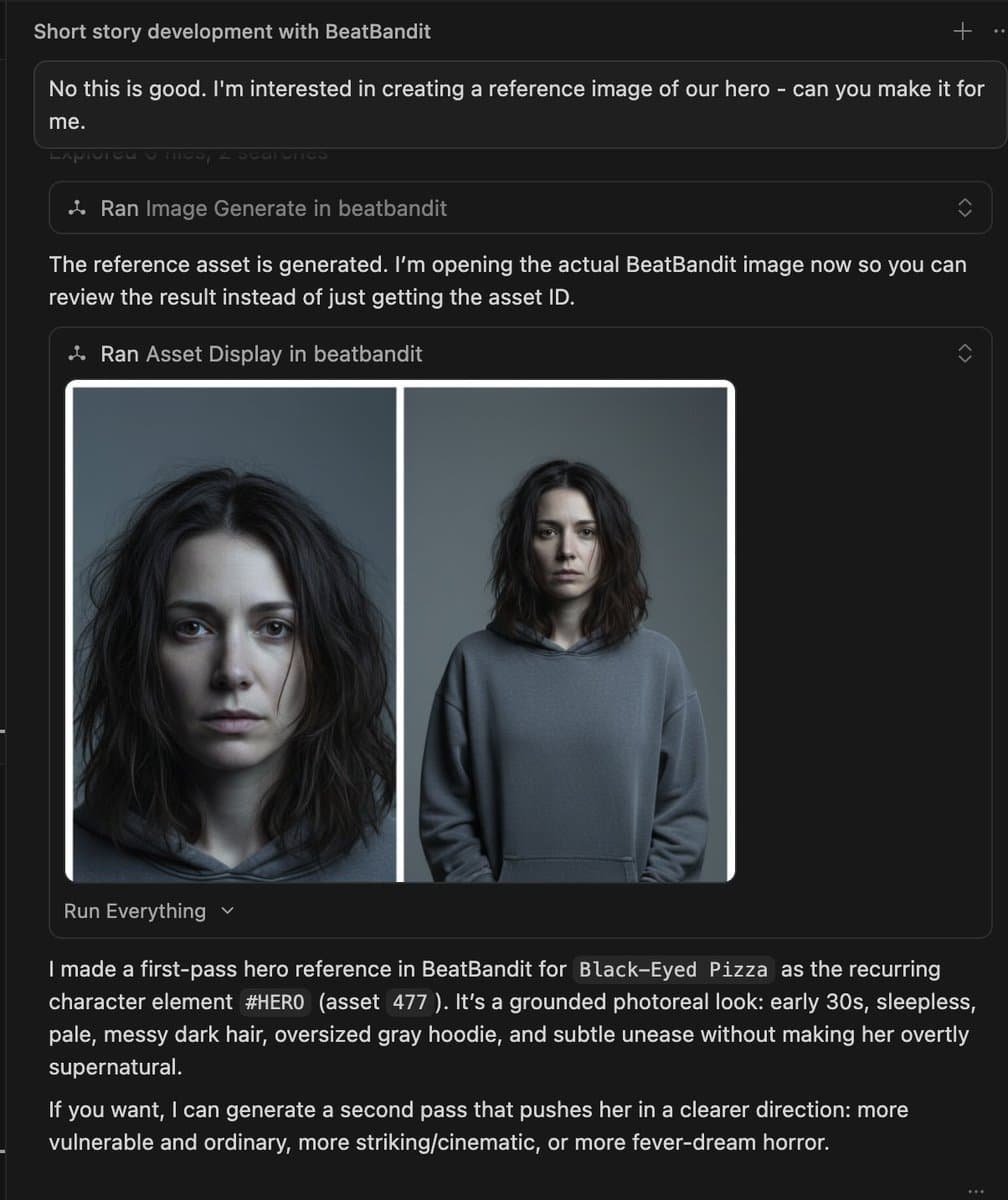
A second example pushes the flow one step further. In rainisto's character-design demo, BeatBandit first develops the character's personality, then generates an image of the hero, which hints at a sequential workflow where the agent can move from narrative development into visual preproduction without changing tools.
Shared projects, credits, and auth
The operational detail that matters most is continuity. rainisto's launch post says projects, credits, and authentication are shared when the MCP is added to Cursor or Claude Code, and rainisto's MCP install post frames the workflow as mix-and-match between the website and MCP, back and forth.
That means BeatBandit is not launching a separate agent product. It is extending the same account system and project layer into code-driven workflows, with installation details collected on the official MCP page.