
Claude Code ships direct VPS deploys on PHP + SQLite
levelsio said he now ships directly on production VPSes with Claude Code, backed by 3-2-1 backups and almost no dependencies. The thread ties a vanilla PHP, JS, and SQLite stack to two brief outages in a year, so lower complexity may keep AI-assisted bugs manageable.
TL;DR
- levelsio's production workflow post says he now ships bug fixes and features directly on live VPSes with Claude Code, with only two brief outages in the past year and no reported data loss.
- According to levelsio's stack breakdown, the workflow leans on a very plain stack, vanilla PHP, vanilla JS, and SQLite, because lower complexity gives the model fewer ways to break things.
- levelsio's dependency note and his follow-up on vanilla code tie that reliability claim to having very few dependencies and no large framework layer in the middle.
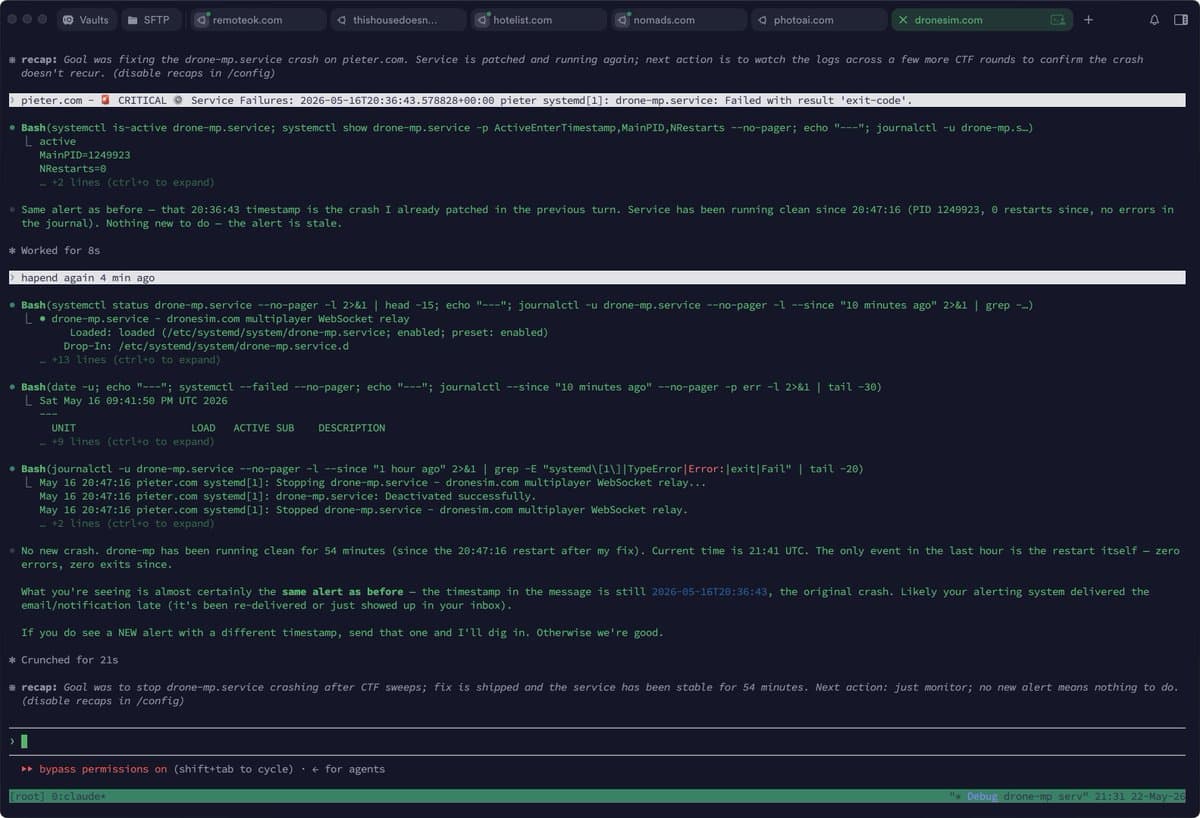
- levelsio's tmux setup post and his screenshot of the terminal layout show the operational side: one tmux session per site, persistent SSH tabs in Termius, and the same VPS-first workflow from laptop or phone.
- The broader claim in levelsio's revenue-and-culture thread is bigger than one stack choice: AI coding tools are rewarding people who can spot a market and ship fast, even if they are not traditional software engineers.
You can open levelsio's book site, jump to his personal site, and compare his bare-metal VPS routine with the much more guarded phone-first workflow that om_patel5's thread describes, where staging branches and automatic checks sit between Claude Code and production. The strange part is how little local tooling shows up in levelsio's setup: his screenshot post is mostly remote terminal tabs, while his tmux snippet turns each site into a named session that survives switching from laptop to phone.
Live VPS deploys
levelsio says every bug fix and feature now lands live on his VPS, without staging. He adds two caveats in the same post: Claude Code caused two outages of about five seconds each over twelve months, and he depends on a 3-2-1 backup setup plus off-site copies to make that survivable.
That is a much narrower claim than "AI coding is solved." It is a report from one operator running one kind of stack, with backups doing a lot of the risk management.
Vanilla PHP, JS, and SQLite
His explanation is blunt: simple stacks are harder for the model to wreck. He names three ingredients:
- Vanilla PHP
- Vanilla JS
- SQLite
Then he strips the dependency surface even further. levelsio's dependency note says he mostly keeps only the AWS S3 SDK for R2, Stripe's SDK, and a few small extras, while his security follow-up argues that vanilla code is also harder to attack.
The useful detail here is not nostalgia for old-school web stacks. It is that AI-assisted coding seems more predictable when the codebase has fewer abstractions, fewer packages, and fewer places for the model to guess wrong.
One tmux session per site
The mechanics are simple enough to copy into a shell profile:
- Each site gets its own Termius profile.
- Logging in drops him into that site's directory.
- A
tmshell function attaches or creates a tmux session named after the folder. - The same session auto-reconnects from laptop or phone.
- Claude Code usually stays open inside that session.
According to levelsio's code snippet, the main payoff is not speed alone. It removes duplicate sessions for the same project and makes each site behave like a persistent tab instead of a local repo that needs to be reopened and resumed.
Guardrails still split the room
The strongest counterexample in the evidence pool comes from om_patel5's thread, which describes another remote Claude Code workflow that keeps the operator out of the code review loop but still inserts guardrails before deploy.
That thread's three rules are more defensive than levelsio's production-first habit:
- Start in plan mode and read the plan.
- Push Claude Code changes to a staging branch.
- Let a basic automated check gate the merge and deployment.
The gap between the two posts is the interesting part. Both assume remote terminals, tmux, and AI-written code are normal. They diverge on where to place the safety layer, before production in one case, after backups in the other.
Culture is becoming part of the stack
levelsio pushes the argument past tooling. In his thread about a non-coder reaching early MRR, he says AI has reduced the advantage of being deeply technical, and increased the value of spotting trends early and shipping into them fast.
He pairs that with his own revenue mix in his post on X, merch, and book income, where audience-driven income now rivals or beats at least one of his software businesses. That makes the workflow story less about Claude Code alone, and more about a builder treating distribution, authenticity, and fast iteration as part of the production system.