Creators shared Nano Banana 2 pipelines for brand-specific ad mockups, embossed metal logos, hidden-object games, and macro material studies, often pairing the model with Firefly or LTX. The examples keep layout or brand identity stable while swapping surfaces, objects, and campaign variants.
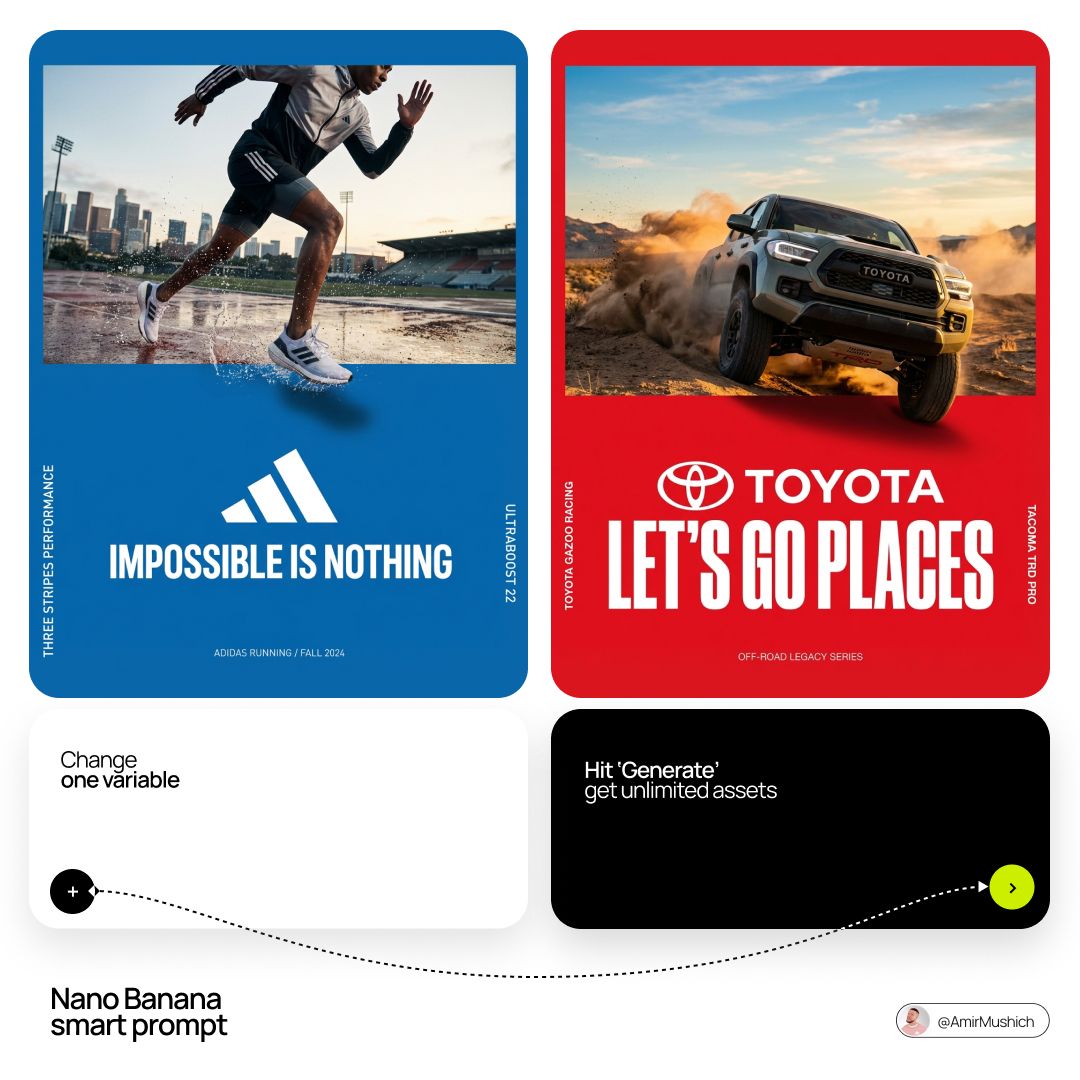
The clearest use case here is brand-specific mockup generation. Mushich’s workflow starts with a reference image and base prompt, then replaces a brand-name variable and injects the reference before generating final assets in Nano Banana via LTX prompt share. The sample output keeps the composition stable while swapping identity systems, turning the same ad structure into distinct branded visuals.
His embossed-logo recipe pushes the same idea further into identity design. According to the full emboss prompt, the logo should read as a bas-relief pressed outward from one continuous surface, not a floating 3D object. The instructions get unusually specific: resolve logo geometry first, map color to material choice, use a soft key light from the upper left, keep depth of field off, and preserve negative spaces by recessing them back to the flat plane. That level of constraint is why the output looks closer to packaging CGI or medal stamping than generic logo rendering. The attached LTX page also shows the workflow is being framed inside a broader production toolchain rather than as a standalone image trick.
Outside brand work, creators are using Nano Banana 2 as a promptable concept engine. Williams’ macro template is basically a reusable recipe: start with an organic subject, define where it transitions into a manufactured material, add tiny domain-specific elements at the seam, then lock the shot to a 100mm macro lens, shallow depth of field, and scientific-photo realism macro prompt. The posted examples show that structure holding across very different pairings, from leaf-to-circuit-board to pinecone-to-copper and dragonfly-to-stained-glass.
He also used Adobe Firefly with Nano Banana 2 to build a hidden-object scene in a junkyard, where readable silhouettes like a harp, butterfly, key, mushroom, and skull are embedded into a dense composition hidden objects demo. That matters because it shows the model can support game-art style images where the brief is not just atmosphere but controlled discoverability. Together with the structured prompt collection in the prompt library, these posts suggest Nano Banana 2 is gaining traction when the goal is consistency across variants, not just single-image novelty.
Your clients will love this: /mockup-gen-pipeline │ ├── input │ ├── reference_image.jpg │ └── base_prompt │ ├── preprocessing │ └── prompt_engine │ └── replace [brand_name] │ → inject reference_image │ ├── Show more


Nano Banana smart prompt: Embossed metal logo Prompt 👇

Nano Banana smart prompt: Embossed metal logo Prompt 👇
Prompt share: Extreme macro photograph of [ORGANIC SUBJECT] where [NATURAL FEATURE] transitions into [MANUFACTURED MATERIAL], [MATERIAL-SPECIFIC DETAIL] replacing [BIOLOGICAL DETAIL], tiny [DOMAIN-SPECIFIC ELEMENT] at transition points, soft [LIGHTING TYPE] revealing Show more


Hidden Objects | Level .095 Can you find all 5 hidden objects? Made in Adobe Firefly with Nano Banana 2


