
Anthropic cuts Claude subscription access for third-party harnesses on Apr. 4
Anthropic said Claude subscriptions will stop covering third-party harnesses such as OpenClaw on Apr. 4, with discounted extra-usage bundles, refunds, and one-time plan credits. Heavy Claude-based agent workflows may need to move to API billing or extra-usage bundles because Anthropic cites subscription capacity constraints.
TL;DR
- Boris Cherny's announcement said Claude subscriptions stop covering third-party harnesses such as OpenClaw on Apr. 4 at 12 pm PT, while the customer email screenshot shows Anthropic framing the change as a policy for third-party harnesses more broadly.
- Anthropic's follow-up post said subscribers get a one-time credit equal to their monthly plan cost, and Extra usage credit for Pro, Max, and Team plans lists the amounts as $20 for Pro, $100 for Max 5x, $200 for Max 20x, and $200 for Team.
- Cherny's capacity explanation said subscriptions were not built for the usage patterns of these tools, while his later reply added that Anthropic had already pushed changes to improve prompt-cache hit rate for OpenClaw on API or overage usage.
- Cherny's clarification said API keys and overages still work, and Buy usage bundles says those pre-purchased balances work across Claude, Claude Code, Claude Cowork, and third-party products tied to the same account.
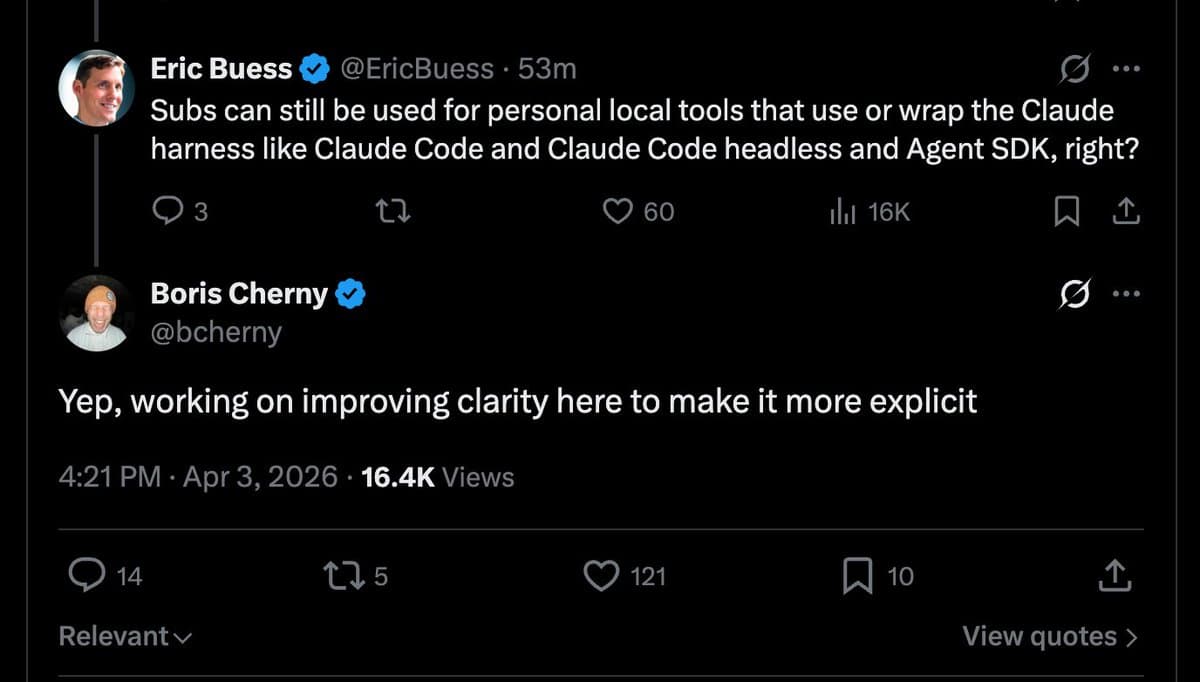
- Theo's screenshot briefly looked like a green light for local wrappers around Claude Code, but a follow-up correction said that should not be read as new guidance for the Agent SDK.
You can read the new usage-bundle docs, the separate credit policy, and the main HN thread. The oddest detail is that Anthropic shipped a brand new prepaid overage system at the same moment it shut off subscription-backed use for third-party harnesses. The most useful clarification came in replies, where Cherny said API and overage paths still work and even mentioned cache-efficiency PRs aimed at OpenClaw.
Apr. 4 cutoff
Anthropic's core change is narrow in mechanism and broad in effect. Starting Apr. 4 at 12 pm PT, Claude subscription limits no longer apply when the workload comes through a third-party harness.
The screenshot shared by Matthew Berman fills in the customer-facing wording: subscriptions still cover Claude's own products, but third-party harnesses now require extra usage billed separately. That distinction matters because Anthropic is not blocking Claude account logins outright. It is changing which meter gets charged.
Credits, bundles, refunds
Anthropic paired the cutoff with three commercial patches: a one-time credit, discounted prepaid bundles, and refunds for subscribers who want out.
The help-center rollout makes the mechanics more concrete. Extra usage credit for Pro, Max, and Team plans says eligibility required being subscribed by Apr. 3 at 9 am PT and having extra usage enabled. Buy usage bundles says larger prepaid bundles can cut prices by up to 30 percent, and that the same balance can be spent across Claude, Claude Code, Claude Cowork, and third-party products.
Early community reaction focused on the size of the credit, especially for Max users, but the docs make clear the credit is tied to plan tier and routed through the new overage system rather than through subscription limits.
Capacity and cache efficiency
Anthropic's public explanation is capacity management. Cherny said subscriptions were optimized for Anthropic's own workload mix, while third-party services were not.
In later replies, Cherny and Cherny again added two more specifics. First, Anthropic considers this an engineering-constraints problem, not an anti-open-source posture. Second, he said he had already opened PRs to improve prompt-cache efficiency for OpenClaw, which should lower cost for people who keep using Claude through the API or paid overages.
Peter Steinberger's follow-up acknowledged those cache-use fixes even while criticizing the policy. The HN thread landed in a similar place: the loudest disagreement was about fairness and ecosystem impact, but the underlying model Anthropic is moving toward is plain enough, subscriptions for first-party usage patterns, metered billing for agentic workloads that hammer the system harder.
What still counts as first-party
One of the first questions after the announcement was whether local tools that wrap Claude Code are now out of bounds too.
The screenshot Theo posted shows Cherny replying "Yep" to a question about personal local tools that use or wrap the Claude harness like Claude Code, Claude Code headless, and Agent SDK. A second reply arrived fast: trq212's correction said that exchange should not be treated as guidance or an update on the Agent SDK.
That leaves a narrower practical reading than the initial celebratory posts suggested. Anthropic was explicit about subscriptions still covering Claude Code and Claude Cowork in the customer email, but the boundary around wrappers, headless use, and SDK-based tooling was still being clarified in public.
Rollout beyond OpenClaw
OpenClaw took the first hit, but Anthropic did not present this as a one-off exception.
The email screenshot says enforcement begins Apr. 4 with OpenClaw, then adds that the same policy applies to all third-party harnesses and will roll out to more shortly. Peter Steinberger said he and Dave Morin had spent a week trying to delay the move, and argued that Anthropic first copied popular harness features into its own closed product before tightening access for open source competitors.
That final detail turns a billing-policy change into an ecosystem fight. Anthropic described a capacity problem. OpenClaw's camp described platform foreclosure. The cutoff is already live enough that both readings are now part of the record.