
Google launches Antigravity 2.0 with CLI, SDK, and single-call Managed Agents
Google launched Antigravity 2.0 as a desktop app plus CLI/SDK stack for multi-agent workflows, and added Managed Agents to the Gemini API with persistent Linux sandboxes. Try it for agent orchestration and API-based sandboxing, but verify harness costs and runtime fit.
TL;DR
- Google shipped Google's Antigravity 2.0 launch post as a standalone desktop app for parallel agent work, while Google's product list added a CLI, SDK, voice support, and integrations across AI Studio, Android, Firebase, and the web.
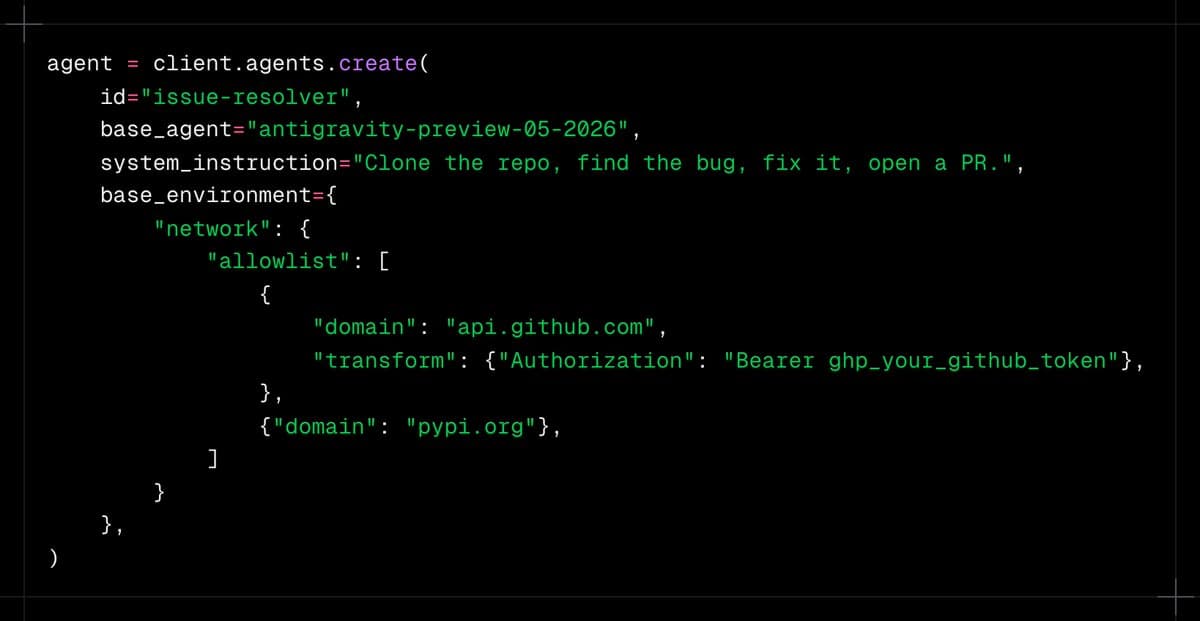
- Google's Managed Agents announcement and _philschmid's feature thread describe a single API call that provisions a Google-hosted Linux sandbox with code execution, web access, and file operations, backed by the Managed Agents blog post and Gemini API docs.
- The API surface is more opinionated than a raw model endpoint: _philschmid's environment note says environments persist across turns via
environment_id, while _philschmid's security note adds network allowlists and proxy-side credential injection. - Google used the launch to show off long-horizon orchestration: Google's OS demo says Antigravity 2.0 plus Gemini 3.5 Flash built a working OS in 12 hours with 93 sub-agents, and mirrokni's /teamwork example adds a second stress test, reproducing AlphaZero from the paper.
- The stack also collapsed some older surfaces into Antigravity: mattlam_'s transition post points to Google's Gemini CLI transition notice, while pvncher's critique says the new CLI is closed source and drops ACP support.
You can read the Managed Agents launch post, jump straight to the quickstart, browse Google's CLI transition note, and open the OS deep-dive. The weirdest tell is that andyzhang's screenshot shows worktrees and scheduled tasks inside the desktop app, while Google's Managed Agents post pitches the same internal harness Google uses, and Google's Search demo pushes Antigravity into generated mini-apps inside Search.
Antigravity 2.0
Google is positioning Antigravity 2.0 as mission control for agents, not a chat wrapper. Google's desktop app reveal says the app is built around core agent conversations, agent-produced artifacts, and multi-agent orchestration.
The product surface that shipped around it is broader than the desktop app itself. According to Google's feature list and GoogleDeepMind's Antigravity thread, the launch includes:
- Antigravity 2.0 desktop app
- Antigravity CLI
- Antigravity SDK
- Native voice support with Gemini Audio models
- Integrations with Google AI Studio, Android, Firebase, and the web
andyzhang's screenshot adds two details the launch copy barely lingers on: a scheduled tasks view in the sidebar, and a project menu with a "New Worktree" option. andyzhang's follow-up says the team has been using Antigravity to build Antigravity internally.
Managed Agents
Managed Agents is the cleanest technical reveal in the bundle. Google says in its launch post that one API call returns both an agent and a secure hosted Linux environment, and the official blog post frames it as Google's internal Antigravity harness exposed through the Gemini API.
_philschmid's thread and the Gemini API docs sketch the actual contract:
- Base agent is
antigravity-preview-05-2026 - Sandboxes run Bash, Python, and Node.js
- Agents can read and write files, browse the web, and execute code
- Custom behavior can live in
AGENTS.mdandSKILL.md - Environments can mount inline files, GitHub repositories, or GCS buckets
The state model matters more than the marketing line. _philschmid's environment note says the first call provisions a sandbox and later calls resume it by passing back environment_id, preserving files, packages, and state. _philschmid's agent-definition example adds that you can fork an active environment into a reusable agent definition.
Security controls are also unusually explicit for a launch tweet. According to _philschmid's security note, developers can restrict outbound domains with network allowlists, while auth headers are injected by the egress proxy instead of being exposed inside the sandbox. _philschmid's rollout update says the feature reached both Google AI Studio and the Gemini API on launch day.
CLI consolidation
Google is not just adding another shell wrapper. mattlam_'s link post points to Google's transition notice, which explicitly moves Gemini CLI into Antigravity CLI, while the Antigravity CLI launch post positions it as the terminal surface for the same harness.
That unification is the nice part. The frictions showed up immediately in community replies. yacineMTB's install-script post notes the new harness is written in Go and links the shell installer, while pvncher's critique says the replacement is not open source and no longer supports ACP. pvncher's later reply adds that the CLI felt "extremely light of features" in early use.
Google's own framing stays tighter: its CLI post calls it a lightweight, high-velocity surface with the same harness and models as the hosted products, and andyzhang's follow-up says the team wants it to be a daily driver from the terminal. The gap between "same harness" and "lighter feature surface" is probably where most first-week comparisons will land.
/teamwork and the OS demo
The headliner demo was an operating system build, and Google gave unusually concrete run stats for it. Google's post says Antigravity 2.0 and Gemini 3.5 Flash used 93 parallel sub-agents, 15,000-plus model requests, and 2.6 billion processed tokens over 12 hours, for less than $1,000 in API credits.
mirrokni's architecture note explains the orchestration model behind that run. /teamwork-preview spins up specialized Orchestrators, Explorers, Workers, and Critics for long-horizon tasks that a single model call cannot hold.
The same framework got a second benchmark-style demo. mirrokni's examples says the system also rebuilt AlphaZero in JAX and Flax by reading the original paper, and mirrokni's availability note says /teamwork-preview is available as a research preview for Google AI Ultra subscribers. The corresponding OS deep-dive gives Google a reference artifact beyond the keynote clip.
Community reaction was less impressed by the spectacle than by the harness details. mattpocockuk's reaction zoomed in on a visible /grill-me skill in the demo, which suggests Antigravity's skill system is close enough to the emerging markdown-skills pattern for outside developers to recognize it instantly.
Search, AI Studio, and Android exports
Google also used the launch to wire Antigravity into other product surfaces. Google's export post says AI Studio can now export an entire project into Antigravity with one click, which turns prototyping and scaled agent work into one pipeline instead of two disconnected tools.
Search is getting its own Antigravity-powered UI layer. Google's generative UI post says Search can design layouts, build custom components, fan out research, and deploy code to produce interactive visuals, while Google's availability note says recurring "custom experiences" like trackers and mini-apps start in the coming months for U.S. AI Pro and Ultra subscribers.
Android is another explicit integration target. According to Google's Android update, AI Studio now supports building native Android apps from a prompt, Antigravity gets official Android support, and Android CLI is now stable for agent-driven Android tasks. That makes the last section of this launch less about one product and more about a new routing layer: build in AI Studio, export to Antigravity, then ship into Search, Android, or the web.