
Warp Oz launches /orchestrate for Claude Code, Codex, and local-to-cloud handoff
Warp launched Oz orchestration across Claude Code, Codex, and Warp Agent, with subagent delegation, isolated worktrees or containers, and beta multi-harness control. Try the new '&' handoff and Agent Memory if you run long sessions that need cloud continuation.
TL;DR
- Warp shipped Oz with
/orchestrate, and warpdotdev's launch post says it can delegate work across Claude Code, Codex, and Warp Agent from one platform. - According to warpdotdev's subagent post, Oz can spin up multiple agents in parallel, giving each one its own worktree locally or its own isolated Docker container in the cloud.
- warpdotdev's handoff post adds a small but useful workflow detail: typing
&hands a Warp Agent conversation from the terminal to the cloud, then back to local later. - warpdotdev's Agent Memory post puts cross-harness memory into research preview, with a separate Agent Memory waitlist.
- warpdotdev's infrastructure post rounds out the release with granular per-agent permissions, per-team billing, and self-hosting options including Kubernetes pods and Docker.
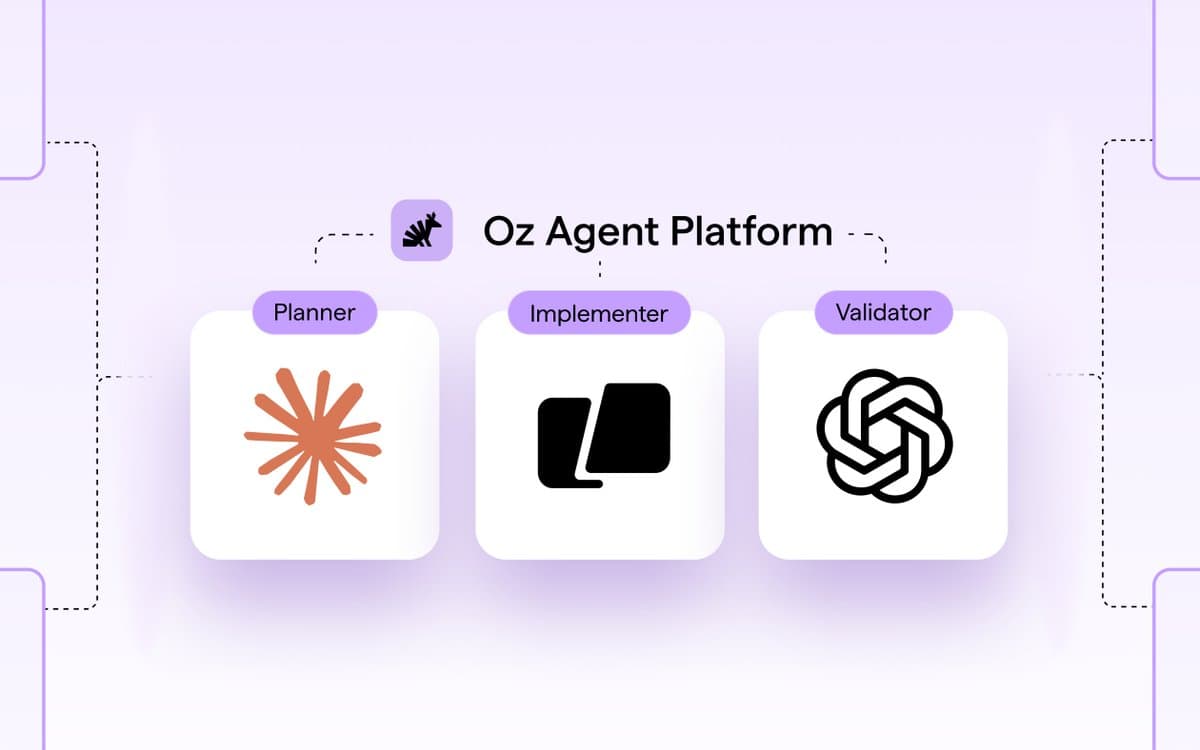
You can open Oz, skim the Agent Memory waitlist, and warpdotdev's architecture image already shows the intended split: Claude as planner, Warp as implementer, Codex as validator. warpdotdev's later demo post adds message passing between subagents, while warpdotdev's handoff post turns long agent runs into a terminal-to-cloud relay instead of a single session tied to your laptop.
Oz
Warp is pitching Oz as a control plane for multiple agent harnesses, not just another wrapper around one model. In warpdotdev's architecture image, the system is explicitly split into planner, implementer, and validator roles across Claude, Warp, and Codex.
The beta is available to all users, according to warpdotdev's beta post, and the entry point is the /orchestrate command described on Oz.
Subagents
The core mechanic is parallel delegation. warpdotdev's subagent post says Oz deploys multiple agents automatically, and warpdotdev's message-passing demo adds that the agents coordinate through message passing.
The isolation model is concrete:
- Local runs: each agent gets its own worktree, per warpdotdev's subagent post.
- Cloud runs: each agent gets its own isolated Docker container, also per warpdotdev's subagent post.
- Planning: Warp can generate a delegation plan itself, or you can invoke
/orchestratedirectly, according to warpdotdev's subagent post.
Later that day, warpdotdev's beta update narrowed the status a bit further by calling Claude Code and Codex subagents beta features inside the latest Warp release.
Handoff
& is the small feature here that probably gets used a lot. warpdotdev's handoff post says it hands an in-terminal Warp Agent conversation to the cloud, lets it keep running overnight, then lets you pick it back up locally.
That makes Oz more than an orchestration dashboard. It also gives Warp a session handoff model for long-running work that starts in a shell and finishes off-machine.
Agent Memory
Warp also previewed Agent Memory, which warpdotdev's Agent Memory post describes as a cross-harness memory layer for Claude Code, Codex, and Warp Agent. It is not generally available yet, and Warp is collecting signups through the Agent Memory waitlist.
That pairing matters because the rest of the launch is about switching between harnesses without losing structure. Memory is the piece aimed at not losing prior solutions, either.
Permissions
The least flashy part of the thread is also the part that makes this look more like shared infrastructure than a demo. warpdotdev's infrastructure post says Warp added:
- Granular permissions for individual agents
- Per-team billing
- More self-hosting options, including Kubernetes pods and Docker
Those details only show up at the end of the rollout thread, but they answer the obvious operational question: Oz is being framed for teams, not only for solo terminal users.