
Cline launches SDK and hits 74.2% on Terminal-Bench 2.0
Cline open-sourced the runtime behind its extension and CLI as the Cline SDK, then rebuilt the CLI on top with agent teams, cron jobs, connectors, and example apps. The harness score gives teams a new reference point if they want to compare agent tooling on Terminal-Bench 2.0.
TL;DR
- In cline's launch thread, rendered here as cline's launch thread, Cline open-sourced the runtime behind its coding agents as
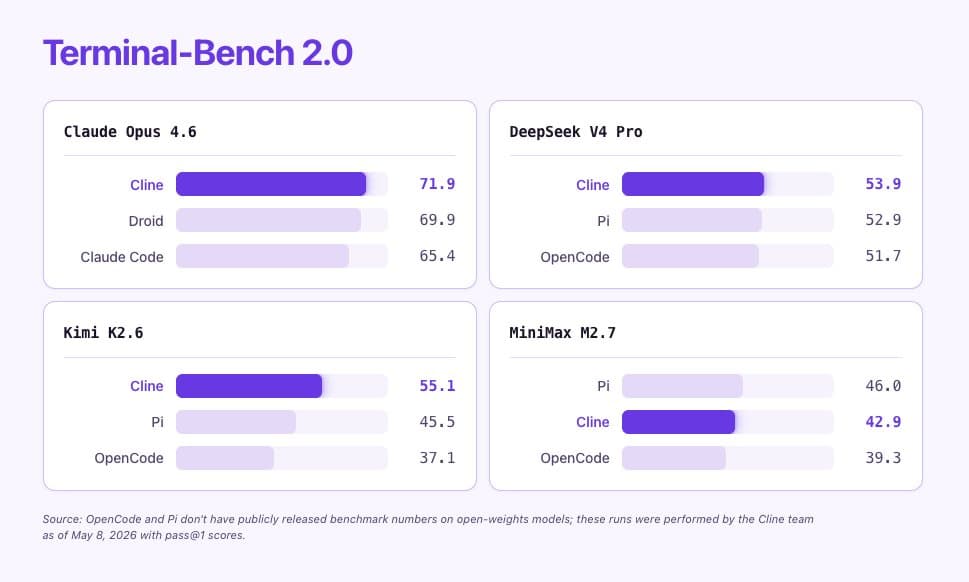
@cline/sdkand said the extension and CLI were rebuilt on top of it. - According to cline's Terminal-Bench post, the new harness leads Cline's own Terminal-Bench 2.0 chart across frontier and open-weight models, and testingcatalog's summary put the top published number at 74.2% for Cline CLI with
claude-opus-4.7, versus 69.4% for Claude Code. - In cline's CLI post, Cline said the rewritten CLI adds a new TUI, agent teams, scheduled jobs, and connectors, while the SDK docs present the same runtime as a package teams can build on directly.
- cline's examples post linked example apps for a Slack bot, VS Code extension, and desktop app, and the official blog post framed the release as a full harness rewrite rather than a thin package export.
You can read the official blog post, skim the SDK docs, and browse the example apps. The launch thread also slips in a useful build sheet: cline's architecture note credits Vercel AI SDK and Models.dev for routing, OpenTUI for the new CLI, and Zed's ACP for IDE interoperability.
The runtime is now a product
Cline says the SDK is the rebuilt harness behind its own extension and CLI, now published as @cline/sdk. That makes the release more than a library drop, because the company is exposing the same runtime it uses internally rather than a separate developer-facing wrapper.
TestingCatalog's summary adds one concrete rollout detail that is not in the launch tweet: the runtime is already powering Cline's CLI, VS Code, JetBrains, and Kanban surfaces, and the rest of the product line is being migrated onto it. The SDK docs pitch the same idea in product terms, an agent runtime teams can extend without forking the Cline stack.
The feature list looks like a full harness
Across cline's launch thread, cline's CLI post, and testingcatalog's summary, the feature set reads like a complete agent harness inventory:
- Plugin architecture for customization
- Checkpoints
- Web fetch
- MCP support
- Cron or scheduled jobs
- Subagents and agent teams
- Connectors, including chat channels called out for Slack, Telegram, and WhatsApp
- Multi-provider support, according to ai_for_success's summary
The packaging is split too. testingcatalog's summary describes a stateless loop, stateful orchestration, and provider layer as separate packages, which is the most concrete architecture hint in the evidence pool.
Terminal-Bench became the comparison point
Cline made benchmark performance a headline feature of the launch. Its claim is not just that the SDK scores well, but that context management tuned for how current models are RL-trained is the reason the harness leads its chart.
The specific comparison circulating outside the company was Cline CLI at 74.2% on Terminal-Bench 2.0 with claude-opus-4.7, ahead of Claude Code at 69.4%, as testingcatalog's score breakdown wrote and ai_for_success's reply echoed. Cline did not publish methodology details in the tweet thread itself, so the number is best read as a launch-day reference point for harness performance rather than a fully explained benchmark report.
The CLI is now the SDK's reference app
The new CLI is doing two jobs at once. It is the user-facing terminal app, and it is also the main proof that the SDK can carry a full product surface.
That post gives the clearest install split in the launch:
npm i -g clinefor the rebuilt CLInpm i @cline/sdkfor building on the runtime directlynpx skills add cline/sdk-skillfor attaching the runtime to another agent via a skill
The official blog post and SDK docs matter here because they turn the tweet thread's feature names into a more legible product shape: the CLI is no longer just a shell around Cline's extension logic, it is the reference application for the extracted runtime.
Example apps make the SDK legible fast
Cline shipped example apps on day one instead of leaving the SDK at API docs and abstractions. The repo link in cline's examples post points to three starter surfaces:
- Slack bot
- VS Code extension
- Desktop app
That is a small but useful choice. The examples show the intended build targets immediately, and they line up with the launch's broader pitch that the runtime is for internal tooling, agent workflows, and IDE integrations, as testingcatalog's follow-up put it.
The stack behind the rewrite
The most revealing implementation note is the thank-you list. Cline says the new SDK and CLI use Vercel AI SDK and Models.dev for inference routing, take plugin inspiration from Pi, use OpenTUI for the new terminal interface, and use Zed's ACP for IDE interoperability.
That list says a lot about the rewrite without a long architecture diagram. The launch is part open-source SDK release, part recomposition of existing agent infrastructure into separable layers and interfaces.