
Claude Opus 4.7 opens fast mode with ~2.5x speed as Cursor, v0, Droid, and OpenRouter add support
Anthropic rolled fast mode for Opus 4.7 into Claude Code and tools including Cursor, v0, Droid, Conductor, and OpenRouter. Use it where latency matters, but watch pricing: Cursor disclosed a 6x multiplier and others treat it as premium.
TL;DR
- Anthropic turned on fast mode for Claude Opus 4.7 in research preview on the API and in Claude Code, according to alexalbert__'s repost of ClaudeDevs and bcherny's repost.
- Distribution moved fast: Cursor shipped support first, then FactoryAI's Droid post, v0, charlieholtz's Conductor post, and OpenRouter all announced availability within hours.
- The cleanest number on the tradeoff came from Cursor's rollout note, which described Opus 4.7 fast as roughly 2.5x faster at 6x the cost.
- Fast mode is not treated like ordinary included usage in Claude Code subscriptions, because daniel_mac8's screenshot of Anthropic guidance says it runs as extra usage outside subscription rate limits even on Pro, Max, Team, and Enterprise.
- The rollout lands on top of a messier Opus 4.7 conversation, where the main HN thread focused on tokenizer overhead, higher default effort, and refusal changes while a Reddit thread about switching models showed some Claude Code users actively trying to get back to older behavior.
You can start with Anthropic's Opus 4.7 launch post, check the live OpenRouter model page, and skim the big HN thread if you want the broader 4.7 context. The weird operational detail is that fast mode ships as a separate premium lane, not a simple latency toggle, and some of the most useful specifics surfaced in product posts and screenshots rather than a single canonical announcement.
Where it shipped
The launch pattern was ecosystem first. Anthropic's own message, via alexalbert__'s repost of ClaudeDevs, said fast mode for Opus 4.7 was live in research preview on the API and in Claude Code.
After that, partner surfaces filled in quickly:
- Cursor: Opus 4.7 fast available, with the rollout note that it is 2.5x faster at 6x cost, per Cursor.
- Droid: FactoryAI said users get full Opus 4.7 intelligence with about 2.5x faster speed, per FactoryAI.
- v0: support announced in v0's post.
- Conductor: support announced in charlieholtz's post.
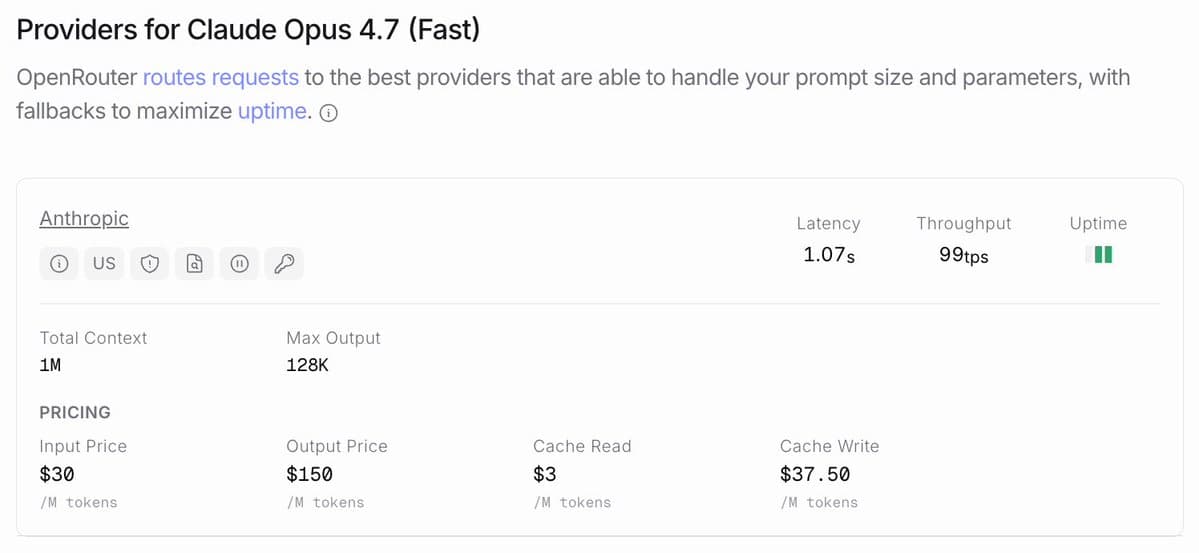
- OpenRouter: exposed a separate model slug,
anthropic/claude-opus-4.7-fast, in OpenRouter's announcement and on its model page.
That matters mostly because the rollout did not stay confined to Anthropic-owned surfaces. By the end of the day, fast mode had already shown up in IDE-adjacent products, agent tooling, and a router used by teams that swap providers behind one API.
Pricing and switches
The speed claim is consistent across the rollout. Cursor, FactoryAI, and OpenRouter all used roughly the same language, about 2.5x faster while keeping Opus 4.7 quality.
The cost language is not as neat. Cursor gave the bluntest disclosure, 2.5x the speed at 6x the cost, in its launch note. daniel_mac8's screenshot captured separate Anthropic guidance saying fast mode pricing is $30/150 MTok on Opus 4.6 and 4.7, and that Claude Code subscribers get it only as extra usage, not inside normal subscription rate limits.
The screenshot in that Anthropic guidance capture also listed the operational toggles in one place:
/fastenables fast mode in Claude Code CLI./fastalso works in the VS Code extension.- Opus 4.7 fast requires
CLAUDE_CODE_ENABLE_OPUS_4_7_FAST_MODE. - Claude Console gets access too.
- Subscription plans can use it, but billed as extra usage.
That makes fast mode look less like a default performance upgrade and more like a premium execution path that vendors can decide to surface explicitly.
Model slugs and defaults
Serious: How do I switch to Opus 4.6?
14 comments
OpenRouter made the separation especially visible by publishing a distinct slug, anthropic/claude-opus-4.7-fast, in its launch post. That is a small but useful clue about how the ecosystem is likely to expose the feature: not as an invisible backend optimization, but as a separately selectable target.
Claude Code looks a bit stranger. daniel_mac8's screenshot says /fast exists as its own toggle, while the Reddit thread shows how confused model selection already is for some users. One commenter in that thread claimed fast mode in Claude Code still maps to Opus 4.6 by default unless the Opus 4.7 fast environment variable is set, which matches the screenshot's note about CLAUDE_CODE_ENABLE_OPUS_4_7_FAST_MODE.
The practical result is two layers of choice:
- pick a base model or alias,
- then decide whether to route that session through the fast lane.
That is more flexible than a single model picker, but it also creates more room for users to think they changed one thing when they actually changed two.
Opus 4.7 reception
Claude Opus 4.7
Claude Opus 4.7 matters here mainly as a developer-facing model update: commenters are testing its instruction-following, refusal behavior, adaptive-thinking UI, and the practical cost impact of the new `xhigh` default plus tokenizer changes. The useful takeaway is operational: teams may need to re-tune prompts/harnesses, revisit budget assumptions, and check how Claude Code/session defaults affect agentic workloads.
Serious: How do I switch to Opus 4.6?
14 comments
Fast mode rolled out into an audience that was already arguing about the underlying model. The main HN thread centered on four concrete complaints: Claude Code's xhigh default effort, tokenizer overhead in the 1.0 to 1.35x range, adaptive-thinking output changes, and stricter refusals in some agentic workflows.
The HN discussion summary also captured Simon Willison's note that Opus 4.7 no longer shows a human-readable reasoning summary by default unless "display": "summarized" is set. That is not a fast-mode detail, but it helps explain why latency is only one part of the operator experience people are reacting to.
The backlash is visible outside HN too. A Reddit post in r/ClaudeCode asked how to switch away from Opus 4.7 entirely, describing a pattern of over-cautious pauses and unsolicited progress checkpoints. On the other side, kilocode's PinchBench post said Opus 4.7 led PinchBench v2 with 91.6% across 148 tasks, after the benchmark changed its scoring to reduce cherry-picking.
That split, stronger benchmark claims and noisier hands-on sentiment, is the real backdrop for the fast-mode rollout. Anthropic and its partners are selling speed, but a lot of engineers are still deciding whether they like normal Opus 4.7 behavior in the first place.