
agent-tui 0.2.0 adds markdown rendering, tool approvals, and local Gemma 4 support
agent-tui shipped v0.2.0 with markdown rendering, tool approvals, configurable reasoning views, and an AI SDK-only dependency chain. The demo also showed Gemma 4 31B running locally, so the terminal UI now covers hosted and on-device models.
TL;DR
- lgrammel's v0.2.0 update says agent-tui now ships markdown rendering, tool approvals, and configurable rendering for both tools and reasoning.
- The project stays deliberately small: according to lgrammel's dependency note, the only runtime dependency is the AI SDK, whose own dependency tree he described as limited.
- lgrammel's UI demo shows the package as a terminal wrapper for AI SDK 7 agents, not just a log tail, with structured panes for agent output and controls.
- lgrammel's local-model demo also shows Gemma 4 31B running locally with reasoning visible, extending the same TUI pattern beyond hosted APIs.
You can open the GitHub repo, skim lgrammel's launch post, and jump straight to the v0.2.0 feature note. The small but interesting bit is that the package is being pitched as an AI SDK-native shell, while a later demo shows the same interface driving a local Gemma 4 31B run with reasoning turned on.
What shipped
Version 0.2.0 adds three concrete UI features:
- Markdown rendering
- Tool approvals
- Configurable rendering for tools and reasoning
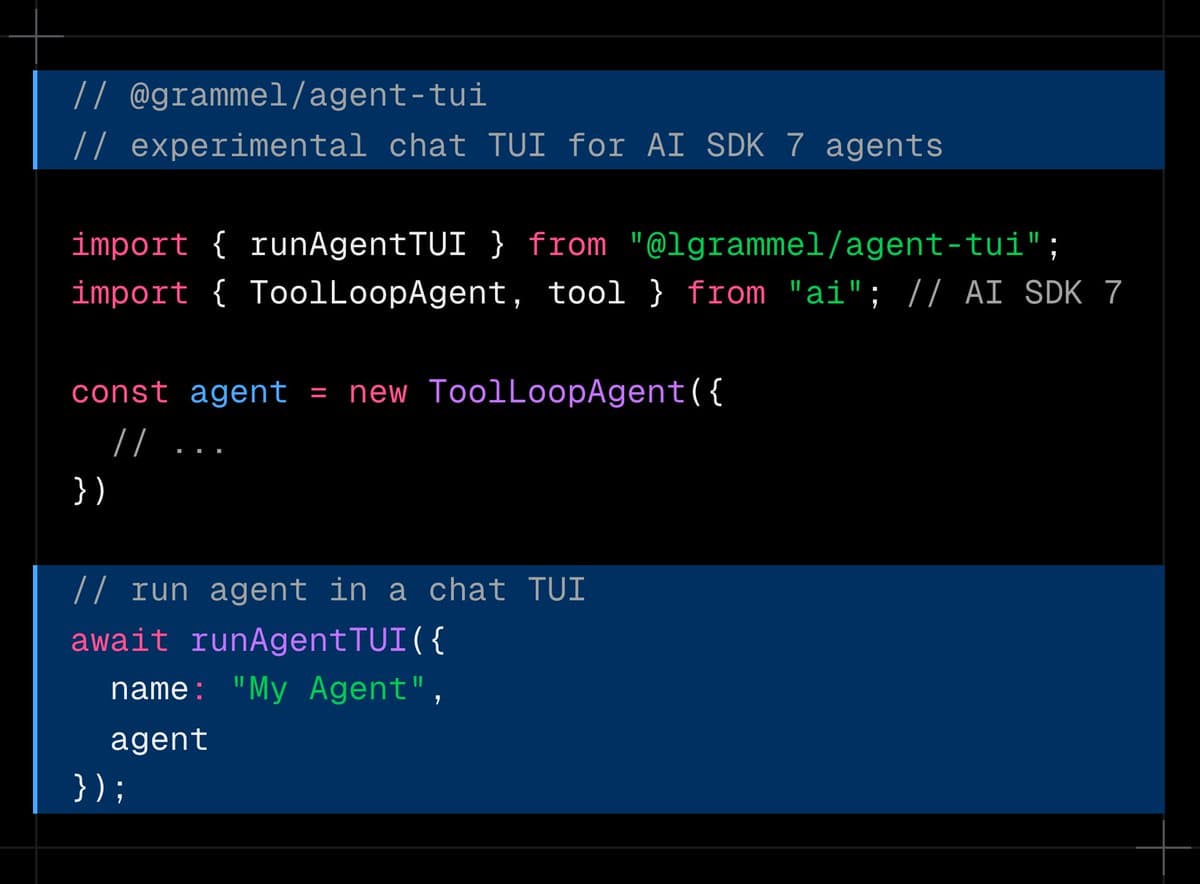
That moves agent-tui from a bare terminal wrapper toward something closer to a controllable agent console. The repo linked in the project page is positioned as a basic TUI for AI SDK 7 agents, which matches the feature set lgrammel called out in the release thread.
Dependency footprint
The dependency story is part of the pitch. In lgrammel's follow-up, he said agent-tui depends only on the AI SDK, and the gr2m retweet lgrammel shared framed adding a TUI as roughly a two-line integration for AI SDK builders.
For engineers already using the SDK, that makes agent-tui look less like a separate framework and more like a thin terminal surface layered on top of an existing agent stack.
Local Gemma 4
The most useful extra reveal came after the release note. lgrammel's Gemma 4 example showed the TUI running Gemma 4 31B locally, with reasoning output visible in the interface.
That matters because it expands the demo from AI SDK-hosted model plumbing to an on-device workflow. The screenshots in the earlier UI preview and the local run suggest the same interface can cover both approval-heavy agent runs and local reasoning inspection without changing the surface area much.