
OpenAI says rollout mistakes caused the Astra reset
OpenAI says a reset fixed Astra problems by disabling a context experiment, tuning eager skills, and removing bad engines. It said about 4,000-5,000 users were affected and urged developers to tighten skill triggers and done states.
TL;DR
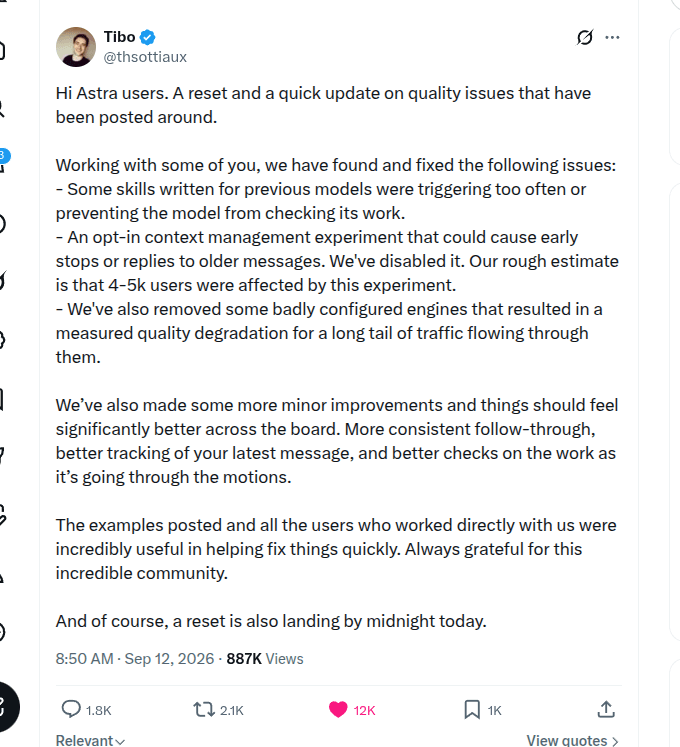
- OpenAI's Astra quality reset followed three identified rollout faults: the rollout update says legacy skills over-triggered or blocked self-checks, an opt-in context experiment misrouted conversations, and badly configured engines degraded a long tail of traffic.
- The context-management experiment was disabled after it caused early stops and replies to older messages for an estimated 4,000 to 5,000 users, according to the rollout update.
- A separate Codex usage-meter incident came from banked resets failing to apply fully in Work and Codex, the incident explanation says. Affected accounts are getting another reset and an apology email.
- OpenAI's updated setup guidance favors short, specific skill triggers, lean repository instructions, and explicit completion conditions, as OpenAIDevs' setup guidance puts it.
- One 419-run community comparison found Astra used weekly quota about twice as fast per hour as Sol at the same reasoning level, although kunchenguid's measurement also found broadly similar API-priced work per quota point.
OpenAI's developer guide wants a root skill document to act as a minimal router, loading supporting material only when relevant. Its usage guide says Work and Codex share one allowance, and both five-hour and weekly windows need remaining capacity.
Three rollout faults
The public explanation from thsottiaux names three changes made after user reports:
- Older skills fired too broadly or interfered with the model checking its own work.
- An opt-in context-management experiment produced early stops or responses anchored to older messages.
- Some poorly configured engines delivered measurable quality degradation to a long tail of traffic.
The update says the context experiment is off, the engines have been removed, and smaller adjustments should improve follow-through, attention to the latest message, and in-progress checks.
Skill routing and AGENTS.md
OpenAI's September 11 guide treats accumulated agent scaffolding as a source of context and routing failure. Its configuration pattern breaks down into four pieces:
- Skill descriptions: short trigger conditions that say when a skill applies, rather than broad or overlapping instructions.
- Documentation: a minimal root document that routes the agent to deeper docs, scripts, or references only when the task calls for them.
AGENTS.md: current repository-wide rules and safe workflow authorization, without mandatory full-repository maps for small edits.- Task prompts: a concrete definition of done, with the relevant verification path available to the agent.
The guide also warns that enough skills can force descriptions to truncate, making the routing layer itself less useful.
Context management
OpenAI called the affected feature an opt-in context-management experiment, but the quality update did not publish its implementation design. Separately, mattlam_ described an Astra-specific compaction flow that replaces a server-produced encrypted summary with retrievable working notes:
- Save state through
notes.write_file. - Reset into
new_context. - Request a
thread_hintidentifying notes to recover. - Read previous notes files or history-tool results.
- Insert recovered material into the fresh context as tool results.
Whether this described flow is the experiment OpenAI disabled remains unspecified in the rollout update.
Usage-limit resets
The meter failure was a separate incident from the quality fixes. A developer community thread includes reports of balances falling to zero while idle, while bridgemindai's report said several users saw their Codex balance go from 70% to 0% without warning.
reach_vb's incident update said OpenAI was investigating unexpected usage resets. The later explanation from thsottiaux attributed the failure to banked resets not fully applying in ChatGPT Work and Codex during an affected window; everyone who used one then is receiving another reset and an email.
Worker and orchestrator roles
Hands-on posts describe Astra less as an all-purpose campaign lead than a model assigned bounded expert work inside a mixed-model harness.
- koltregaskes described Astra as a worker and expert, while using Sol at higher reasoning levels for orchestration.
- onusoz's early notes placed Astra in planner, designer, and debugger roles for difficult code paths, citing cost as a reason against daily-driver use.
- In a refactor after-action posted by Teknium, Astra's own diagnosis recommended Fable as campaign orchestrator and Astra for bounded implementation or review tasks.
Quota drain measurement
Astra's faster depletion has a concrete, if narrow, measurement behind it. kunchenguid's table compared 419 medium-reasoning runs on the same tasks across eight open-source repositories using one Codex Pro account.
- API-priced work per 1% of weekly quota: Astra $13.26, Sol $15.34.
- Median wall-clock time per task: Astra 41 seconds, Sol 59 seconds.
- Median tokens per task: Astra 99.6K, Sol 162.2K.
- Weekly quota consumed per task: Astra 0.024%, Sol 0.017%.
- Weekly quota consumed per hour of continuous agent work: Astra 2.10%, Sol 1.02%.
The table estimates an uncertainty of roughly plus or minus 15% because its quota readings came from integer meter ticks.