
Vals reports Mercury 3 costs $1.25 per coding task, versus $0.38 for its predecessor
Vals reports that Mercury 3 scores 60.9% on Vibe Code Bench and costs $1.25 per app, versus $0.38 for its predecessor. It also reports weak terminal results and crashes when output budgets are reached.
TL;DR
- Mercury 3 reached 60.9% on Vibe Code Bench versus 3.7% for Mercury 2.5 in ValsAI's comparison, while reported spending rose from $0.38 to $1.25 per app in its cost breakdown.
- Input accounted for 88% of Mercury 3's Vals Index spending, according to the cache breakdown; only 84% of input tokens came from cache.
- Terminal-Bench 4 accuracy was 3.0%, and ValsAI reported repeated agent crashes on a task that exhausted the output budget on reasoning.
Inception advertises 1,068 tokens per second, and its API counts reasoning tokens as output. The live Vals model page uses launch-discount prices and reports a different cost per test from the thread.
Vibe Code Bench gains
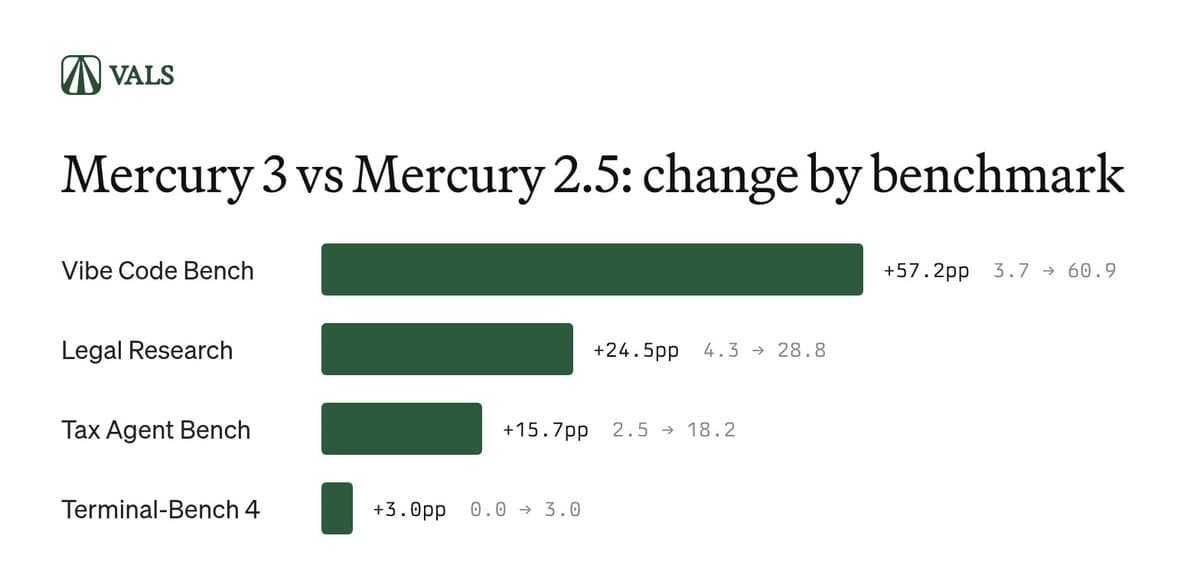
Mercury 3 placed #23 on the Vals Index, just ahead of Beam 1.0, according to ValsAI. Its reported improvements over Mercury 2.5 span three benchmarks:
- Vibe Code Bench: 3.7% → 60.9%, +57.2 percentage points.
- Legal Research: +24.5 points.
- Tax Agent: +15.7 points.
Six of the 50 apps passed every test; Mercury 2.5 produced no perfect apps. The headline 60.9% averages per-app test scores: under Vals' scoring methodology, a UI test passes when at least 90% of its substeps succeed.
Longer reasoning raises per-app spend
The reported app-building cost rose from $0.38 to $1.25, about 3.3 times as much, despite slightly cheaper output tokens. Vals quoted $0.70 per million output tokens for Mercury 3 versus $0.75 for Mercury 2.5, with input unchanged at $0.20 per million.
Vals attributed much of the performance gain to longer reasoning. Mercury 3 generated substantially more output:
- Legal Research: about 12 times Mercury 2.5's output-token volume.
- Tax Agent: about 9 times its predecessor's output-token volume.
Cache misses drive the Index bill
At the prices quoted in ValsAI's thread, Mercury 3 averaged $0.97 per Vals Index test. Three higher-scoring models cost less:
| Model | Reported cost per Index test |
| --- | ---: |
| Mercury 3 | $0.97 |
| GPT-6 Luna | $0.45 |
| DeepSeek V4.1 Flash | $0.66 |
| MiMo V2.6 Flash | $0.22 |
Uncached input carried the sting: each token cost 10 times the cached rate. Vals attributed the cost gap to these input-side numbers:
- Cached share of input: 84% for Mercury 3, versus 95–98% for those competitors.
- Input's share of total token spending: about 88% for Mercury 3.
- Code Migration spending: $4.41 per task.
Launch discounts change the cost figures
Inception's official pricing table lists a 50% launch discount: $0.10 per million input tokens and $0.35 per million output tokens, versus the $0.20/$0.70 rates quoted in Vals' cost thread.
Vals now lists those discounted token rates on its model profile, alongside $0.478 per Index test, compared with the thread's $0.97. The $1.25-per-app figure accompanies the undiscounted rates in the thread.
Terminal runs exhaust the output budget
Mercury 3 scored 3.0% on Terminal-Bench 4. On one task, it consumed its entire output budget on reasoning and the agent crashed; Vals observed that failure in two separate runs.
Vals' published default settings list high reasoning effort and a maximum output of 131,072 tokens. Individual benchmarks can use different providers and parameters.