
ARC Prize verifies Gemini Carbon at 99.1% on ARC-AGI-3 with a provider adapter
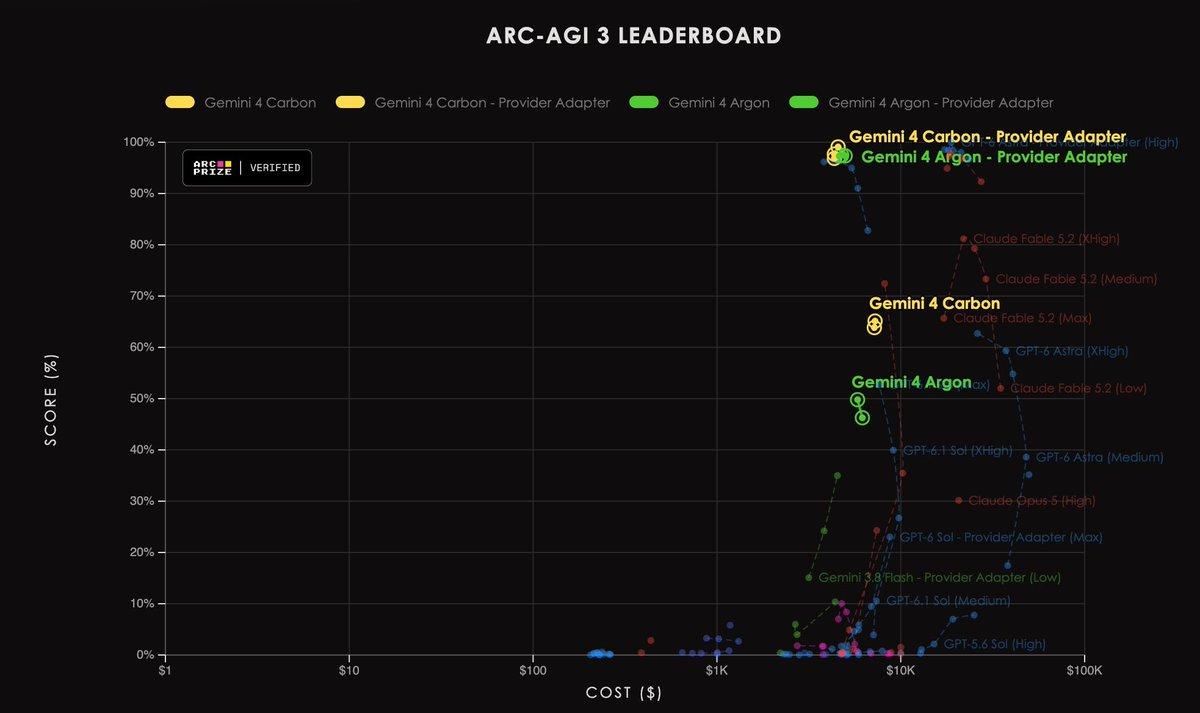
ARC Prize verified Carbon at 99.1% on ARC-AGI-3 with a provider adapter versus 65.1% with its standard harness. Carbon also used more first-action reasoning tokens than Argon on 24 of 25 public games.
TL;DR
- Carbon reached 99.1% on ARC-AGI-3 with a provider adapter versus 65.1% with the standard harness, according to ARC Prize's verified results. Those headline runs used different reasoning levels.
- Carbon used more first-action reasoning tokens than Argon on 24 of 25 public games, ARC Prize found.
- Extra reasoning pushed public ARC-AGI-2 costs from $0.36 to $0.75 per task, about 2.1×, despite unchanged token pricing, according to ARC Prize's cost breakdown.
Carbon's high-reasoning standard run paused so long between moves that game sessions expired. The scoring rules measure completion and action efficiency against humans, while excluding internal reasoning steps from the action count.
Provider adapter
The headline comparison changes both harness and effort. ARC Prize's full score table separates the semi-private results:
| Reasoning level | Standard harness | Provider adapter |
| --- | ---: | ---: |
| Low | 65.1% | 97.7% |
| Medium | 63.9% | 99.1% |
| High | Not reported | 96.9% |
At matched medium effort, the adapter adds 35.2 percentage points. The harness earns equal billing here.
Under ARC Prize's testing policy, the two configurations retain different context:
- Standard: A minimal, provider-neutral interface carries forward notes the model chooses to keep.
- Provider adapter: Provider-designed context management preserves opaque reasoning state between requests and compacts longer conversations, allowing prior work to be reused.
The headline adapter evaluation cost $4,600 in total, versus $7,200 for the headline standard evaluation.
Reasoning levels
ARC Prize omitted Carbon's high-reasoning standard result because it completed only 30 of 55 games, according to its evaluation notes.
Medium reasoning also beat high reasoning on the two earlier benchmarks:
- ARC-AGI-1: 98.5% at medium versus 97.5% at high, a 1-point drop.
- ARC-AGI-2: 94.2% at medium versus 92.1% at high, a 2.1-point drop.
The generational gain also depends on effort. Comparing the published Argon results with Carbon gives a 17.6-point standard-harness improvement at medium effort, roughly the 18 points in ARC Prize's announcement; comparing each model's best standard score gives 15.3 points.
Reasoning-token costs
On ARC-AGI-3 public games at high reasoning, Carbon averaged roughly 6,000 reasoning tokens before its first action versus Argon's 2,000, about 3×. The increase appeared on 24 of 25 games, according to ARC Prize's follow-up.
The public ARC-AGI-2 evaluation at high reasoning showed a similar compute increase:
- Reasoning tokens per completed task: 28,000 for Argon → 68,000 for Carbon, about 2.4×.
- Cost per task: $0.36 → $0.75, about 2.1×.
- Token pricing: Unchanged, with similar input and non-reasoning output usage.
Those public high-effort costs describe a different evaluation from the headline 94.2%, $0.38-per-task result.
Action counts
Carbon's extra thinking produced a much smaller change in moves. On the 23 public ARC-AGI-3 games both models won at high reasoning with the provider adapter, ARC Prize reported:
- Argon: 5,846 actions.
- Carbon: 5,731 actions, about 2% fewer.
- Human speedruns: 4,804 actions, leaving Carbon 19.3% above that reference.
The human comparison here uses speedrun action totals, distinct from the benchmark's per-level human baseline used to calculate scores.