
Google adds automatic model handoffs to Antigravity with Orchestrator
Antigravity's new Orchestrator uses Carbon to plan and Hydrogen to edit and test. Google reports near-Carbon Terminal-Bench success with 24% less quota use and 19% faster completion; rollout starts with AI Ultra subscribers.
TL;DR
- Automatic model handoffs have arrived in Antigravity: Google’s announcement puts Carbon on planning, Hydrogen on edits and tests, and Carbon back in control when execution hits trouble.
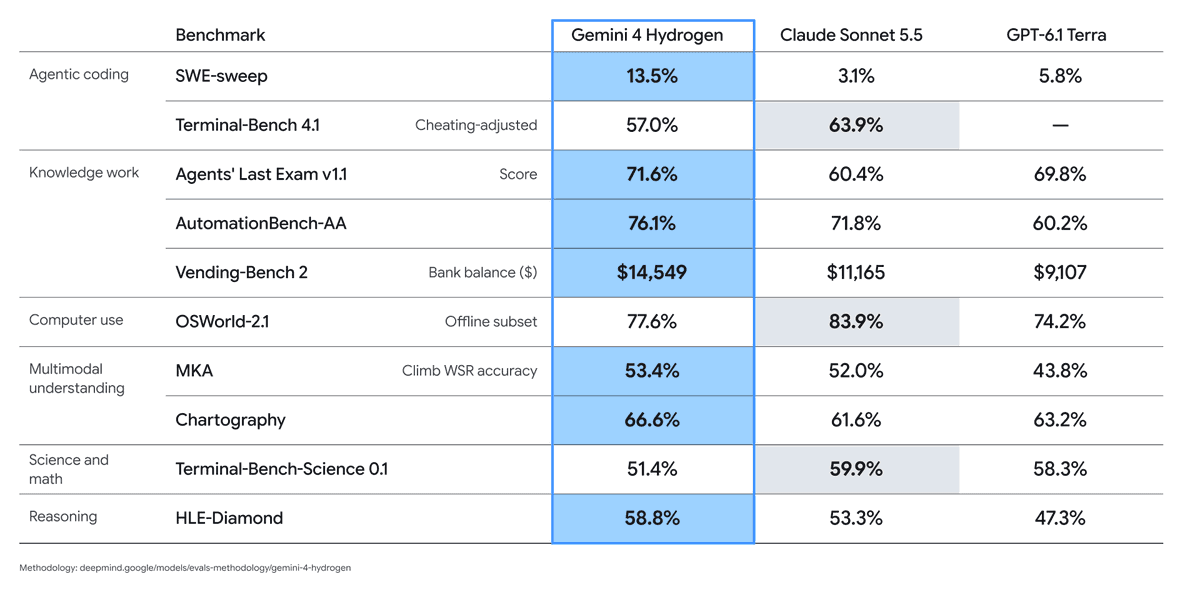
- Orchestrator consumed 24% less quota and finished 19% faster than Carbon alone, with near-Carbon task success, according to Google’s launch thread.
- Hydrogen costs $1.50 per million input tokens and $7.50 per million output tokens across its 1M-token context, per the Hydrogen announcement.
- Carbon-backed Orchestrator starts with Ultra subscribers, as Google announced; the detailed rollout also lists Argon-backed Orchestrator for paid Pro subscribers.
Carbon can start by exploring dependencies in read-only mode, with explicit triggers for taking control back later. The /swarm implementation gives workers isolated git worktrees and zero-token idle waits, while a developer requesting automatic switching had already raised cache rebuilding as a possible cost.
Model handoffs
Users select Orchestrator from Antigravity’s model dropdown, kevinhou22 explained. Google’s technical description gives a three-stage example:
- Carbon plans: It explores dependencies, resolves ambiguities and produces a concrete plan with explicit replanning triggers, initially working read-only.
- Hydrogen executes: It writes edits, updates packages and runs tests.
- Carbon repairs: When Hydrogen hits friction, Carbon inspects the current state, repairs the plan and hands execution back.
Early-access user itsPaulAi reported that Carbon planning plus Hydrogen execution gave him the best results he had obtained from any models.
Terminal-Bench results
Google does not publish an exact success-rate gap or dollar cost per task in the Antigravity announcement. Its efficiency figures are relative quota consumption and average completion time.
Benchmark versions differ across Google’s descriptions: the social announcement names Terminal-Bench 4.0, while the Antigravity blog names 4.1 for the same efficiency figures.
A forum user raised cache rebuilding as a potential switching cost a day before launch; Google’s Orchestrator post does not explain how handoffs handle cached context.
Hydrogen execution costs
Hydrogen’s flat token rates leave reasoning effort as another source of cost variation. When selected directly, it exposes four levels in Google’s description:
lowmediumhigh, the defaultxhigh, the new highest tier
In ValsAI’s tests, moving from High to xhigh roughly doubled cost and runtime, with gains concentrated in particular tasks:
| Measurement | High | xhigh |
| --- | ---: | ---: |
| Vals Index accuracy | 67.00% | 68.49% |
| Cost per task | $4.94 | $9.84 |
| Time per task, rounded | 17 minutes | 32 minutes |
| Tax Agent Bench | 41.42% | 52.30% |
| Vibe Code Bench | 89.23% | 87.78% |
| Legal Research Bench | 55.77% | 53.85% |
Google does not identify the Hydrogen thinking level used in its Orchestrator comparison.
Swarm agent teams
Google launched Carbon on November 10 alongside the /swarm preview, two days before Orchestrator. The Antigravity team’s implementation distributes work across parallel agents:
- Coordinator and workers: A coordinator starts specialized workers in isolated git worktrees to keep edits from colliding.
- Adversarial verifiers: Separate agents run tests and challenge diffs.
- Shared message board: Agents communicate directly through an append-only board, waiting at zero token cost when idle and activating when input arrives.
- Inspection UI: The side pane exposes a Board feed, Members roster and replayable Graph timeline.
/swarm boardor Alt+S opens the live terminal board.
Agents can be pinned to different models. Google describes Carbon taking coordination, architecture and auditing roles while faster models handle routine implementation, and warns that parallel swarms consume quota much faster than standard chat.
Rollout by plan
Google’s detailed availability section specifies separate planner entitlements:
- Google AI Pro: Standalone Hydrogen and Orchestrator (Argon).
- Google AI Ultra: Standalone Hydrogen, Orchestrator (Carbon) and Orchestrator (Argon).
- Enterprises: Hydrogen and Orchestrator through Gemini for business.
Hydrogen also rolls out through the Gemini API in AI Studio and Android Studio, according to GoogleDeepMind. Those developer surfaces are listed separately from the Antigravity rollout.
Antigravity SDK pipelines
The Antigravity SDK supports explicit model assignments for individual agent roles. Google’s open-source issue-triage demo divides the work as follows:
- Hydrogen agents: Triage incoming issues, search the codebase, ask clarifying questions, write code and make rapid UI iterations from PR comments.
- Carbon agent: Handle larger refactors, new features and security checks.