
Kevin Kern delegates coding tasks from Opus 5.5 to GPT-6.1 Sol
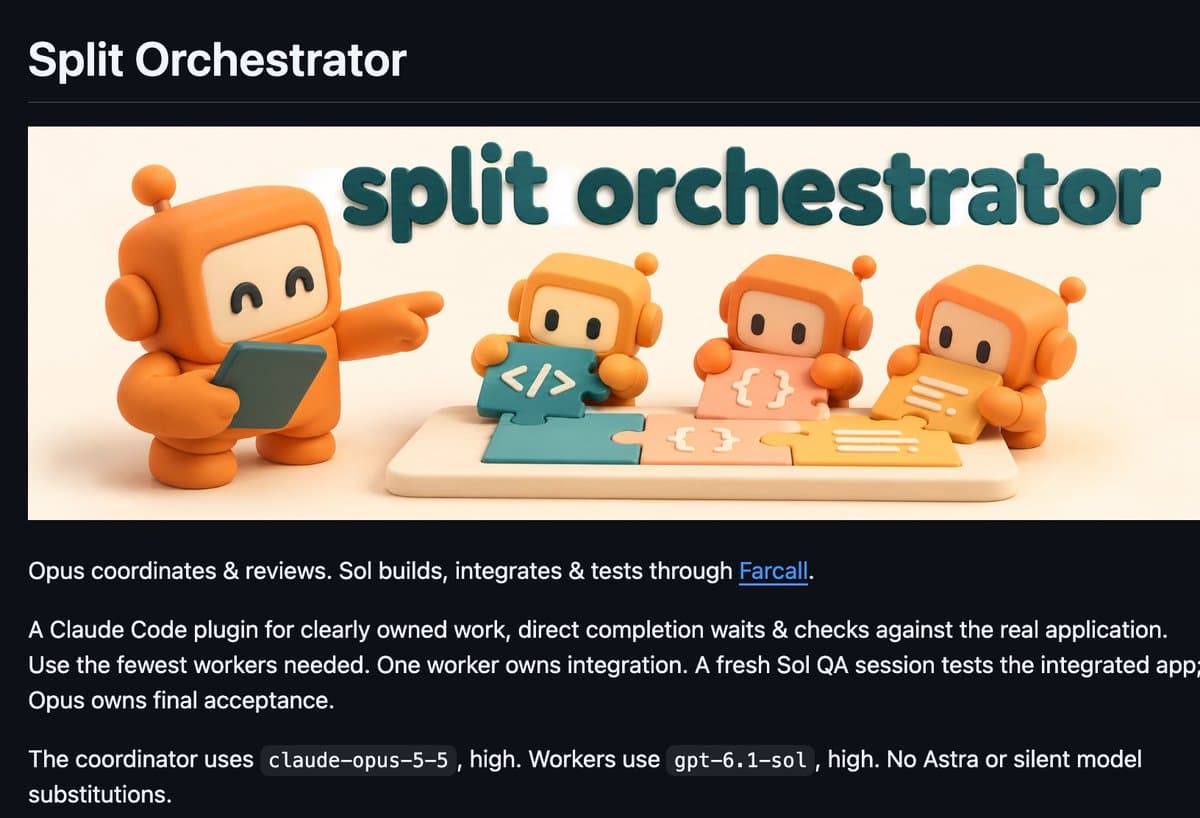
Kevin Kern uses Opus 5.5 for orchestration and UI work, with GPT-6.1 Sol handling delegated coding. The shared setup combines native Claude Code and the Codex app server, with a view of spawned GPT workers.
TL;DR
- Opus 5.5 handles orchestration and UI work while GPT-6.1 Sol does delegated coding in kevinkern's setup.
- One main conversation fans out to feature coordinators and workers, as Kern explains in his walkthrough.
- File ownership is checked during integration rather than enforced by tooling, according to his explanation of handoff cards.
- Spawned GPT workers are now visible inside bb, as demonstrated in the expanded sidebar.
Farcall's launch command gives MCP calls a two-hour timeout. The orchestrator README calls for a fresh Sol QA session against the integrated application. The sidebar plugin brings inactive threads back when they need input.
One chat, feature coordinators
Kevin Kern writes a spec upfront, then adds features through the main orchestrator, as he explained in a follow-up. His annotated walkthrough divides the setup into five parts:
- Machine: the computer running the agents.
- Main orchestrator: the only conversation Kern talks to.
- Feature coordinator: one independently working coordinator per feature.
- Workers: build, merge and test, with one entry per run.
- Additional review: complex features can consult Astra or Fable 5.1.
Kern called orchestration “nothing new” in a reply. He also said his earlier Opus-to-Sonnet pairing worked well in the follow-up about specifications.
Farcall MCP
Kern runs native Claude Code and the Codex app server inside bb, with Farcall carrying communication between them.
Farcall exposes two execution tools:
run: an individual delegation withcwd,delegation_id,prompt,modelandeffortfields.run_batch: one call for 1 to 5 parallel workers in separate checkouts.
One MCP call stays pending until the worker returns. The parent can then resume that worker's session for corrections, without status polling.
The documented Claude Code launch disables automatic MCP backgrounding and sets the tool timeout:
The orchestrator requires Node 24+, a signed-in Codex CLI, and both the Farcall and Split Orchestrator plugins.
Worktrees and handoff cards
Each parallel stream runs in its own worktree and branch, Kern clarified in a follow-up. Within a stream, he avoids two agents touching the same module and assigns one integrator to check changed paths before merging, according to his reply about conflicts.
Sol receives a handoff card. Its integrator compares the changed files against that card, but the scope is not enforced by tooling.
Kern reports low conflict rates, with some remaining problems around i18n text. Giving integration a single owner is the best part of this setup.
Fresh Sol QA
Acceptance in the published workflow follows three stages:
- One Sol worker integrates the workers' commits.
- A fresh Sol QA session tests the integrated application.
- Opus reviews the evidence and owns final acceptance.
UI QA requires a working browser connection to the real application and backend. The sample task prompt requests approval before any push, main-branch merge, deployment or publishing.
Model routing and costs
- Guidance: Kern describes Sol as cheap but needing direction, and Astra as the heaviest model in his runs, in a pricing discussion. His current pairing is Opus → Sol.
- Published defaults: the coordinator uses
claude-opus-5-5athigh; workers usegpt-6.1-solathigh. The README explicitly rules out Astra and silent model substitutions, a narrower configuration than the annotated walkthrough's review options. - Cursor variant: Kern describes spawning a thread, choosing Cursor with Composer 2.5 and changing a variable in another reply.
Machine Sidebar
Runs are grouped by machine, project and thread in Machine Sidebar, with git branch labels and status indicators.
Kern shared the sidebar plugin when asked about the interface. He also connected his machines through Tailscale and showed bb on a foldable phone.
Sol design reviews
Opus can delegate a review while continuing its own investigation, as a demo shared by theo illustrates. The request asks the models to agree on a diff panel's UX, user expectations, behavior in other tools and performance.
Dot reminders and wall measurements
Dot supplies another interface to Codex: dkundel says the combination reduces mental overhead and adds proactivity in a post about his workflow. Kern's other examples move beyond the repository:
- He shared a Dot reminder about a Monday anniversary and a gift still unbought.
- He used prompting to position three 32 × 42 cm frames with 16 cm gaps in a picture-hanging example.