
Perplexity launches Multiagent teams that mix models
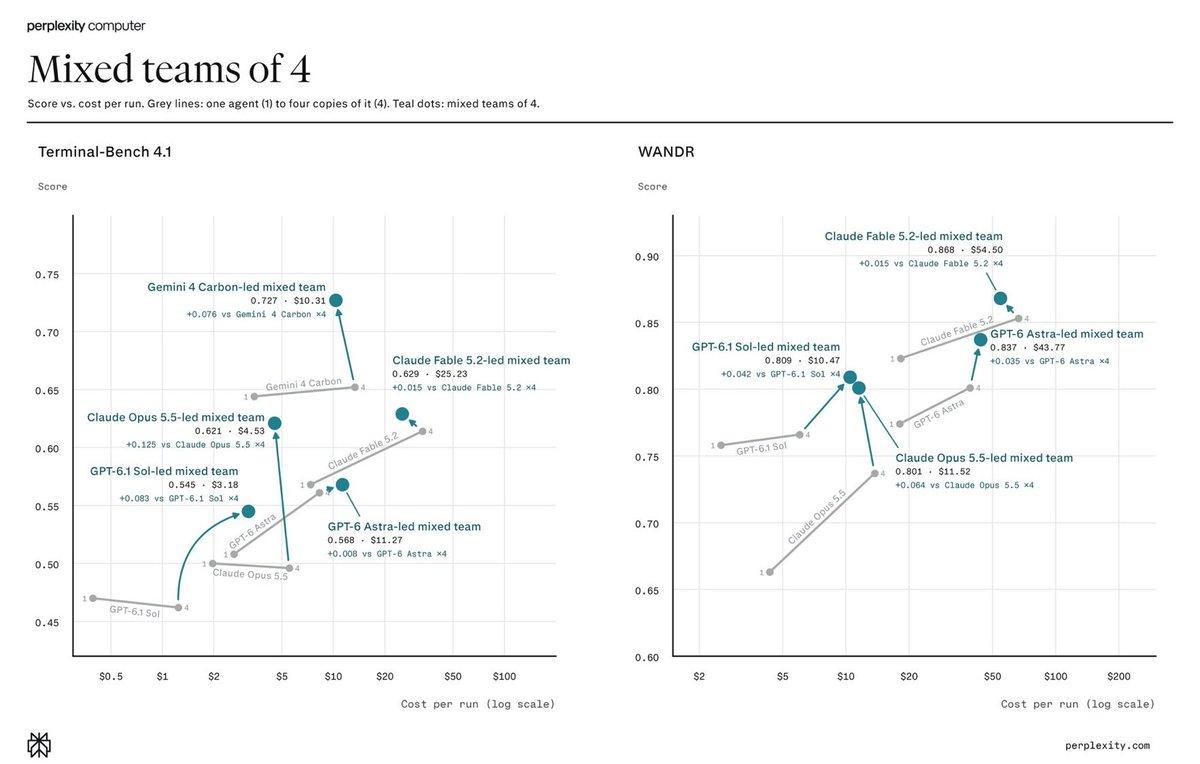
Perplexity's Multiagent setting lets Max web users run Fable-led teams in Computer and Teammates. Perplexity reports that mixed-model teams beat identical-agent teams on Terminal Bench and WANDR.
TL;DR
- Multiagent adds Fable-led, mixed-model teams to Computer and Teammates, with agents exchanging findings during the task, according to the launch announcement.
- Mixed teams beat identical-agent teams on Terminal-Bench and WANDR in Perplexity’s reported comparisons.
- Access starts with Max subscribers on the web, and Perplexity calls the mode credit-intensive in its rollout thread.
The lead can assign up to 16 agents, well beyond the four-agent teams in the benchmark comparisons. Perplexity’s WANDR benchmark contains 500 collection-building tasks totaling 170,495 source-backed records.
Fable-led teams
Multiagent sits above Ultra in the effort selector, as a launch report describes.
- Lead: Claude Fable 5.2 plans the task, delegates work, and assembles the final response.
- Default workers: Claude Opus 5.5, GPT 6.1 Sol, and Gemini 4 Carbon.
- Shared work: Agents exchange evidence, challenge assumptions, and coordinate edits to shared files, according to Perplexity’s launch guide.
- Model selection: Users can name supporting models in the prompt. Fable 5.2 and GPT 6 Astra join as supporting agents when requested or when a particular task calls for them.
- Follow-ups: The lead tells affected agents what changed, and the existing team continues working. Stopping the thread stops the whole team.
Ultra and Model Council
Perplexity still lists Model Council as a separate option in its launch guide, alongside the mode testingcatalog described as its successor.
- Ultra: A lead delegates subtasks to supporting agents, which report back only to the lead.
- Multiagent: The same lead model as Ultra coordinates workers that communicate directly and contribute to shared deliverables.
- Model Council: Several models independently investigate the same question, then Computer combines their findings and shows agreement and disagreement.
Mixed-model benchmarks
The most useful comparison holds team size at four: mixed teams beat four copies of their lead model on both benchmarks, according to Perplexity’s benchmark thread.
- Terminal-Bench 4.1 setup: Five frontier models ran alone, as two and four identical copies, and as leads of mixed-model teams of four.
- Terminal-Bench 4.1 scores: Mixed teams gained 0.008 to 0.125 over four identical copies. The highest-scoring team, led by Gemini 4 Carbon, reached 0.727 versus 0.652 for four Carbon copies.
- WANDR scores: Every mixed team beat four copies of its lead, with gains of 0.015 to 0.064.
- Cost versus four identical copies: The top mixed team on Terminal-Bench cost $10.31 per run versus approximately $13. On WANDR, the corresponding comparison was $54.50 versus $66.41.
Those savings use four-copy teams as the baseline, not single-agent runs.
Parallelism and latency
Perplexity’s latency chart compares one agent with four identical copies, so it measures same-model parallelism separately from the mixed-model results.
Max access and Mac teammates
Multiagent is rolling out to Max and Enterprise Max subscribers on the web, with mobile and desktop support planned, according to Perplexity’s rollout thread. The effort-mode documentation says the macOS and Windows desktop apps still use the regular model picker.
Users can already build Teammates with their choice of frontier model, according to an earlier product post. Teammates are also available in the Mac app for Max subscribers, where ongoing jobs can use connected tools.