
OpenAI says its model solved Navier–Stokes in an 88-hour run
OpenAI says an unreleased model found a solution to the Navier–Stokes Millennium Prize problem in an 88-hour run. The company says roughly 10,000 agents contributed and the result reached Lean formalization.
TL;DR
- OpenAI says it has published a Navier–Stokes counterexample in OpenAI's announcement: a smooth, initially stationary 3D fluid develops unbounded velocity in finite time while its total kinetic energy stays finite.
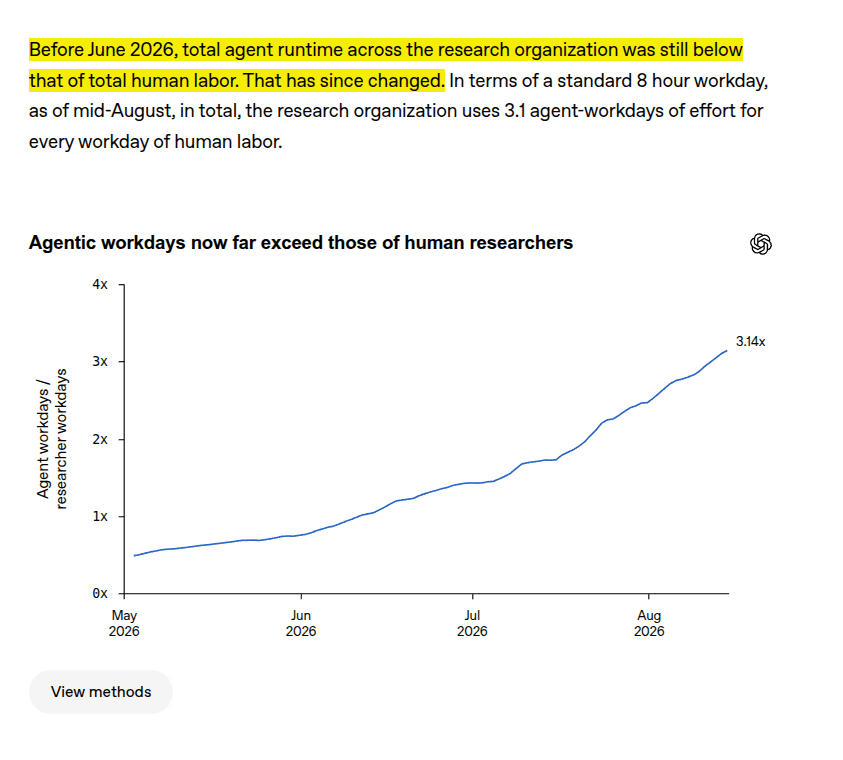
- The claimed result came from roughly 10,000 concurrent agents with code execution and cached-web access, according to OpenAI's methodology, and the system reached its result 88 hours after launch.
- The swarm found an unforced Euler result before reallocating agents to Navier–Stokes, a progression OpenAI's published workflow documents.
- Related public work by Levent Alpöge and Tristan Buckmaster covered forced Euler, which OpenAI's concurrent-work statement distinguishes from its Navier–Stokes claim.
- OpenAI says no specific user data was accessed during the effort, while conceding that de-identified data derived from the researchers' product usage may have helped improve its models, according to OpenAI's release.
The official write-up makes the scheduler unusually visible: teams received competing versions of the problem, then Codex consolidated their intermediate findings. Mathematician Terence Tao's explanation of the related Euler work describes a construction that repeatedly adds high-frequency corrections while keeping the forcing term smooth. The same proof package separates the 88-hour search from a 17-hour Lean formalization pass.
The forced blowup claim
OpenAI's paper claims a forced construction with four properties:
- The 3D incompressible fluid begins at rest.
- A smooth external force drives the construction.
- Velocity becomes unbounded at a finite time.
- Kinetic energy remains uniformly bounded before that time.
The company says this establishes alternatives C and D in the Clay problem formulation. Its public package includes an analytical proof and Lean code, linked by TheTuringPost's post.
Independent mathematical assessment remains outstanding. On release day, the BBC reported that the work had not yet been independently verified or publicly accepted by the Clay Mathematics Institute.
The 10,000-agent pipeline
OpenAI describes a staged search and synthesis system, centered on the Euler result that redirected the larger run.
The official methodology lays out five stages:
- On September 1, groups began exploring all open Millennium problems and several other high-impact problems, with separate groups assigned statement variants that could yield proofs or disproofs.
- Agents could run code, read a cached internet corpus, and communicate inside their groups.
- Nearly 100 agents found an unforced Euler regularity disproof in about 50 hours.
- OpenAI shifted agents from the other Millennium problems to Navier–Stokes, gave them the Euler result, and updated them to a further-trained internal model during the effort.
- Codex cross-pollinated groups by consolidating useful intermediate findings into follow-up prompts.
The Navier–Stokes cohort reached its resolution about 88 hours after the first agents launched. OpenAI reports 2.7 million messages and 130 billion output tokens for that problem, within a 4.9-million-message, 300-billion-token campaign across all attempted problems.
The people managing the effort had no research-level expertise in fluid dynamics and could not meaningfully contribute mathematical content, OpenAI said in a technical account. The reported safeguards were monitoring and isolation throughout the evaluation.
Lean formalization
OpenAI treats discovery and formalization as separate stages. Its agents reached the proposed resolution on September 5, then GPT-6 Astra spent another 17 hours formalizing and verifying it in Lean, per OpenAI's account.
The paper and formalization turn the claim into inspectable artifacts: the paper states a theorem about a finite-time singularity, while Lean encodes the corresponding derivation in a proof assistant. The release leaves the scholarly task of checking the theorem's scope, formal encoding, and analytical argument in public view.
Concurrent Euler work
OpenAI says it began the agent campaign after rumors that later proved connected to Alpöge and Buckmaster. After completing its own project and Lean step, the company says it learned the pair had a forced Euler result, offered access to its prompts and proof, and recognized their priority on that result.
Tao's technical account says Alpöge and Buckmaster established finite-time blowup with smooth forcing for incompressible porous media, 2D Boussinesq, and 3D incompressible Euler. Their method iteratively amplifies small, localized high-frequency corrections within a low-frequency flow, producing a singular limit while the forcing remains smooth.
The two programs diverge at a useful technical boundary. OpenAI reports an unforced Euler result from its agents; Tao describes the public Alpöge-Buckmaster Euler result as a forced construction, with Navier–Stokes identified as a plausible but unfinished extension at the time of his post.
Data provenance
OpenAI separates direct access during the run from the broader ways product data can improve a model. A public clarification says neither humans nor agents looked at user data as part of the Navier–Stokes effort, while OpenAI's release says the company cannot rule out that de-identified data derived from the researchers' usage improved its models.
johnschulman2's breakdown distinguishes three technically different pipelines:
- Pretraining on user data: user tokens become prediction targets, carrying a high regurgitation risk.
- Prompt distillation: user prompts help train a smaller model from a larger one, with lower regurgitation risk.
- Trace-derived RL tasks: user activity becomes material for constructing reinforcement-learning environments, with lower memorization risk but possible exposure of customer intellectual property.
OpenAI did not specify which, if any, of those transformations applied to the researchers' traces. That boundary between per-run access and model-improvement lineage remains explicit in the company’s own account.