
SemiAnalysis says DeepInfer supports only offline, single-turn inference
SemiAnalysis says DeepInfer cannot yet run InferenceX serving tests because it supports only offline, single-turn inference. It reports vLLM matches DeepInfer's published benchmark and shares serving configurations.
TL;DR
- DeepInfer cannot yet run InferenceX's serving tests: SemiAnalysis says the released code supports only offline, single-turn inference.
- vLLM gets within 6% of DeepInfer's published decode performance under matched model and context settings, according to vLLM's comparison.
- DeepSeek's $38-per-accelerator-hour disclosure is revenue from a cache-heavy production workload: ZhihuFrontier's breakdown reports a 96% input cache hit rate.
The API companion translates three request formats but leaves HTTP transport to its caller. DeepInfer's configuration notes expose a 140-token bounded-replay suffix and deterministic sampling that requires setting DEEPINFER_ENABLE_MTP_VARLEN=0.
Offline inference and missing service components
SemiAnalysis says filling in DeepInfer's missing serving infrastructure would require too many assumptions for an InferenceX submission. DeepSeek's README explicitly excludes three components needed for a complete service:
- A KV cache system.
- Disaggregation of vision encoding, prefill and decode, although most required engine functionality is already implemented.
- Load balancing across data-parallel replicas for prefill and decode.
The Apache-2.0 release supports V4.1-Flash on NVIDIA SM100 GPUs and Huawei Ascend 950 NPUs, as described in the release overview.
The companion deepseek-recipe supplies Rust libraries and Python bindings for Chat Completions, Responses and Messages conversion. Model inference and tool execution also remain the caller's responsibility.
A 96% cache hit rate
DeepSeek reports 155 trillion tokens/day from one production cluster in the deployment breakdown. Its operational table separates cached input, newly processed input and generated output:
DeepSeek's production measurements, including cached and uncached throughput, latency and revenue
Behind those cache hits sits a formidable storage dependency:
- Roughly 100 PiB of SSD capacity in a separate 3FS cluster stores persistent KV prefixes.
- Any prefill worker can retrieve any cached prefix, decoupling cache access from worker placement.
- Retention reaches three days for agent traffic and seven days for chatbot traffic, according to the accompanying report.
- Asynchronous cache loading overlaps host-to-device transfers with layer execution.
vLLM's decode comparison
vLLM reports decode throughput within 6% of DeepInfer's published curve across batch sizes 8 to 256. The comparison uses:
- Model and context: DeepSeek-V4.1-Flash at 131K tokens.
- Speculation: three DSpark draft tokens and a fixed 3.25 accepted tokens per step.
- vLLM configuration: 32 GB200 GPUs, wide expert parallelism and expert-parallel load balancing.
- DeepInfer reference: the published 64-GPU EP64/DP64 curve, with 384+64 experts versus vLLM's 384+32.
The engines share DeepSeek kernel libraries, which vLLM credits for their similar performance. DeepInfer's acknowledgments also state that it was originally built primarily on vLLM.
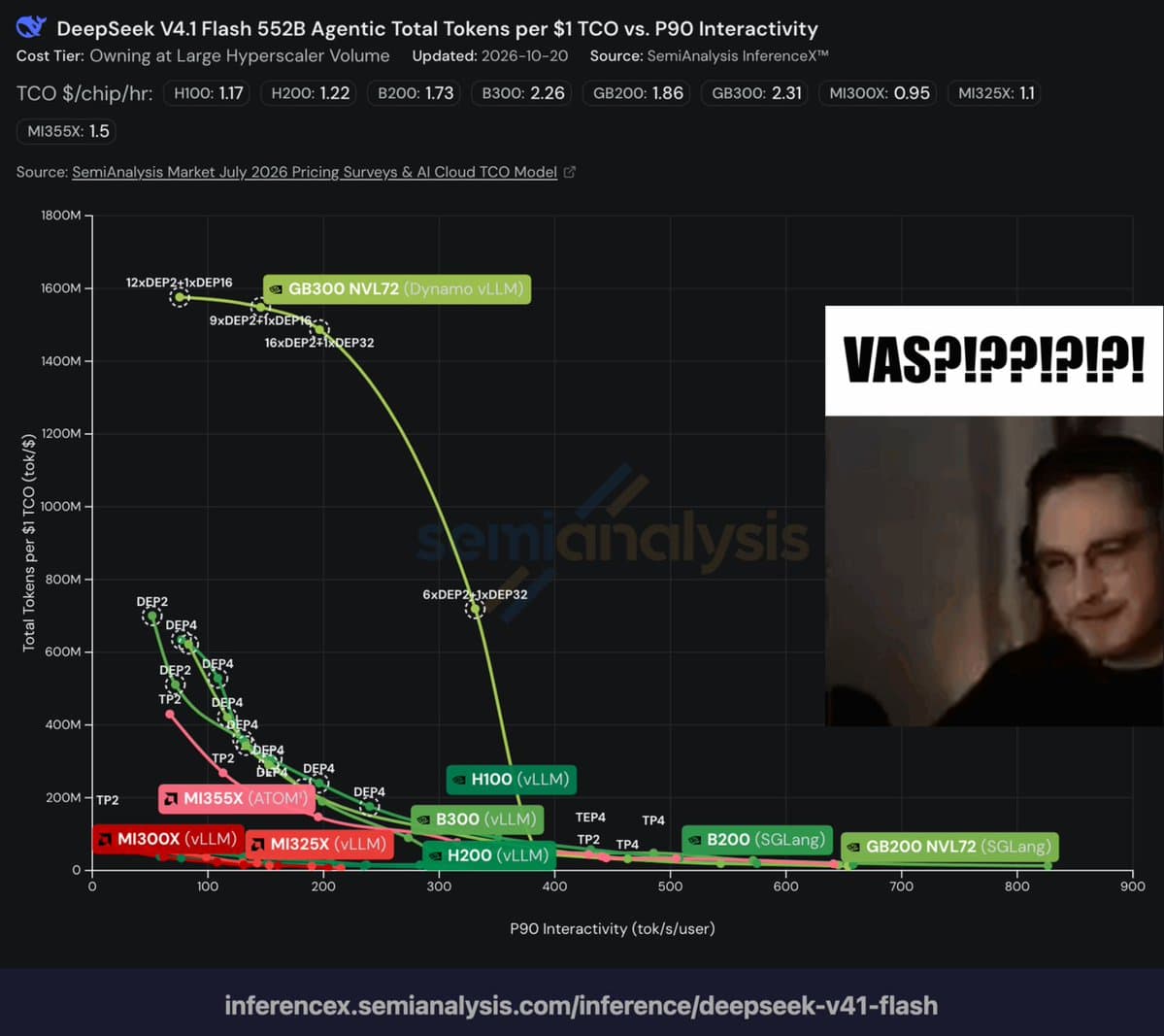
The InferenceX dashboard covers long-context, multi-turn serving workloads. SemiAnalysis links configurations and logs for the vLLM serving results alongside its profit estimator.
Revenue, profit and utilization
vLLM warns that its AgentX revenue estimate uses a different workload from DeepSeek's production figure. The numbers circulating around the comparison also use different accounting assumptions:
- DeepSeek production: $38 in revenue per accelerator-hour at off-peak API prices, as reported in the deployment breakdown.
- vLLM on AgentX: $38.96 in revenue per GPU-hour at 196 P90 tokens/s/user. Its 954K tokens/s/GPU total includes cached input, uncached input and output.
- Profit-estimator snapshot: $33.96 modeled profit after $5/GPU-hour compute expense, an 87.2% margin, using 100% utilization and a three-year rental commitment.
- SemiAnalysis's separate estimate: $50/GPU-hour in profit on GB300 at 125 TPS and 60% utilization, using OpenRouter prices.
Low-latency decode
A separate AgentX test reached 829 P90 tokens/s for one user on four B300 GPUs with vLLM's specialized decode path. The comparison reached 656 tokens/s on GB300 with the standard path, so both hardware and execution path changed; both runs used five DSpark draft tokens.