
Meta releases 816B-parameter Muse Spark Open with 1M-token context
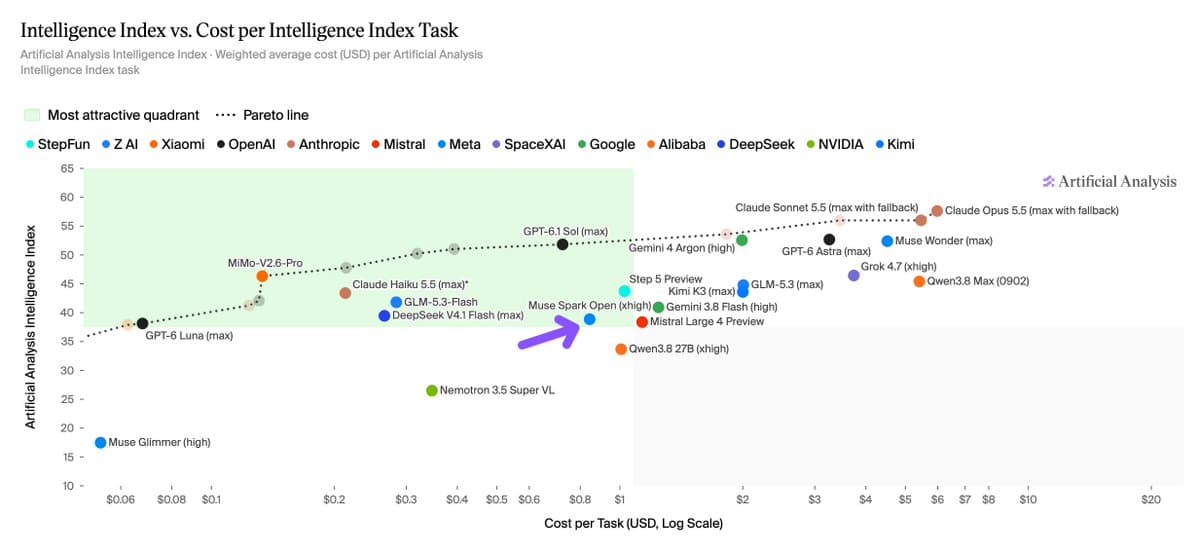
Meta released Muse Spark Open with 816B parameters and a 1M-token context window. It scores 39 on Artificial Analysis’s Intelligence Index, with launch support from vLLM, Ollama and Together AI.
TL;DR
- Meta released Muse Spark Open weights: 816B parameters, 42B active per token and a 1M-token context window, according to the release overview.
- It leads US open-weight models on Artificial Analysis’s Intelligence Index at 39, but ranks last on the index’s four agentic evaluations among its nine highest-scoring open models, per Artificial Analysis’s results.
- Launch API pricing is $1.25/M input and $4.25/M output tokens; measured Intelligence Index task cost is $0.84 in Artificial Analysis’s cost comparison.
- Ollama supports running it through Claude Code, as described in its launch announcement, with access now spanning Pro, Max, Pay-as-you-go and Teams in the completed rollout.
The serving-stack work is the best part: Meta’s deployment guide ships two speculative decoders alongside the weights. The vLLM integration requires a separate audio input for a video’s soundtrack, while the license explicitly exempts embedded product features from its large-provider agreement clause.
Benchmarks at xhigh
Meta’s model card reports these results with xhigh reasoning, temperature 1.0 and top-p 1.0:
| Meta-reported evaluation | Muse Spark Open | GLM-5.3 (max) | Difference |
| --- | ---: | ---: | ---: |
| MCP-Atlas | 89.2 | 84.2 | +5.0 points |
| JobBench | 61.8 | 61.4 | +0.4 points |
Independent testing puts Spark Open 22 Intelligence Index points above August’s Muse Glimmer, which scored 17, and one point below Muse Spark 1.2’s 40, according to Artificial Analysis. Meta’s newer closed models remain ahead: Muse Wonder scores 52 and Wonder Full scores 56.
Spark Open also leads open-weight models on AA-Omniscience at 25. Its 24% hallucination rate is the lowest among open-weight models scoring at least 30 on the Intelligence Index.
Agentic gaps
GLM-5.3’s six-point Intelligence Index lead comes entirely from the four agentic evaluations, according to Artificial Analysis’s breakdown. Spark Open ranks fourth across the other six evaluations combined.
Meta’s own coding results show the same unevenness in its benchmark table:
- Terminal-Bench 2.1, Terminus 2 agent: 76.4 versus GLM-5.3’s 83.9, 7.5 points lower.
- DeepSWE 1.1, preferred harness: 60 versus GLM-5.3’s 67, 7 points lower.
Against Muse Spark 1.2, Artificial Analysis found stronger AutomationBench-AA performance and fewer hallucinations, but weaker GDPval-AA v2.1, CritPt and AA-Omniscience accuracy. The hallucination advantage coexists with lower answer accuracy on that knowledge evaluation.
Token use and API pricing
Spark Open generates about 40,000 output tokens per Intelligence Index task, the fewest among the nine highest-scoring open-weight models in Artificial Analysis’s launch comparison. That is 16% fewer than Spark 1.2’s 48,000 and 43% fewer than GLM-5.3’s 71,000.
At launch prices, its $0.84 task cost compares with Spark 1.2’s $0.97, GLM-5.3’s $2.01 and DeepSeek V4.1 Flash’s $0.27 in Artificial Analysis’s measurements. Together AI, Fireworks and Baseten also list cached input at $0.15/M tokens.
Together’s promotion terms add three conditions to the free launch window:
- Free serverless access ends October 18, 2026 at noon PT.
- The promotional endpoint automatically becomes paid after the deadline.
- New accounts require a payment method and a minimum $15 credit purchase; those credits remain untouched during free usage. Standard rate limits apply, and Together can change or end the offer early.
Expert routing and KV cache
The architecture combines sparse experts with hybrid attention. The Hugging Face breakdown describes:
- 62 decoder layers, with hidden dimension 8,192.
- 256 experts per MoE layer, with eight selected for each token.
- 128 query heads and 16 KV heads, each with dimension 64.
- Experts holding approximately 97% of the model’s parameters.
Sparse activation reduces computation while the full expert pool remains resident in memory.
The vLLM implementation uses 46 sliding-window attention layers with a 2,048-token window and 16 full-attention layers. vLLM says this reduces the KV cache at 1M tokens to just over one-quarter of an all-full-attention implementation.
Multimodal preprocessing
Text, images, video and audio share the context window; output is text. The Transformers integration documents several consequential defaults:
- Vision: a 1.8B-parameter Perception Encoder processes images and video frames.
- Video: sampling defaults to two frames per second, capped at 96 frames.
- Audio: the processor expects mono 24 kHz audio, with one embedding per 80 milliseconds, or 12.5 tokens per second.
- Video soundtracks: Transformers supports
load_audio_from_video=True; vLLM requires video and extracted audio as separate content parts.
Meta also records a video-input limitation: very short, roughly 100-pixel clips can trigger a response saying the model cannot view the video.
Reasoning and tool channels
Reasoning cannot be completely disabled, according to Hugging Face’s implementation notes. The supported reasoning_effort values are low, medium, high and xhigh, with xhigh the default; the processor maps them to strengths 16, 64, 256 and 512.
The channel-based template separates four destinations:
self: internal reasoning.commentary: user-visible comments before and between tool calls.user: the final response.- Named tools: calls routed through
to=tool_namewith structured function arguments.
Meta’s inference settings specify temperature 1.0, top-p 1.0 and disabled top-k. Unsupported symbolic reasoning-effort values return an error.
NVFP4 and Mac Studio memory
Meta publishes separate checkpoint sizes and GPU-memory requirements:
| Format | Checkpoint size | Required GPU memory |
| --- | ---: | ---: |
| BF16 | About 1.6 TB | At least 2 TB |
| NVFP4 | About 530 GB | At least 700 GB |
NVFP4 quantizes only the experts. Meta lists deployment on four Blackwell Ultra GPUs or eight H200s.
Apple’s MLX path uses either two 512GB M5 Ultra Mac Studios or four 256GB machines, connected through Thunderbolt 5 and RDMA. Tensor parallelism divides each layer across machines; weights stay local while intermediate results cross the link.
Lower-bit GGUF builds reach a single workstation. Hugging Face measured a 304GB, imatrix-calibrated 2-bit quant at 18 tokens/s on a 512GB M3 Ultra; rohanpaul_ai reported a 344GB 3-bit quant at roughly 21 tokens/s on a short prompt.
SemiAnalysis added B200 inference measurements at launch. Its InferenceX dashboard separates AgentX agentic inference from fixed-sequence measurements and exposes hardware, precision and serving configuration.
DSpark and launch runtimes
Launch support covers BF16, NVFP4 and MXFP4, NVIDIA and AMD GPUs, plus initial TPU support, according to vllm_project’s launch thread. The runtime release notes distinguish prebuilt NVIDIA and AMD container images from PyPI availability, which awaits review and merging of the integration PR.
Two draft models provide speculative decoding in Meta’s serving recipes:
- DSpark for vLLM:
Inferact/Muse-Spark-Open-DSpark, proposing up to seven tokens per pass, with adaptive verification as server load grows. - DFlash V2 for SGLang:
RadixArk/Muse-Spark-Open-DFlash2. Meta reports 3.7× single-request throughput and 2.9× at 16 concurrent requests on MI355X, with unchanged accuracy.
The vLLM recipe exposes separate muse reasoning and tool-call parsers.
vLLM’s launch configuration, including tensor parallelism and reasoning/tool parsers
Hosted endpoints and coding agents
Meta’s provider lineup includes Baseten, Fireworks, Groq, Modal, Nebius, OpenRouter and Together. Groq access starts as a limited preview.
Ollama added Pro access after its initial launch; its latest availability update covers Pro, Max, Pay-as-you-go and Teams. Its cloud and Claude Code commands are:
Vercel uses meta/muse-spark-open across AI SDK, OpenAI-compatible Chat Completions and Responses, and Anthropic-compatible Messages. Its gateway announcement specifies text and image input, narrower than the model’s full modality support.
Venice also exposes text and images. Its privacy description specifies zero retention, without end-to-end encryption or TEE isolation, and retains Meta’s safety alignment.
Muse Model License
The custom license includes attribution and a large-provider agreement requirement, both highlighted in Artificial Analysis’s release analysis. The full license specifies:
- Attribution: prominently display “Built with Muse Spark Open” in the product UI, documentation, website or settings.
- Model-as-a-Service threshold: providers exceeding $20M in aggregate gross revenue across the licensee and affiliates during any consecutive 12-month period must notify Meta and enter a separate written agreement.
- Exceptions: the agreement clause excludes internal use, research, non-MaaS commercial activity and model-powered features within a product that is not itself Model-as-a-Service.
- Derivatives: the definition includes models fine-tuned, distilled or otherwise improved using the software or its outputs. Meta claims no ownership of generated outputs.
LoRA reinforcement learning
Meta used vLLM for RL inference during training, according to the training announcement. The vLLM release report also documents a launch-day LoRA RL experiment:
- Serving: original NVFP4 weights with a LoRA adapter applied on top.
- Training: BF16 dequantization of the same weights, updating only the adapter, with rank 32 and alpha 64.
- Synchronization: replayed rollout MoE routing, with only adapter updates sent back to vLLM.
- Run: GRPO on DAPO-Math-17K for 150 steps using 16 GB300 GPUs.
- Result: AIME-2024 mean@8 accuracy rose from 56% to 85%, +29 percentage points.