
ORA uses DeepSeek for robot control, reporting 69.2% on RoboTwin
The open ORA harness combines robot descriptions, perception tools and file-backed context. It reports 69.2% on RoboTwin and 81.4% on LIBERO-Pro, alongside preliminary real-arm demos.
TL;DR
- ORA connects DeepSeek-V4.1-Flash to robot perception and motion tools without a vision-language-action (VLA) policy or task-specific training, according to the launch announcement.
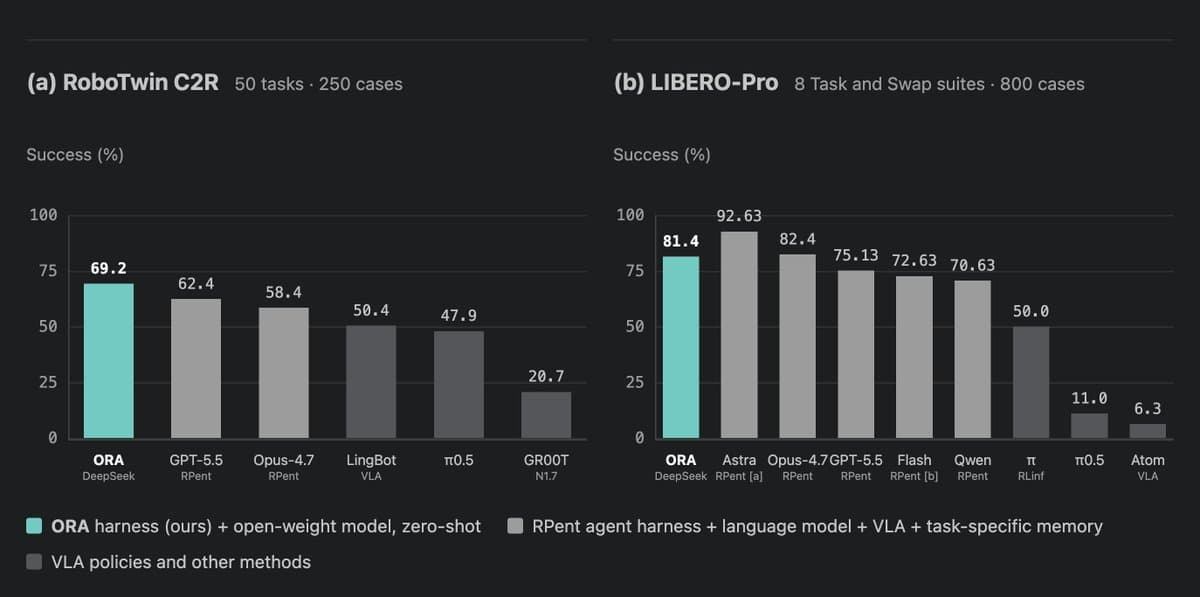
- Simulation success reached 69.2% on RoboTwin and 81.4% on LIBERO-Pro in the team's comparison, using the same cases as RPent but different tools and memory.
- Estimated model-token cost is $0.30 to $0.35 per solved benchmark case, including failed attempts, at off-peak API rates in the team's accounting.
Robot manuals are the gem here: the published cards specify which point a command moves and where the fingers make contact. Human-steered sessions receive a separate flag, excluding them from autonomous results.
RoboTwin and LIBERO-Pro
The launch evaluation uses official success checks and RPent's case lists:
- RoboTwin C2R: 173/250 successes, or 69.2%, across 50 tasks with five randomized seeds each. RPent reports 62.4% with GPT-5.5 and 58.4% with Opus-4.7.
- LIBERO-Pro: 651/800 successes, or 81.4%, across eight Task and Swap suites. RPent reports 82.4% with Opus-4.7.
RPent's leaderboard also reports 92.63% on LIBERO-Pro with GPT-6 Astra, using separately frozen memory batches. ORA remains below that result.
RPent combines a language model, VLA and task-specific memory collected during exploration; ORA excludes demonstrations and preloaded task-specific memory. These are complete-system comparisons, and ORA's authors warn that official success checks can overstate task completion.
Community commenter teortaxesTex praised the system design while describing V4.1 as far from the strongest vision-language model.
The robot-use loop
Each turn, ORA observes the scene, calls a tool, reads the feedback and decides again. The team likens this to a coding agent in its explanation of the loop.
The harness has three main components:
- Prompts: robot descriptions, task instructions and success criteria.
- Tools: perception, geometry and bounded robot motion.
- Context management: recent observations remain visible; older evidence stays accessible in files.
Robot cards
The same harness runs three embodiments with robot-specific cards, tools and controllers. The geometry documented in the cards includes:
- ARX X5, RoboDojo: commands move the wrist flange; the jaw contact centre is 150 mm forward along the approach axis.
- ALOHA, RoboTwin: commands target a tool point 120 mm beyond the flange.
- Franka Panda, LIBERO and LIBERO-Pro: commands target a grip site 97 mm beyond the end-effector root.
Perception and supervised motion
ORA turns visual evidence into motion through distinct tools:
- SAM 3: locates and segments objects.
- Depth: converts image locations into three-dimensional positions in metres.
- Compute: handles vector and rotation calculations.
The repository also supplies Contact-GraspNet for grasp proposals and cuRobo for motion planning. A supervisor checks and executes every action; the model cannot bypass it.
After an action, the environment returns camera images, measured arm poses, gripper state, an action receipt and the remaining budget. The model receives sensor evidence without simulator object ground truth, contact data or the success-checking code.
File-backed context
The context manager retains evidence at different levels of detail:
- Current turn: full observation and action receipt.
- Recent turns: word-for-word history.
- Older turns: image references and a history summary.
- Finished rounds: checkpoints.
Older observations and long tool results remain recoverable within the episode. The team published the source in an Apache-2.0 repository, which records model requests, responses, tool calls, actions and receipts; ora watch replays sealed runs.
API cost estimates
The $0.30 to $0.35 figure divides model-token costs across solved benchmark cases while including failed attempts on RoboTwin, LIBERO and LIBERO-Pro. The 40 showcased solved episodes average $0.13 each.
The cost calculation uses DeepSeek's off-peak API prices and estimated cache hits. These are API-equivalent estimates, not measured self-hosting costs, and exclude GPU and simulator costs.
Preliminary real-arm trials
Physical testing used a low-cost arm, a fixed RGB-D camera and a wrist camera. In preliminary runs, DeepSeek-V4.1-Flash opened a drawer by its knob and placed a candy bar into a box.