
Grok Voice 3.0 ranks first on Artificial Analysis’s Speech-to-Speech Index
Grok Voice 3.0 leads Artificial Analysis’s Speech-to-Speech Index with a score of 86.9. It posts 0.81-second first audio, costs $0.08 per minute of input audio, and ranks second on Tau Voice.
TL;DR
- Grok Voice 3.0 leads Artificial Analysis’s Speech-to-Speech Index: 81.3 → 86.9, +5.6 points over Voice 2.0, according to the benchmark report.
- Tool-using support calls delivered the biggest gain: 56.5% → 71.6%, +15.1 percentage points, per the τ-Voice results. GPT-Live-1 with Astra still leads that test.
- First audio got slower than the predecessor: 0.70 → 0.81 seconds, +0.11 seconds, according to the latency results.
- Pricing remains $0.08/minute, with Artificial Analysis reporting $4.80 per input-audio hour on its benchmark, per the cost comparison.
Existing agents using grok-voice-latest were switched automatically. The index calculation freezes its preference rating even as the live Arena changes, while the pricing table lists a separate text-input fee alongside the advertised voice rate.
What shipped
- API availability: Grok Voice 3.0 became available October 14 through the Voice Agent API, according to the announcement.
- Model identifier: The pricing documentation lists
grok-voice-3.0and marksgrok-voice-2.0deprecated. - Transport: Speech-to-speech sessions use WebSockets at
/v1/realtime, per the voice documentation. - Voice price: $0.08/minute ($4.80/hour), unchanged from Voice 2.0, according to the pricing results.
Benchmarks that moved
First-party
SpaceXSI attributes its numerical launch table to Artificial Analysis, including the conversational-dynamics result.
Third-party evaluators
All comparisons below are Grok Voice 2.0 → Grok Voice 3.0:
- Speech-to-Speech Index: 81.3 → 86.9, +5.6 points, per the overall results.
- τ-Voice support tasks: 56.5% → 71.6%, +15.1 percentage points, per the agentic evaluation.
- Big Bench Audio reasoning: 97.2% → 98.5%, +1.3 percentage points, per the reasoning results.
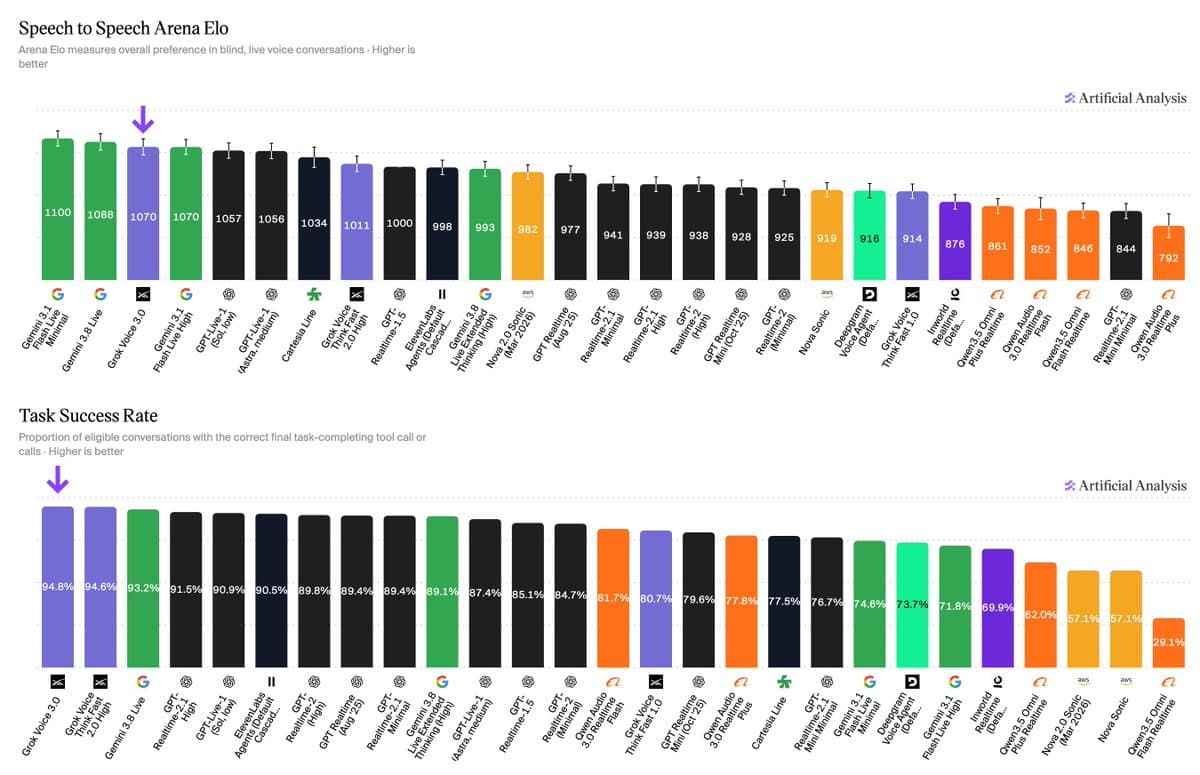
- Arena preference: 1011 → 1070, +59 Elo, per the blind-conversation results.
- Arena task success: 94.6% → 94.8%, +0.2 percentage points, per the task-success results.
- Full Duplex Bench conversational dynamics: 95.1% → 97.0%, +1.9 percentage points, per the comparison table.
Customer-reported
ServiceNow describes a new accuracy/experience Pareto frontier on EVA-Bench in its launch quote. The accompanying material reports that enterprise evaluation alongside measured Big Bench Audio task costs.
Where it regressed
- Predecessor latency: Voice 2.0’s 0.70 seconds → Voice 3.0’s 0.81 seconds means +0.11 seconds, or approximately 15.7% longer to first audio.
- The 40% comparison: The reduction repeated in launch coverage matches GPT-Live-1 with Astra at 1.34 seconds → Grok at 0.81 seconds, −0.53 seconds, or about 39.6% lower latency.
The remaining gaps are against competitors:
- Support-task completion: Grok’s 71.6% trails GPT-Live-1 with Astra’s 74.5% by 2.9 percentage points, according to the τ-Voice evaluation.
- Human preference: Grok’s 1070 Elo trails Gemini 3.1 Flash Live Minimal’s 1100 by 30 Elo and Gemini 3.8 Live’s 1088 by 18 Elo, per the Arena results.
- Spoken reasoning: Grok’s 98.5% trails StepAudio 3 Realtime by 1.2 percentage points, Qwen Audio 3.0 Realtime Plus by 0.7 points, and Qwen3.5 Omni Plus Realtime by 0.2 points, per the Big Bench Audio results.
Latency in the agentic-performance plot comes from Big Bench Audio, a separate test from the support-call benchmark on its vertical axis.
Arena task-success confidence intervals overlap: 91.6%–96.8% for Voice 3.0 versus 91.4%–96.7% for Voice 2.0, according to the live leaderboard.
Under the hood
The four-part index
Each component receives 25% weight in the published methodology:
- Big Bench Audio speech reasoning.
- τ-Voice agentic performance.
- Arena preference, converted into an Arena Score.
- Arena task success.
Artificial Analysis converts the frozen preference Elo into expected preference against an 800-Elo baseline using 100 / (1 + 10^((800 - Elo) / 400)), according to its scoring explanation. Full Duplex Bench is reported separately and contributes no weight to the index.
τ-Voice versus Arena task success
Artificial Analysis’s τ-Voice implementation checks whether tool use produces the correct final database state. Its base task set spans:
- Airline: 50 scenarios.
- Retail: 114 scenarios.
- Telecom: 114 scenarios.
The simulated customer uses GPT-4.1, ElevenLabs eleven_v3 speech, and Deepgram Nova-3 transcription; GPT-4.1 also grades natural-language checks. Agents receive domain tools and a policy document.
Scores average three trials where available, but the leaderboard’s notes identify both GPT-Live-1 configurations as single-trial results. Arena task success instead checks final task-completing tool calls in eligible human conversations, excluding participant deviations and unverifiable cases.
Realtime sessions
Artificial Analysis tested the Rex voice, according to its evaluation report. The API example defaults to Eve, configures sessions with session.update, and enables server-side voice activity detection with turn_detection: {"type": "server_vad"}.
The documentation also supports ephemeral tokens for client-side connections and streams generated audio through response.output_audio.delta events.
Billing details
Artificial Analysis’s hourly cost comparison uses a fixed 40-question Big Bench Audio subset. Its cost definition includes audio, text, and separately exposed reasoning-token usage, normalized by input-audio duration; tool-call costs and cached-token discounts are excluded.
The official pricing table lists $0.004 per text input for both Voice 2.0 and 3.0, plus separate server-side tool prices such as $5 per 1,000 web searches. The launch post and pricing table state the per-minute voice rate without defining whether silence or idle connection time enters that meter.
EVA-Bench’s broader accuracy test
ServiceNow’s EVA-Bench paper describes 213 enterprise scenarios and automatically regenerates conversations when the simulated user fails validation. Its two composite measures cover:
- EVA-A, accuracy: Task completion, faithfulness to instructions and policy, and audio-level fidelity of spoken information such as confirmation codes and monetary amounts.
- EVA-X, experience: Conversation progression, spoken conciseness, and turn-taking timing.
Where it shows up
- Tesla: Grok Voice 3.0 handles millions of daily conversations in vehicles, according to rohanpaul_ai’s report. Connectors cover calendar and email requests; Grok Bot handles actions such as coffee orders and dinner bookings.
- Grok Bot: The model powers its voice mode, according to the announcement. ai_for_success described the experience as fast and responsive after trying it.
- Starlink: SpaceXSI reports 20,000 daily customer calls handled by Grok Voice, roughly 70% resolved without a human, and purchases on one in four sales calls in its deployment account.
The Starlink deployment includes a single agent built on Voice 3.0 that performs four operations, according to the same account:
- Customer verification.
- Hardware troubleshooting.
- Issuing credits.
- Shipping replacement equipment.