
OpenAI launches GPT-Live-1 for full-duplex voice agents
GPT-Live-1 combines listening and speech in one real-time model. Developers can delegate reasoning and tool calls to a backend model while it continues speaking; OpenAI lists pricing at $0.05 per minute.
TL;DR
- GPT-Live-1 is available in the API as a full-duplex voice model, as OpenAIDevs' API announcement puts it.
- Callers can speak over the agent, add a correction mid-sentence, and avoid treating ambient chatter as a turn, according to OpenAIDevs' full-duplex post.
- The API differs from the Realtime series and requires different prompting, juberti's migration note says.
- Voice time is priced at $0.05 per minute, while juberti's API-pricing post says the delegated model and tools are charged separately.
- OpenAI reports 83.6% first-attempt completion on Tau3 with GPT-6 Astra, versus 45.7% for GPT-Realtime-2.1, while genspark_ai's restaurant-call test describes an early phone-agent deployment.
OpenAI's delegation guide says a delegation event tells a client that work is needed but does not contain the user's task text. The model reference supports function calling but not structured outputs. A small web-and-phone demo exposes its agent configuration in routes/agent.ts.
GPT-Live-1
OpenAI moved its ChatGPT Voice model into the API on September 10, according to the launch announcement. The model reference lists audio and text as inputs and outputs, with neither image nor video support.
Voice instructions can set tone, pacing, expressiveness, language, and response length, according to OpenAIDevs' control post.
Full-duplex turn handling
OpenAI says GPT-Live-1 processes incoming and outgoing audio in one model, rather than coordinating separate speech-to-text, language-model, and text-to-speech stages in the conversational loop.
Backend work can run asynchronously and enter the conversation as context arrives, as juberti's explanation describes. The session guide treats received events, audio playback, and backend task state as separate application concerns.
Delegation
GPT-Live separates spoken interaction from reasoning and tools. The delegation documentation defines two paths:
- Responses delegation: GPT-Live calls a configured Responses model, supplies conversation context, and returns its output to the live conversation.
- Client delegation: the application prepares context, runs any model, agent, or service it operates, then sends selected results back to GPT-Live.
The delegation mode is chosen when the session starts, and switching modes requires a new session. In client mode, session.delegation.created contains metadata rather than the utterance or task text, so transcript events and application state supply the backend request; the application retains permissions, confirmations, business records, and durable task state.
The migration guide also tells teams to split an existing text-agent prompt: conversational behavior goes to the voice model, while task rules and business logic stay with the backend.
Benchmarks
OpenAI's launch post reports these results. The Tau3 result is a system score for GPT-Live-1 paired with GPT-6 Astra at medium reasoning effort, not a measurement of the voice model alone.
- Tau3 first-attempt task completion: 45.7% with GPT-Realtime-2.1 to 83.6% with GPT-Live-1 plus Astra, +37.9 percentage points, across airline, retail, and telecom support tasks.
- Full Duplex Bench v1 response start: 1.41 seconds to 0.798 seconds, 0.612 seconds lower.
- Artificial Analysis Conversational Dynamics: 97.3% for deciding whether to wait, take a turn, respond to an interruption, or continue through a short acknowledgment.
- Full Duplex Bench v1.5 interactivity: 80.1% under overlapping speech, background voices, side conversations, and interruptions.
- Full Duplex Bench v3 with a backend model: 87% tool-calling success and 90% response quality.
The API blog's demos and evaluation materials are linked in juberti's follow-up.
Pricing and limits
The model page prices a voice session at $0.05 per minute, billed per second without rounding to a whole minute. It bills backend Responses calls at the configured model and tool rates.
The same reference lists streaming and function calling as supported, while structured outputs, fine-tuning, and predicted outputs are unsupported. Rate limits are concurrent sessions: no Free-tier access, then 25, 50, 200, 300, and 500 sessions from Tiers 1 through 5.
Early deployments
Genspark says it tested GPT-Live on 80 real restaurant-booking calls, where task completion more than doubled over its prior generation and perfect comprehension reached 92%. It has put the model into Call for Me, Realtime Voice Agent, and GenTeam calling, according to the company.
Cognition also shipped Devin Voice, which cognition's Devin Voice launch says combines GPT-Live with its SWE-2 model.
ChatGPT Voice
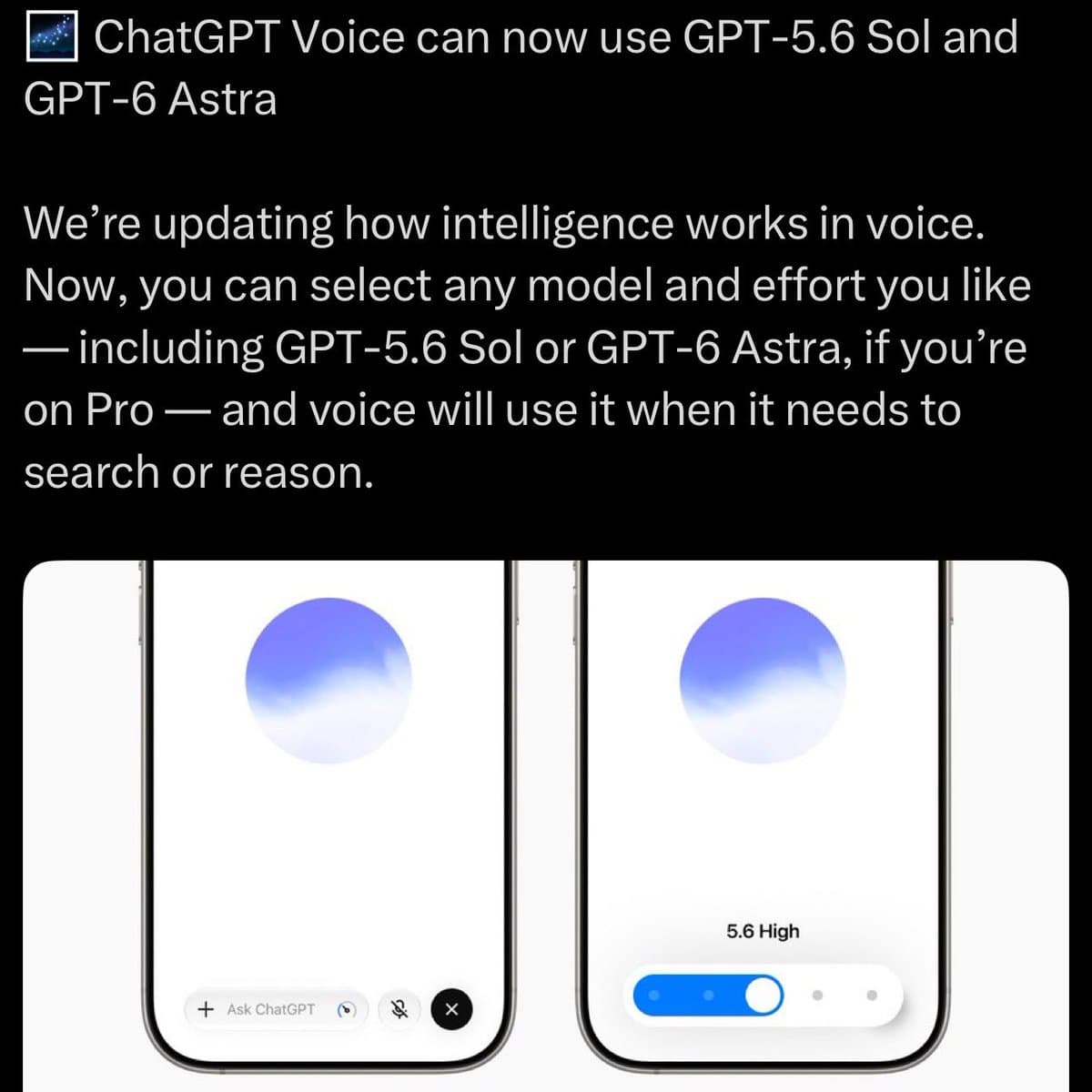
The consumer product is moving in parallel with the API: ChatGPT Voice now delegates to GPT-5.6 Sol, or to GPT-6 Astra when a user selects the Pro high setting.
A juberti limit update lists 3 hours of Live for Plus, 15 hours for Pro $100, and unlimited Live use for Pro $200. Those are ChatGPT usage caps, distinct from the API's concurrent-session limits.
Firefox users had sometimes failed to connect to ChatGPT Voice because of a 12-year-old WebRTC implementation issue, which juberti's Firefox post says OpenAI resolved.